
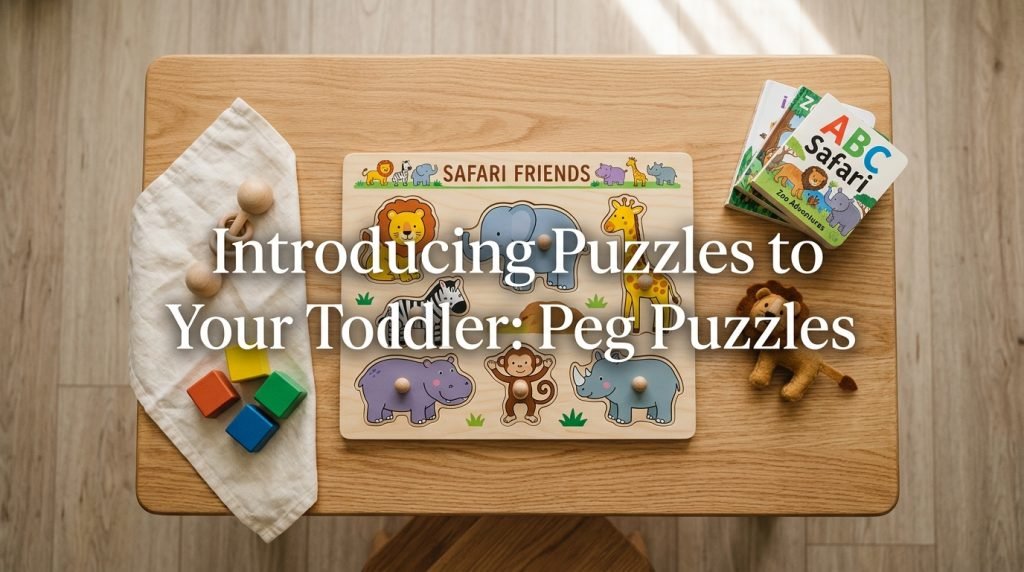
Short answer: a genuine beginner toddler puzzle has three to five jumbo knob pieces, each sitting in its own separate cut-out, on a thick wooden board. The Melissa & Doug First Shapes Jumbo Knob Puzzle (5 pieces, rated ages 1+) is the standard first buy. Most children are ready somewhere between 12 and 18 months, and the honest progression from there is knob puzzles, then peg puzzles with six to eight pieces, then chunky puzzles with no pegs, and only then a real jigsaw of three or four interlocking pieces at around two and a half.
Puzzles for toddlers are a simple and engaging way to help young children develop problem-solving skills, concentration, coordination, and confidence. Choosing the right puzzle for your toddler’s age and ability can make the activity enjoyable while supporting early learning.
Nearly every guide to toddler puzzles starts with the benefits. You already know the benefits. What is harder to find is which puzzle to actually buy first, at what age, and what to do when your toddler tips the pieces on the floor and walks off.
This is that guide. It moves in order of difficulty, names real products at each step, and includes the method an occupational therapist uses to teach a child to complete a puzzle rather than just handing it over and hoping.
Toddler Puzzles for Beginners
How to Tell Your Toddler Is Ready
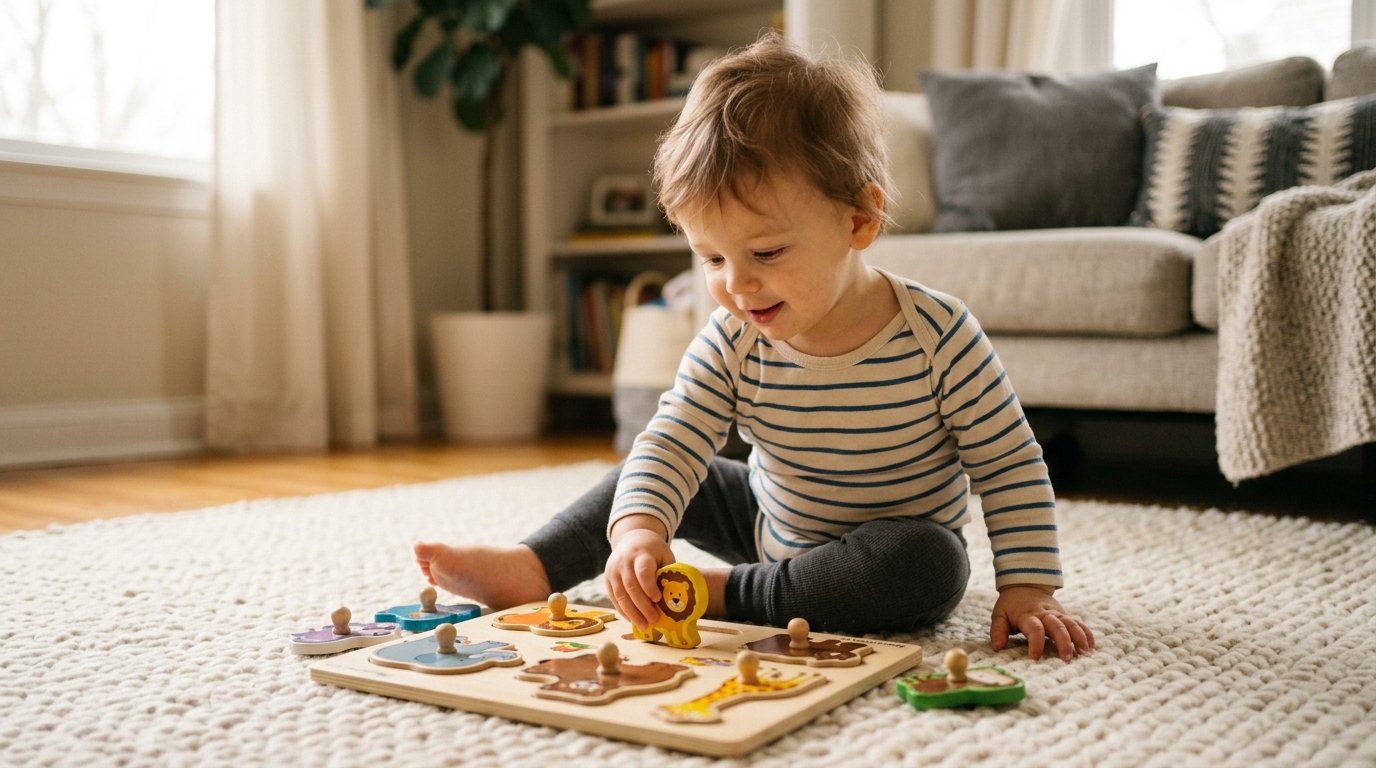
Age is a rough guide. Readiness is better read from behaviour. Your toddler is probably ready for a first puzzle when most of these are true:
- They can pick up an object with a pincer grasp, thumb and forefinger, rather than raking it with the whole hand.
- They deliberately put objects into containers and take them out again. Posting things through gaps is the same underlying skill.
- They can sit and attend to one object for a minute or two without needing it to light up or make a noise.
- They have started matching, even crudely. Holding a toy car next to a picture of a car counts.
- They are not still putting most objects straight into their mouth.
That combination usually arrives between 12 and 18 months, though plenty of children get there at ten months and plenty at two. If your child is not interested, the puzzle is almost always too hard rather than the child being behind. Drop back a stage.
The Five Stages of Beginner Toddler Puzzles
Treat these as steps on a staircase. Each one teaches a distinct skill, and skipping a step is the single most common reason a toddler decides puzzles are not for them.
- Stage 1. Shape sorters and single-shape boards, roughly 10 to 14 months. One shape, one hole, no picture to interpret. The child learns the core idea that objects fit into matching spaces. A shape sorter counts as a puzzle even though it does not look like one.
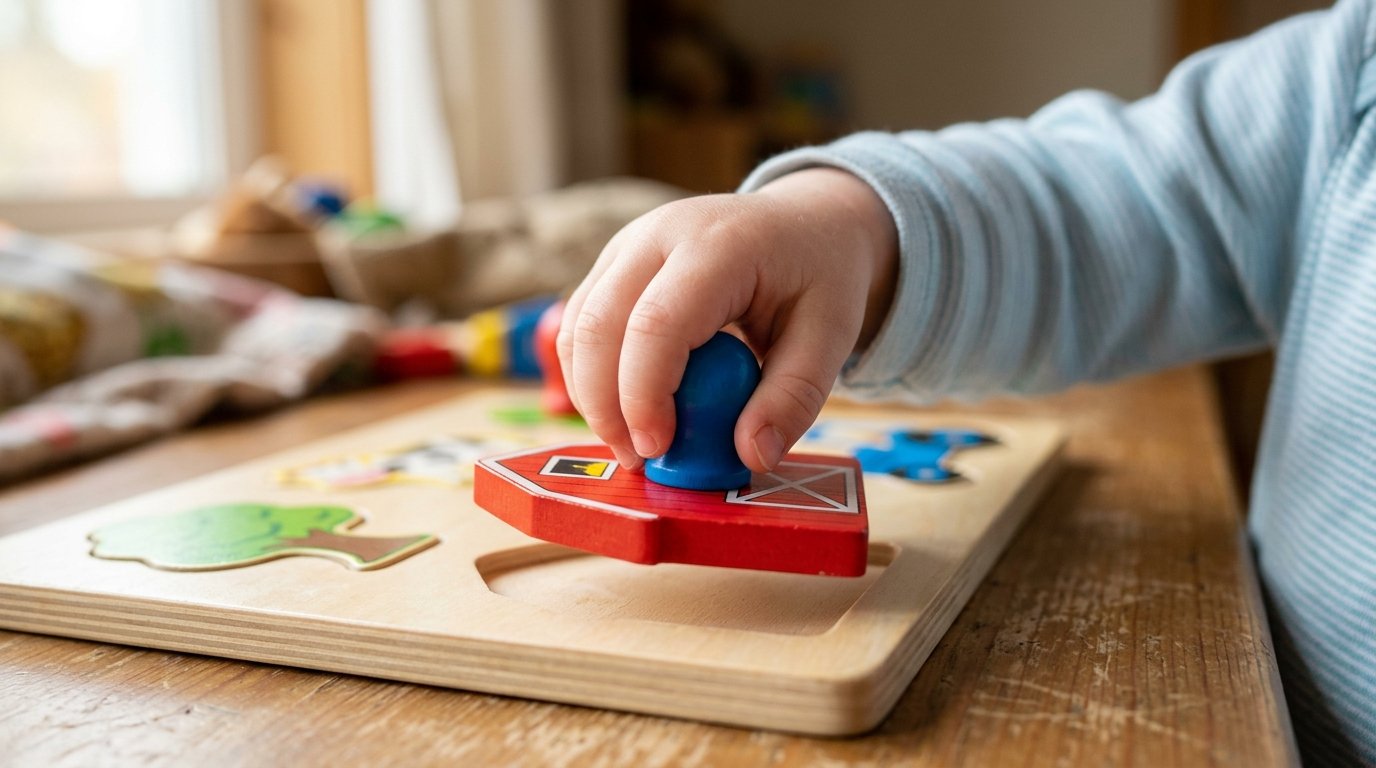
- Stage 2. Jumbo knob puzzles, roughly 12 to 18 months. Three to five pieces, each with a large wooden knob and its own separate recess. Because the recesses are not adjacent, a wrong piece simply will not sit down. Failure is obvious and gentle.
- Stage 3. Peg puzzles, roughly 15 to 24 months. Six to eight pieces, smaller pegs, usually a themed set such as farm animals or vehicles. The pegs are narrower, so this is real fine motor work, and the higher piece count demands more sustained attention.
- Stage 4. Chunky puzzles without pegs, roughly 18 to 30 months. Thick wooden pieces gripped by the whole piece rather than a peg. Removing the peg is a bigger leap than it sounds, because the child now needs a proper grasp and has to judge orientation.
- Stage 5. First jigsaws, roughly 2 to 3 years. Two, three, then four interlocking pieces that form a single picture. This is the first time a piece is meaningless on its own, which is a genuine cognitive shift, not just a harder version of stage 4.
Move up only when the current stage is boring, not merely possible. A child who can just about finish a puzzle with heavy help is not ready for the next one.
Specific Beginner Puzzles Worth Buying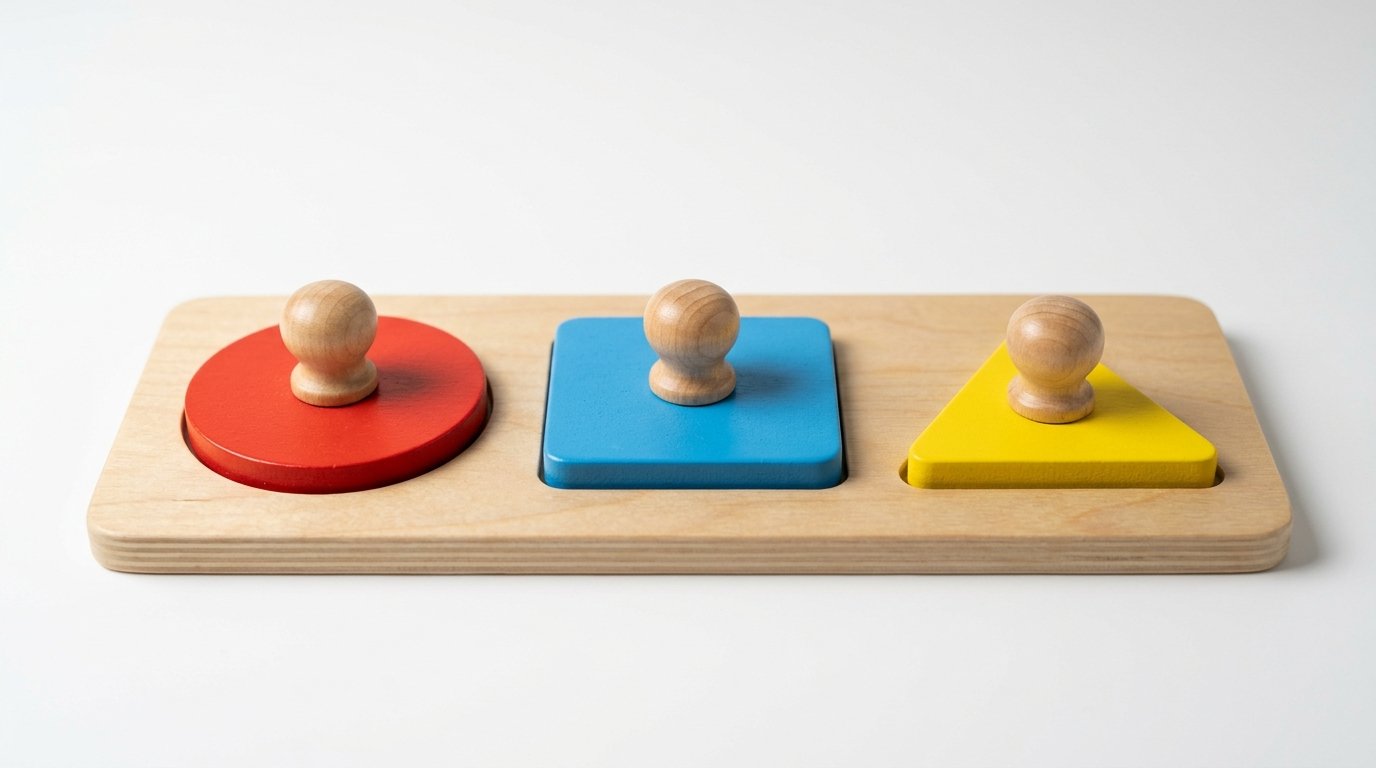
Matched to the stages above. Piece counts and age ratings are the manufacturers’ own, and you should confirm them before ordering, since editions and contents change.
- Stage 1: Melissa & Doug Stack & Sort Board. A long-standing favourite for late babies and early toddlers, combining stacking with shape matching. Often a child’s very first puzzle-like toy.
- Stage 2: Melissa & Doug First Shapes Jumbo Knob Puzzle. Five extra-thick shape pieces with jumbo wooden pegs, rated ages 1+, with a full-colour picture revealed underneath each piece. The most commonly recommended genuine first puzzle.
- Stage 2: Melissa & Doug Jumbo Knob Large Farm Puzzle. Eight jumbo knob pieces, the same format with a higher count when five stops being a challenge.
- Stage 3: Melissa & Doug Wooden Peg Puzzle four-pack. Vehicles, farm, safari and pets in one box. Buying a set rather than a single puzzle matters more than it seems, because rotation is what keeps a toddler interested.
- Stage 3: Hape wooden peg puzzles. Comparable quality with a slightly different aesthetic, and Hape’s chunky alphabet puzzle is a good bridge into letters if your child is showing interest.
- Stage 4: Wee Gallery Beginner Puzzle Set. High-contrast, unfussy illustrations. A good option if you find most toddler puzzle artwork visually noisy.
- Stage 5: Mudpuppy jigsaws rated ages 2+. Genuinely beautiful artwork, which matters because you will be looking at it as often as your child is.
One buying note that saves money: piece count and quality matter far more than theme. A toddler will happily do a farm puzzle they have done forty times. They will abandon a badly cut puzzle on the first attempt.
How to Actually Teach a Toddler to Do a Puzzle
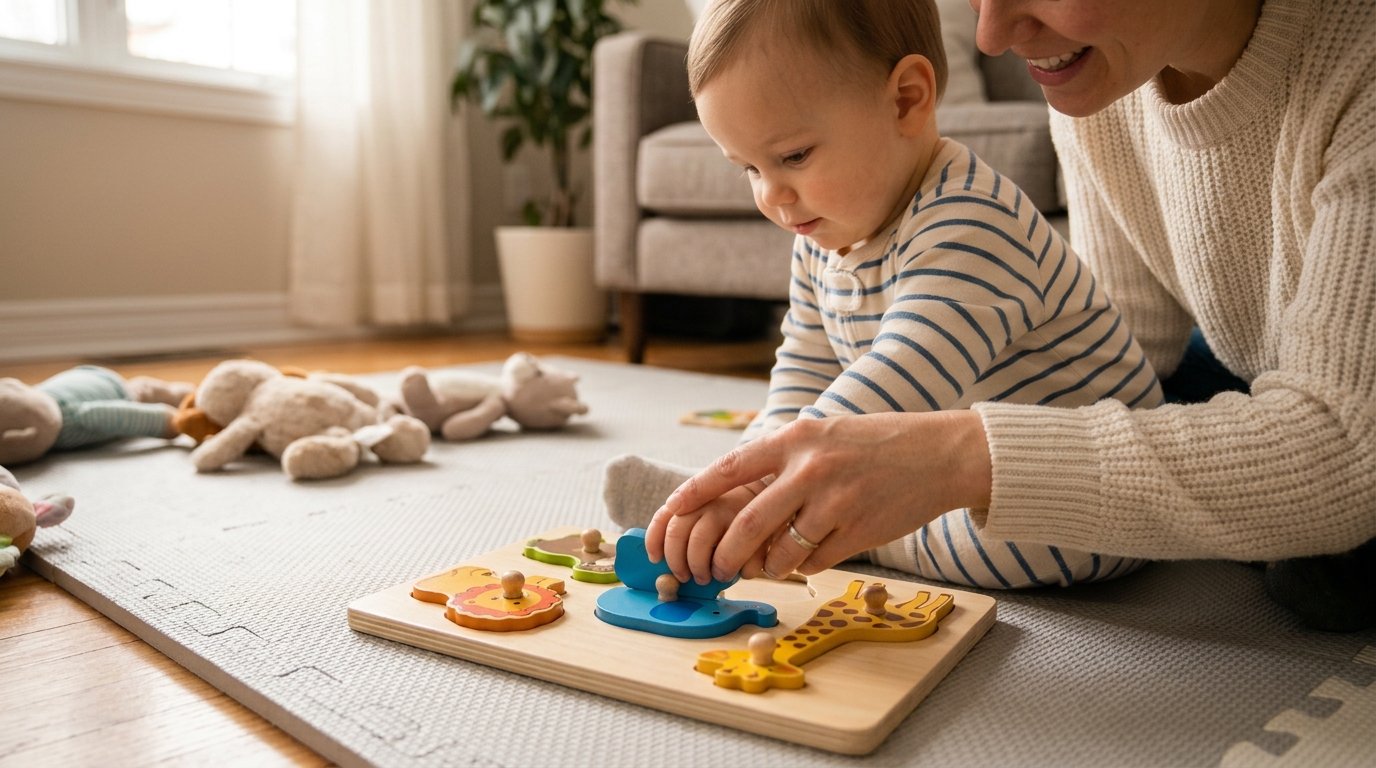
Handing over a jumbled pile of pieces is how most of us start, and it is close to the worst possible introduction. Occupational therapists teach puzzles in graded steps, and the method transfers directly to home.
For a peg puzzle, do not tip the pieces out. Take them off the board and set each one down directly beside its own hole. Your toddler then only has to lift and drop, which is one skill instead of three. Once that is easy, move the pieces further away, then finally into a pile.
For a first four-piece jigsaw, work through these five steps over days or weeks rather than in one sitting:
- Build the whole puzzle yourself while your child watches, so they see that the pieces make a picture.
- Remove one piece and invite them to put it back. Repeat with a different single piece each time.
- Remove two pieces at a time, varying which two.
- Break the puzzle apart but leave every piece the right way round, so no rotation is required.
- Finally, mix the pieces up completely so your child has to turn them as well as place them.
Step five is a large jump and can take many attempts. Also worth knowing: finishing one four-piece puzzle does not mean your child is ready for six. Offer several different four-piece puzzles before raising the count.
What to Look For in a Beginner Puzzle
- Separate recesses, not interlocking pieces. Each piece having its own hole is what makes stages 2 and 3 forgiving.
- Jumbo pegs at least a centimetre across for a first puzzle. Thin pegs are a stage 3 problem.
- Thick board and thick pieces. A piece that flexes or a board that warps ruins the fit, and a bad fit reads to a toddler as failure.
- Realistic, uncluttered pictures. A recognisable single object per piece supports vocabulary. Busy cartoon scenes do not.
- A picture under the piece, not just on it. Matching what is underneath is an extra layer of learning at no extra cost.
- Non-toxic finish and no pieces small enough to swallow. Standard advice, still worth checking on unbranded sets.
Wooden, Plastic or Foam
Wooden puzzles are the default for good reason. The weight gives feedback when a piece seats correctly, they survive being stood on, and the cut tolerances tend to be tighter, which matters enormously at this age.
Plastic is lighter and cheaper and washes easily, which suits a nursery or a nappy bag, but pieces flex and the fit is often loose. Foam puzzles are safe and quiet but too forgiving, since a foam piece squashes into a hole it does not really match, which teaches the wrong lesson. For a genuine beginner, wood earns its extra cost.
Four Mistakes That Make Puzzles Frustrating
- Starting at stage 4 or 5. A 12-piece jigsaw bought for a 20-month-old is the most common cause of a toddler deciding they dislike puzzles.
- Tipping all the pieces into a pile. It looks like the natural way to present a puzzle and it triples the difficulty.
- Taking over. Placing pieces for your child ends the frustration and also ends the learning. Demonstrate one piece, then withdraw your hands.
- Owning one puzzle. Novelty is most of the motivation at this age. Three puzzles rotated weekly get far more use than six left out permanently.
When Your Toddler Gets Frustrated
Some frustration is the work. A child who never struggles is not learning anything, and the moment just before they solve it is usually the moment they look most annoyed. Sit on your hands slightly longer than feels comfortable.
If genuine distress arrives, do not finish the puzzle for them and do not insist they carry on. Drop the difficulty instead. Put two pieces back in yourself and let them do the last one, so the session still ends in a completed picture. Then leave that puzzle alone for a week. Coming back to it later is remarkably effective, because the underlying fine motor and attention skills keep developing whether or not the puzzle is in front of them.
Getting More Out of One Puzzle
A single peg puzzle is more versatile than it looks, and this is where the developmental value actually accumulates.
- Name everything. Each piece is a vocabulary card. Say the animal, the sound it makes, the colour, what it eats. This is the fastest language win available in a toddler’s day.
- Hide and find. Put three pieces behind your back and ask for the cow. You are now practising memory and receptive language, not just placement.
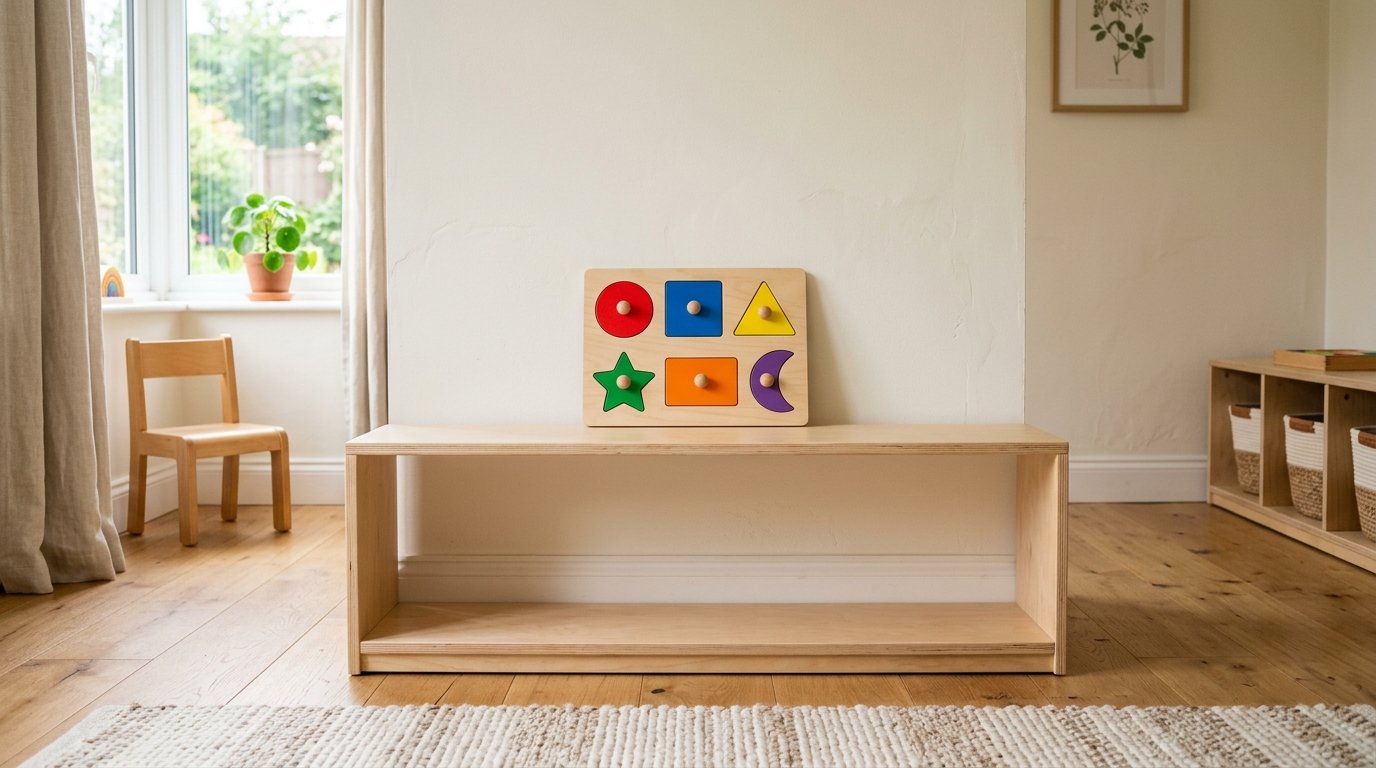
- Present it on a shelf, not in a toy box. One puzzle on a low, open shelf with nothing on top of it gets picked up. The same puzzle at the bottom of a box does not.
- Rotate rather than accumulate. Keep two or three out and store the rest. Bring a stored one back after a fortnight and it is effectively new.
- Let them do it wrong. A toddler stacking the pieces or lining them up in a row is still learning about the objects. It is not a misuse of the puzzle.
Frequently Asked Questions
When can babies start doing puzzles?
Shape sorters and single-shape boards suit many babies from around ten months, once a pincer grasp and object permanence are established. True knob puzzles usually land between 12 and 18 months. Before ten months, a puzzle is a teether.
How many puzzle pieces should a 2 year old be able to do?
Around two, most children manage peg puzzles of six to eight pieces confidently, and are starting on three or four piece jigsaws. By three, four to twelve interlocking pieces is a typical range. Spread is wide and normal at this age.
What is the easiest puzzle for a toddler?
A three to five piece jumbo knob puzzle where every piece has its own separate recess. Because the holes are not adjacent, a piece in the wrong place simply will not sit flat, so the puzzle corrects your child without you having to.
Are wooden peg puzzles better than plastic ones?
For beginners, yes. Wood gives tactile feedback when a piece seats, holds tighter tolerances, and lasts through several children. Plastic is a reasonable second set for travel. Whichever you buy, check the finish is non-toxic.
My toddler just tips the pieces out and walks away. Is that normal?
Completely. Emptying and dumping is a developmental stage in its own right, and it comes before assembling. Try setting each piece beside its own hole so the task is a single lift and drop, and keep the session under five minutes.
How many puzzles does a toddler actually need?
Three or four at any one time, rotated. A beginner benefits more from doing the same puzzle repeatedly than from variety, and rotation restores novelty without new purchases.