
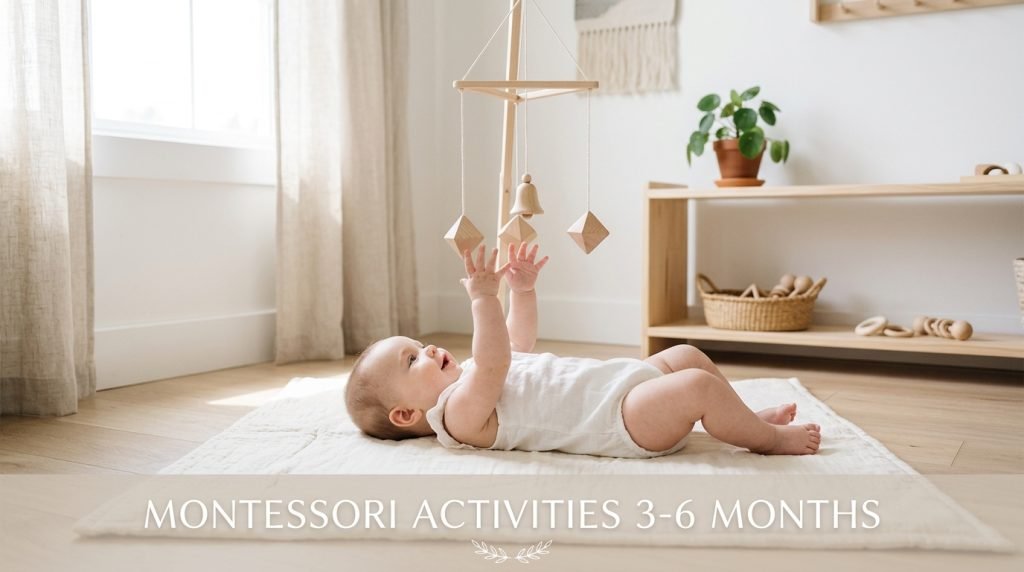
Short answer: the best Montessori baby activities are the ones matched to what your baby can physically do right now, not to their age in months. From birth: tummy time 2 to 3 times a day for 3 to 5 minutes, a high-contrast mobile over a floor mat, and being talked to during nappy changes. Once they can reach and grasp, add wooden rings and a low mirror. Once they can sit unsupported, add a treasure basket. Once they can pull to stand, move things up to standing height. You need almost nothing you do not already own, and the single most valuable activity is the one you are already doing badly: narrating what you are doing while you care for them.
Most lists of Montessori activities for babies are organised by month, which sounds helpful and often is not. Two babies at five months can be a milestone apart, and offering a treasure basket to a baby who cannot sit up yet just puts objects out of reach.
So this guide is organised by what your baby can do. It also corrects two things that get repeated constantly in this niche, including in the earlier version of this article: what high-contrast cards actually do, and where the treasure basket really comes from.
Montessori Baby Activities
Go by Milestone, Not by Month
Every activity below is gated on a capability rather than a birthday. The four that matter in the first year:
- Lifting the head while on the tummy. Unlocks floor play and visual tracking.
- Reaching and grasping deliberately, usually somewhere around 3 to 5 months. Unlocks everything you can put into a hand.
- Sitting unsupported. Unlocks baskets, containers and two-handed exploration. This is the big one.
- Pulling to stand. Unlocks vertical activities and means everything on the floor is now reachable in a new way.
If an activity is not working, the usual cause is that it needs a milestone your baby has not reached. Drop back rather than persisting.
Birth to 6 Weeks

Very little is needed, and almost none of it is a toy.
- Tummy time from the day you come home. Real numbers below, they are lower than most people assume.
- A high-contrast mobile over a floor mat during supervised awake time. Black and white, simple shapes.
- Your face and voice. At this stage a baby’s preferred visual target is a human face at close range.
- Reading aloud. Not for comprehension, for the rhythm of your voice and the association of books with being held.
- A topponcino, if you want one. It is a small quilted oval pillow for holding and passing a newborn so the touch and smell stay consistent. Useful, entirely optional, and not a sleep product. It should not be in the cot while your baby sleeps.
6 to 12 Weeks
Vision is developing quickly and this is the window the classic Montessori mobiles were designed for. See the mobile section below for the sequence.
- Progress through the visual mobiles, changing when your baby stops attending to the current one rather than on a schedule.
- Longer tummy time, working toward 15 to 30 minutes a day in total by around 7 weeks.
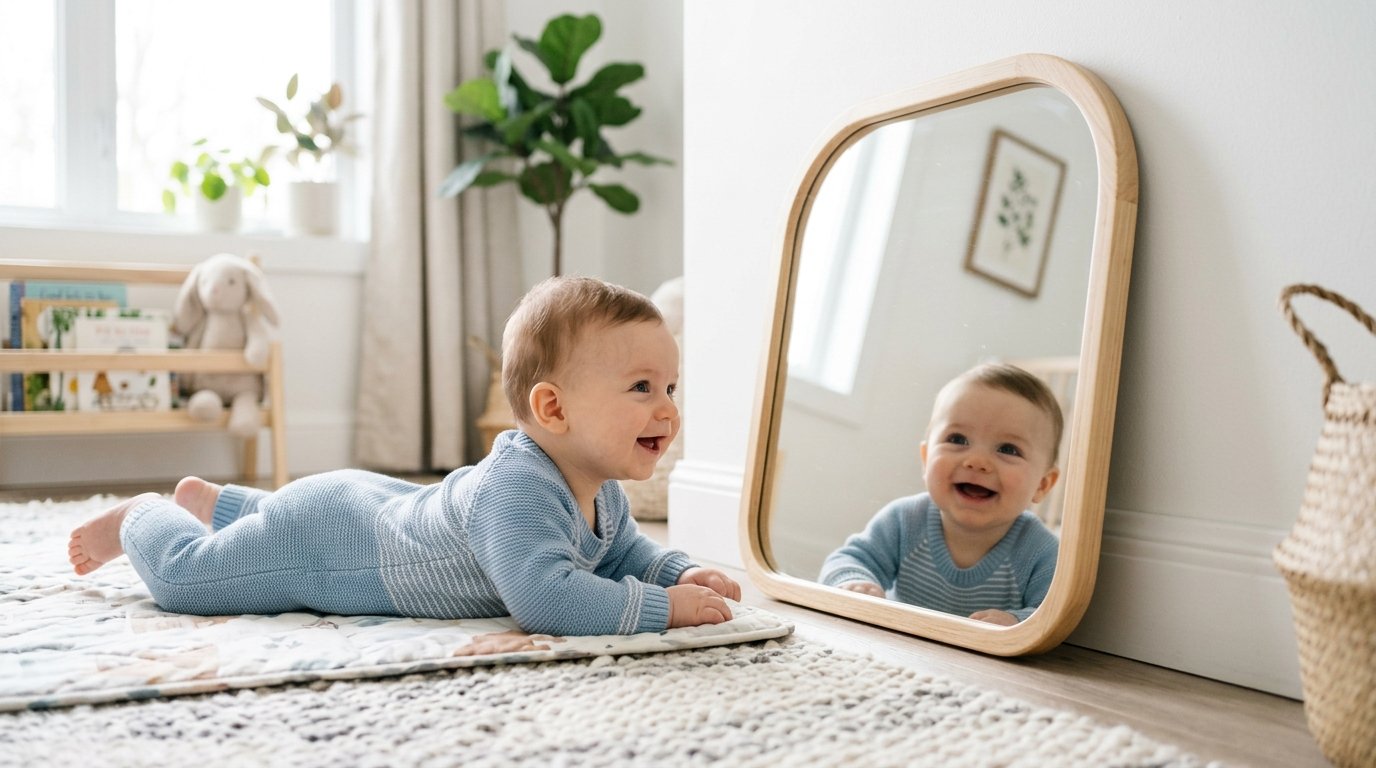
- A low mirror propped securely beside the floor mat, so your baby sees movement including their own.
- Narrated care. Tell them what you are about to do before you do it. This is a real Montessori practice, not a nicety.
3 to 6 Months
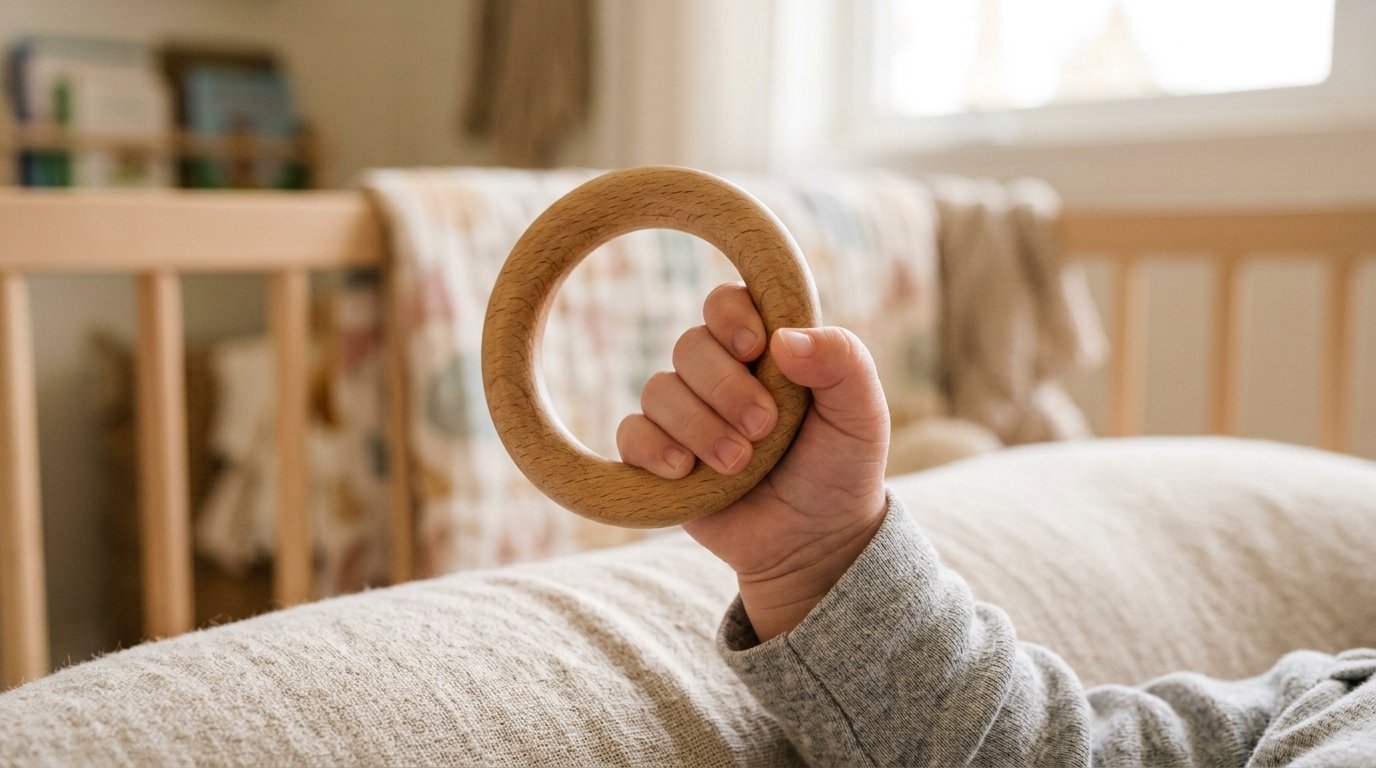
This is the stage most people are searching for, and it is when your baby moves from watching to doing. The change to look for is deliberate reaching: not batting at something, but seeing it and going for it.
- Grasping objects. Lightweight wooden rings, a cloth ring, a small wooden rattle. Light enough to lift, big enough not to be a choking hazard, and interesting to look at.
- A tactile mobile hung within reach, so a kick or a swipe produces a result. This is cause and effect arriving for the first time.
- Tummy time with a reason. Put one interesting object just beyond the hands. The object is the motivation, not the tummy time.
- A low mirror during floor time, which usually gets much more interesting around now.
- Rolling practice. Clear floor and time, nothing else. Resist propping them or helping too quickly.
- Singing and simple songs, with eye contact. Repetition of the same few songs beats variety.
- Books with large, simple, high-contrast images, held close.
What to skip at this stage: a treasure basket, which needs sitting. And anything that props your baby into a position they cannot get into themselves.
6 to 9 Months
Sitting changes everything, because now both hands are free.
- A treasure basket. Once your baby sits unsupported, a shallow basket of everyday objects with different textures, weights and sounds. Wood, fabric, metal, natural fibres. See the section below on what this actually is.
- An object permanence box, or a simple ball and a container. Understanding that things exist when hidden is a major cognitive step and this makes it visible.
- Containers to fill and empty. Putting in and taking out is the dominant drive at this age. A basket and a few objects will occupy them longer than any toy.
- Food exploration, once solids begin, as sensory work rather than a feeding exercise.
- Crawling space. Clear, safe floor. Not a walker, not a seat.
9 to 12 Months
- Pulling to stand against a low, stable surface, with something interesting on top of it.
- Simple posting and slot activities, one large object into one large hole.
- Practical participation. Handing you a nappy, holding a cloth, putting one thing into a basket. It is slower for you and it is the point.
- Opening and closing. Boxes with lids, a small purse, a container with a hinge. Endlessly absorbing at this age.
- Walking preparation, meaning floor time and low furniture to cruise along, not shoes or a push toy.
The Montessori Mobile Sequence, and the Honest Caveat

Montessori infant practice uses four visual mobiles in a set order. The sequence is well established. The ages are not, and it is worth being straight about that.
- Munari. Black and white geometric shapes with a glass sphere. Typically from birth to around 5 or 6 weeks.
- Octahedron. Three octahedrons in primary colours. Typically around 5 to 8 weeks.
- Gobbi. Five spheres in graduated shades of a single colour, so the only variable is tone. Typically around 7 to 10 weeks.
- Dancers. Lightweight metallic figures that move on air currents and catch the light. Typically around 8 to 12 weeks.
- Then tactile mobiles, hung within reach so a swipe produces movement, from roughly 3 months.
The caveat: those age ranges are Montessori community convention, and they vary between sources. I could not find them stated by any clinical or accrediting body. Treat them as a rough order of operations and move on when your baby loses interest, which is the actual signal. The order matters more than the weeks.
Where to Hang a Mobile, and When to Take It Down
This is the part most articles on this topic leave out, including the earlier version of this one, and it matters more than anything else on the page.
- Hang visual mobiles over a floor mat during supervised awake time, not over a sleeping baby. The mobile is an activity, not a nursery decoration.
- Nothing soft or loose belongs in the sleep space. AAP safe sleep guidance is clear on that, and a mobile is not part of a safe sleep surface.
- Remove any cot-mounted mobile or cot gym as soon as your baby can push up on hands and knees, or by 5 months, whichever comes first. This is long-standing CPSC guidance, issued after strangulation incidents involving clothing catching on a crib gym bar. It is guidance of long standing rather than a current mandatory standard, and it is worth following regardless.
- Hang it out of reach for visual mobiles, and within reach only for tactile mobiles designed to be batted.
- Check the attachment every time. A mobile that can come down onto a baby is the failure mode to design against.
Tummy Time: The Actual Numbers
Nearly every article says to do tummy time several times a day for short periods, which is not much help. The AAP gives specific figures:
- Start the day your baby comes home from hospital.
- 2 to 3 times each day, for 3 to 5 minutes at the beginning.
- Work up to 15 to 30 minutes a day in total by around 7 weeks.
- Always supervised, always awake. Tummy time is play, not sleep.
- Vary the position every 10 to 15 minutes during play. Tummy to tummy on your chest, across your lap, and side lying all count.
One figure to be sceptical of: you will see ‘an hour a day by six months’ repeated widely. I could not find it on any AAP page, so I have left it out rather than pass it on.
High-Contrast Cards: What They Do and What They Do Not Do

A correction, including to the earlier version of this article, which claimed high-contrast cards improve visual tracking and concentration.
What is well supported: newborn vision is immature, high contrast is easier for an immature visual system to detect, and babies therefore look at high-contrast patterns for longer than at low-contrast ones. Colour discrimination develops over the first months, with substantial improvement by around four to five months. Early on, a baby focuses best on things within roughly a foot or so.
What is not supported: that high-contrast cards accelerate, train or improve visual development, or produce measurable developmental gains. They are engaging because of how vision works at that age. That is a preference, not a benefit, and it is enough of a reason to use them without overstating it.
The Treasure Basket Is Not Actually Montessori

Worth knowing, because it is repeated wrongly everywhere in this niche including on pages currently outranking this one.
The treasure basket comes from Elinor Goldschmied and her work on heuristic play, not from Maria Montessori. The original is a round basket holding a large number of everyday objects, often 80 to 100 of them, offered to a baby who can sit unsupported, with the adult present but deliberately not directing.
Two practical consequences. First, gate it on sitting rather than on months, which usually means from around five or six months rather than the three to six months it is often marketed at. Second, the original spirit is abundance and free choice with an observing adult, which is a slightly different idea from the curated Montessori shelf of six items. Both are good. They are not the same thing, and knowing which you are doing helps.
For a younger baby who cannot sit, offer one object at a time into a hand instead. That is the Montessori version.
Care Routines Are the Real Curriculum

If you do nothing else on this page, do this. It costs no money and takes no extra time.
- Tell them before you act. ‘I am going to pick you up now.’ Then pause. Then do it.
- Narrate the routine while it happens. Nappy changes and dressing are several minutes of undivided one-to-one language, several times a day.
- Invite cooperation as soon as they are able. A baby who lifts their own arms for a vest is participating, not being dressed.
- Offer a choice of two once they can reach, even at nine months. Two vests, held up, and let them touch one.
- Slow down. Almost all of this is just doing the same things more slowly and with commentary.
A related point one Montessori school makes and few blogs will: minimise time in containers. Swings, bouncers and seats hold a baby in a position they cannot achieve or leave by themselves. Floor time does the opposite.
What You Do Not Need to Buy
An honest list, because this niche sells a great deal to new parents.
- A full mobile set. You can make all four from card, thread and a dowel, and many people do. If you buy one, buy the Munari.
- A branded subscription box. Convenient, not necessary. The objects in a treasure basket should mostly come from your kitchen.
- Wooden everything. A metal spoon, a fabric scrap and a cardboard tube offer more sensory variety than three matching wooden toys.
- A play gym with hanging plastic toys. Use a mat and hang one thing your baby can actually reach.
- High-contrast card packs, if you own a marker and paper. See the honest section above on what they do.
Choking Safety: The Actual Test
Rather than guessing, there is a real standard. Under 16 CFR 1501.4, a part intended for children under three fails if it fits entirely inside a small parts test cylinder in any orientation without being compressed. CPSC guidance describes that cylinder as roughly 1.25 inches in diameter and 2.25 inches long, approximating a young child’s throat.
The practical version: if an object passes through a toilet roll tube, do not give it to a baby. A tube is about 1.7 inches across, so it is more cautious than the legal test, which is exactly what you want when improvising a treasure basket from household objects.
- Check every object individually, including anything that could detach.
- Re-check periodically, because objects loosen and split with use.
- Nothing with cords, ribbons or loops longer than a few inches.
- Supervise directly for anything you have assembled yourself rather than bought as a tested toy.
Frequently Asked Questions
Can you start Montessori activities from birth?
Yes. From the day you come home you can do tummy time, hang a high-contrast mobile over a floor mat during supervised awake time, read aloud, and narrate care routines. None of it requires a purchase, and the narrating is the part that matters most.
How long should a Montessori activity last for a baby?
Follow the baby, not the clock. A newborn might attend to a mobile for a minute or two; a six month old might explore a basket for fifteen. Several short sessions across the day beat one long one, and stopping while they are still interested is better than pushing to the point of overstimulation.
What age is a treasure basket for?
Once your baby can sit unsupported, which is usually around five or six months. It needs two free hands and a stable trunk, so offering it earlier does not work. Before that, hand your baby one object at a time instead.
Do babies only see black and white?
No, but newborn vision is immature and detects high contrast most readily, which is why black and white patterns hold their attention. Colour discrimination develops over the first months and improves substantially by around four to five months. Early on, focus is best at close range, roughly a foot away.
What order do the Montessori mobiles go in?
Munari, then Octahedron, then Gobbi, then Dancers, followed by tactile mobiles from around three months. The order is well established. The specific weeks are community convention rather than clinical guidance, so change mobiles when your baby stops attending rather than on a schedule.
Are Montessori toys necessary?
No. A wooden ring, a metal spoon, a fabric scrap and a cardboard tube cover most of what a baby under one needs. Spend on a good floor mat and a securely mounted mirror before spending on materials, and make the mobiles yourself if you are inclined.
When should I take the mobile down?
Remove any cot-mounted mobile or gym as soon as your baby can push up on hands and knees, or by 5 months, whichever comes first, following long-standing CPSC guidance. Visual mobiles used over a floor mat during supervised awake time are a different case, but nothing should hang over a sleeping baby.