
Short answer: a healthy toddler birthday cake is a banana and oat cake with no added sugar at all, frosted with whipped cream cheese or thick yoghurt. The bit almost every recipe gets wrong: the guidance to avoid added sugar covers children under two, not under one. So the second birthday needs the same cake as the first, which nobody tells you when you are planning the first one. No honey before twelve months in any form, including baked into the cake, because heat does not destroy the spores that cause infant botulism. Recipe below, and it takes about forty minutes.
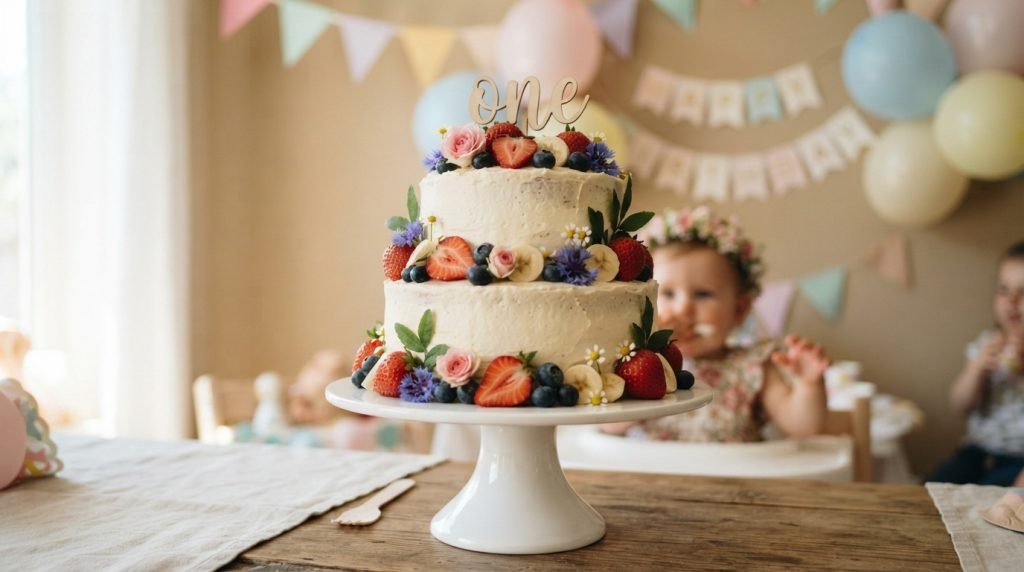
Almost every healthy toddler birthday cake recipe online is written for a first birthday and treats it as a one-off event. It is not a one-off event. You will be doing this twice, and knowing that in advance makes the first one much less precious.
Healthy Toddler Birthday Cake
Why Two Birthdays, Not One
The Dietary Guidelines for Americans say that children under two should avoid all foods and drinks with added sugar. The American Academy of Pediatrics, the American Heart Association, the Academy of Nutrition and Dietetics and the American Academy of Pediatric Dentistry all align on the same age.
Under two. Not under one. That distinction gets lost constantly, including in the earlier version of this page, which said under one and therefore implied the restriction expires on the very day the cake is served. It does not.
What that means practically:
- The first birthday cake should have no added sugar. Everyone agrees on this and every recipe online covers it.
- The second birthday cake should also have no added sugar, and almost nobody says so. Your child is still under the threshold on the day they turn two.
- The third birthday is the first one where added sugar is not against the guidance. Even then the advice is to keep it limited.
There is a reason beyond dental health. Under-twos need nutrient-dense food in small stomachs, and this is the period when taste preferences are forming. Early and repeated exposure to very sweet flavours makes them more appealing later. One cake will not decide anything. But knowing you have two of these ahead of you, rather than one, changes how much of a production you make of the first.
The Recipe
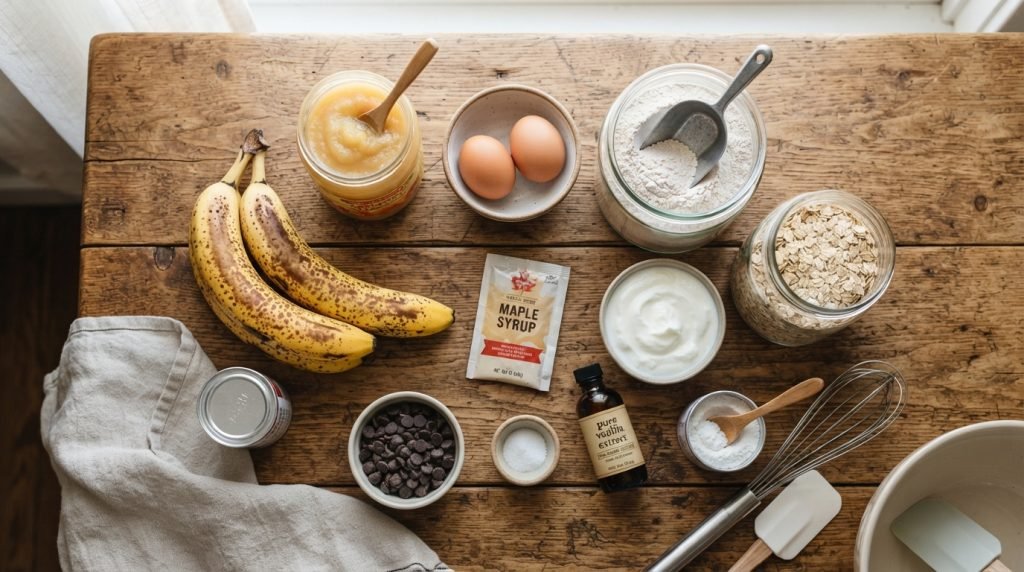
Makes one 6 inch single layer cake, which is the right size for one child to demolish. Double it for a 6 inch two layer cake if you want height for photographs.
For the cake:
- 1 cup (about 100g) oat flour, or rolled oats blitzed fine in a blender
- 1/2 cup (about 50g) almond flour (see the nut note below)
- 1 tsp baking powder
- 1/4 tsp bicarbonate of soda
- 1/2 tsp ground cinnamon, optional
- 2 very ripe bananas, mashed, about 1 cup. The browner the better, because they are the entire sweetener
- 1/4 cup unsweetened applesauce
- 1 egg
- 2 tbsp olive oil or melted unsalted butter
- 1 tsp vanilla extract
- No salt. Adults would add a pinch. Under-twos do not need the sodium and the cake does not miss it
Method:
- 1. Heat the oven to 350F / 175C. Grease a 6 inch round tin and line the base with baking paper.
- 2. Whisk the oat flour, almond flour, baking powder, bicarbonate of soda and cinnamon together in a bowl.
- 3. In a second bowl, mash the bananas thoroughly, then mix in the applesauce, egg, oil and vanilla.
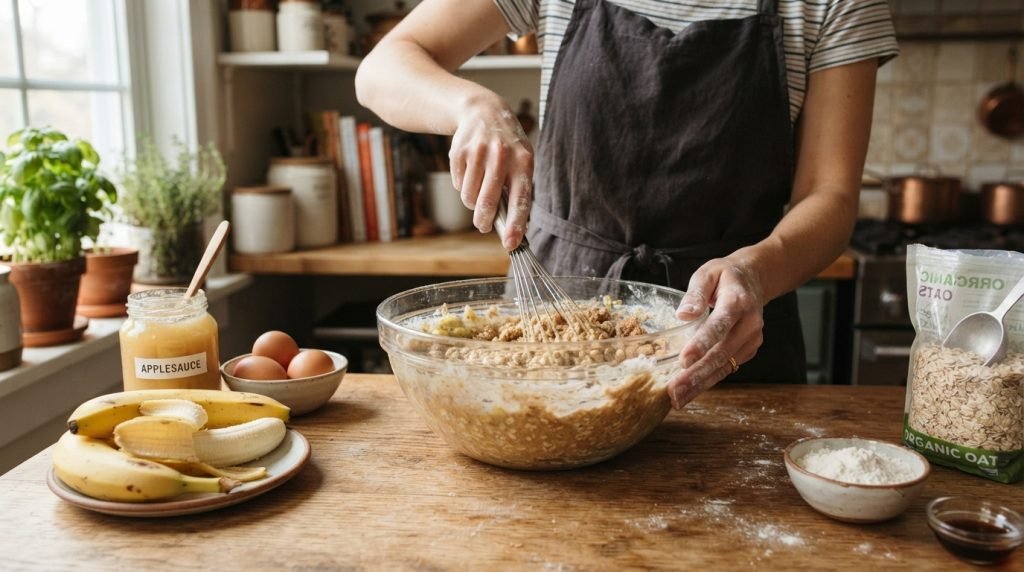
- 4. Fold the dry into the wet until just combined. Do not beat it. Overmixing gives you a dense, rubbery cake, which is the single most common failure with oat-based bakes.
- 5. Pour into the tin and level the top.
- 6. Bake 22 to 28 minutes, until a skewer comes out clean and the top springs back. Start checking at 22.
- 7. Cool in the tin for 10 minutes, then turn out onto a rack and cool completely before frosting. Warm cake plus cream cheese frosting equals soup.
Make it nut free by replacing the almond flour with another 1/2 cup of oat flour and adding an extra tablespoon of applesauce, since oat flour is thirstier. Make it dairy free by using olive oil rather than butter and frosting with coconut yoghurt.
The Frosting
Two options, and the choice matters more than the cake does.
Cream cheese, which holds its shape. Beat 8oz (about 225g) of full-fat cream cheese until smooth. That is the whole recipe. It is tangy rather than sweet, which is the point, and it pipes and spreads properly.
Thick yoghurt, which does not. Full-fat Greek yoghurt, strained through a cloth for a few hours if you want it stiffer. Lighter and fresher, but it will slump within the hour and it will weep on a warm day. Fine if the cake is being smashed within minutes of being photographed, which it usually is.
A tablespoon of mashed banana or a spoon of fruit puree stirred through either one adds sweetness without adding sugar. Do not add maple syrup or honey, for the reasons below.
Natural Colours, Honestly
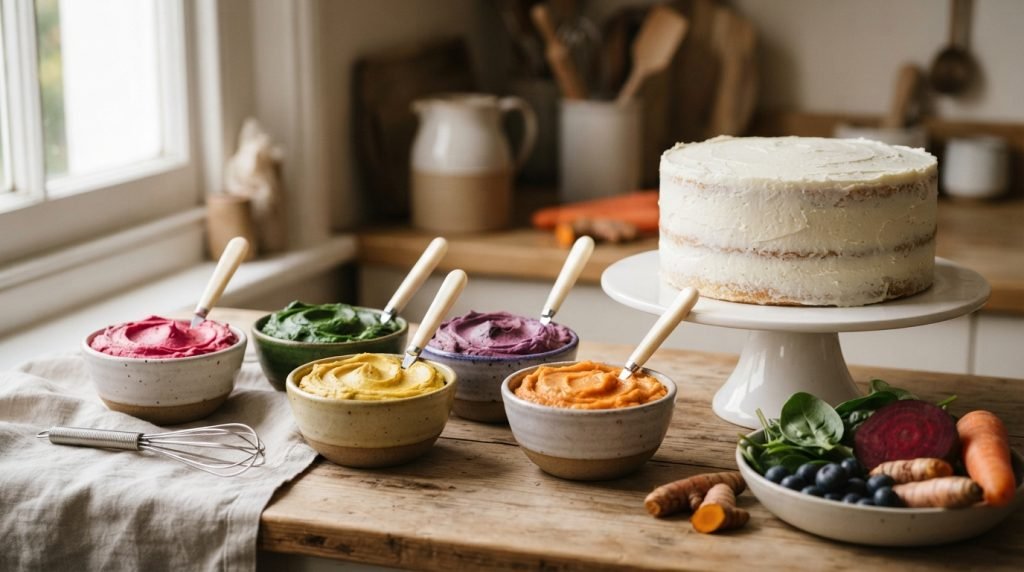
Every article on this subject gives you a cheerful list of natural colourings and none of them tells you how the colours actually turn out. Here is the honest version.
- Pink and red: beetroot powder or freeze-dried strawberry. These genuinely work and the colour is strong. Beetroot is the most reliable natural colour there is.
- Yellow: turmeric. Colours beautifully with a very small amount. It also tastes of turmeric. Use the smallest quantity that gives you the colour, add it to a portion rather than the whole batch, and taste it.
- Purple: blueberry puree. Works, but it tends towards grey-purple rather than the vivid purple on the packet, and the puree loosens the frosting.
- Orange: carrot puree. Reliable, mild, and it also loosens the frosting.
- Green: spinach powder. This is the one that disappoints. It usually produces a grey-green rather than a bright green, and it is the colour most likely to make people politely decline a slice. Matcha is greener but is not appropriate for this age.
The practical approach: divide the frosting into small bowls, colour each one separately, and start with a quarter teaspoon. You can always add more. Powders give stronger colour than purees and do not loosen the mixture, so use powders where you can.
Decorating Safely
This gets overlooked because a cake feels like a treat rather than a meal, but the choking rules do not take the day off.
- Cut everything to no larger than half an inch, which is the American Academy of Pediatrics guidance for young children.
- Quarter any grapes lengthwise. Halved is not enough.
- No whole nuts, and none before age four. Chopped nuts on top of a cake are a common decoration and not a good idea here.
- Berries are ideal. Blueberries squashed slightly, raspberries, strawberries cut small.
- Skip anything hard or round: whole nuts, hard sweets, sprinkles containing hard pieces, and the little silver balls, which are hard enough to crack teeth.
- Edible flowers look lovely and are fine, but check the variety is genuinely edible and unsprayed.
What About Honey and Maple Syrup?
Both come up constantly in no-added-sugar recipes and they are different problems.
Honey is a safety question before twelve months. No honey in any form before a child’s first birthday, and that includes honey baked or cooked into food, because heat does not destroy the Clostridium botulinum spores that cause infant botulism. A first birthday cake is often made and tasted a day or two early, and siblings and guests may be younger. The simplest answer is to leave honey out entirely, which is what the recipe above does.
Maple syrup is not a safety question, it is a definitional one. Maple syrup is an added sugar. So is date syrup, agave, coconut sugar and fruit juice concentrate. A recipe using any of them is not a no-added-sugar recipe, whatever the title says. Whole mashed fruit is different, because the sugar comes packaged with the fibre.
The Party Problem
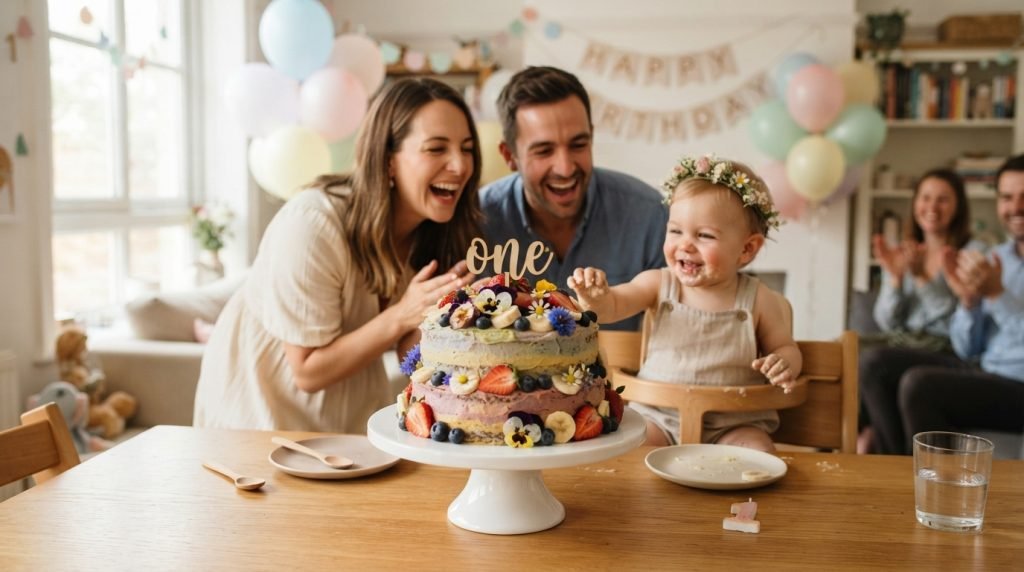
Recipe blogs write the recipe and stop. The bit people actually worry about is the party, where there will be a normal cake, other children, and a relative who brought sweets.
- Make one cake, not two, if you can face it. Two cakes signals that your child’s cake is the compromise version. The banana cake is genuinely nice and adults eat it happily.
- If there is a second cake for the adults, keep them apart and do the candle moment on your child’s one. The photographs are of your child, not the cake.
- Tell people in advance, once, lightly. ‘We are doing a no-sugar one because she is not two yet’ is a sentence that ends the conversation. Announcing it repeatedly at the party does not.
- Decide beforehand what you will do about a grandparent with a chocolate button. It is one button and it is one day, and the relationship usually matters more. Being relaxed about the exception is easier if the default is solid.
- Do the cake early, before your child is overtired. A smash cake at 4pm on a party day is a cake nobody enjoys.
Why a Smash Cake Is a Montessori Activity
This is worth saying because it is true and because no recipe blog will say it.
A smash cake is a child sitting in front of food with no spoon, no adult feeding them, and no instructions. They decide whether to touch it, how to touch it, whether to eat it and when to stop. It is entirely self-directed, entirely sensory, and the adult’s only job is to sit back and let it happen.
That is closer to Montessori practical life than almost anything else in a first birthday party. Compare it with the alternative, which is an adult holding a fork and a phone camera and saying ‘try it’.
So the useful reframing: the cake is not a treat you are giving them. It is a material you are presenting. Put it down, step back, and let them work out what to do with it. Some children destroy it. Some children touch the frosting once and burst into tears. Both are legitimate outcomes and neither is a verdict on your baking.
If They Hate It
- Roughly half of them do, at least at first. A whole cake in front of you is an overwhelming amount of food for a one year old.
- Break a piece off and put it on their tray rather than presenting the whole cake, if they seem daunted.
- Do not put frosting on their hands for them. It is a very common instinct and it is the fastest way to end the activity.
- A refused smash cake is not a failed birthday. Cut it up and eat it as a family the next day. It is banana bread with cream cheese on it, and it is good.
Frequently Asked Questions
What cake can a 1 year old eat?
A cake with no added sugar, sweetened only with whole fruit such as mashed banana and unsweetened applesauce, frosted with plain cream cheese or thick yoghurt. Avoid honey entirely before twelve months, including baked in, and keep any decorations cut to under half an inch.
Can a 1 year old have sugar on their birthday?
The guidance is that children under two should avoid added sugar, so a first birthday falls well inside that. A small amount on one day is not a catastrophe, but there is no nutritional reason for it and a naturally sweetened cake is easy to make.
What is a smash cake?
A small cake given to a child on their first birthday to explore with their hands, with no cutlery and no help. The point is the exploring rather than the eating, and it is usually photographed. A 6 inch single layer is plenty.
Does my child need a sugar free cake at two as well?
Yes, by the guidance. Children under two should avoid added sugars, and a child turning two is still under two on the day. The same recipe works, and by then they will eat considerably more of it.
Is maple syrup or honey allowed in a no added sugar cake?
Neither. Maple syrup, honey, agave, date syrup and fruit juice concentrate are all added sugars. Honey is also unsafe before twelve months in any form, including baked, because heat does not destroy the spores that cause infant botulism. Whole mashed fruit is fine, because the sugar comes with the fibre.
How far ahead can I make it?
Bake the cake the day before and keep it wrapped at room temperature. Frost it on the day, since cream cheese frosting needs refrigerating and a cold cake straight from the fridge is dense. Yoghurt frosting should go on within an hour of serving.