
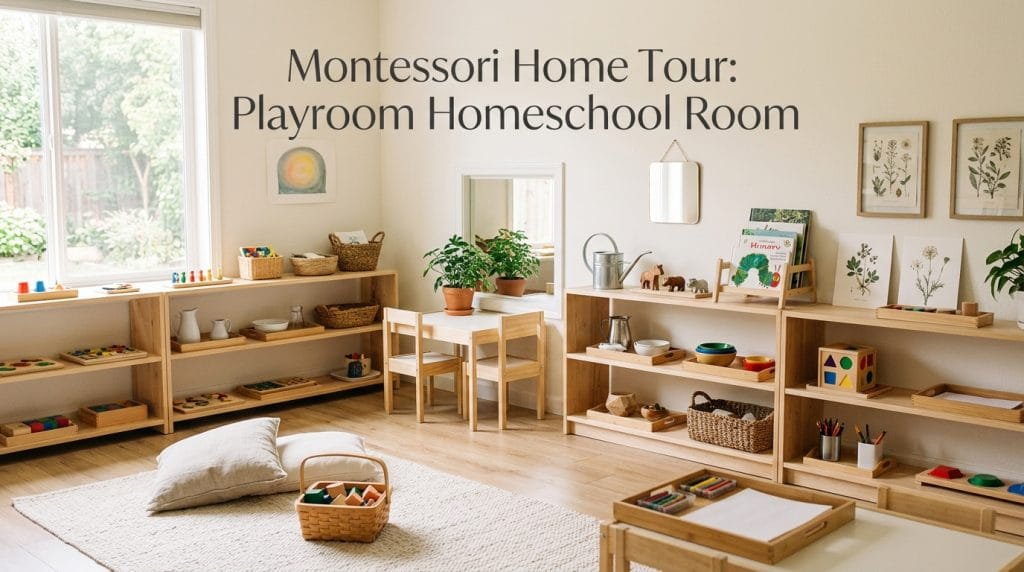
Montessori playroom ideas can help you create a calm and purposeful space where children can explore, play, and learn independently. Instead of filling the room with many toys, focus on creating an organized environment with carefully selected activities that match your child’s age and interests.
Short answer: a Montessori playroom needs one low open shelf, a small number of activities on it, a child-sized table, somewhere soft to sit, and clear floor space. It does not need to be a separate room; a corner of your living room works. On how many toys to display, every guide says six to ten and none of them cites a source. The one controlled study on this question tested 4 toys against 16 and found children played longer, more variedly and more complexly with 4. So start lower than the internet tells you, rotate every one to three weeks, and buy the shelf secondhand.
Search this and you will find rooms that look like showrooms. Pale wood, three wooden toys, no clutter, excellent natural light. What is harder to find is how many toys to actually put out, what any of it should cost, and what to do when the room is also where you keep the laundry.
This guide gives you the numbers, the ratio for furniture heights, what to buy secondhand, and an honest section on the criticisms of the method, because Google’s own People Also Ask box asks about them and nobody answers.
Montessori Playroom
You Probably Do Not Need a Playroom
This is the first thing to say, and two of the pages currently ranking for this term say it too. A dedicated playroom is optional. A corner of the living room, a hallway alcove, a section of the kitchen or a shelf in the dining room all work, and in one respect they work better: your child wants to be in the room where you are.
A separate playroom often becomes a room your child will not use alone. If you have one, good. If you do not, you are not starting at a disadvantage, and everything below applies to a corner just as well as to a room.
How Many Toys on the Shelf: What the Research Actually Says
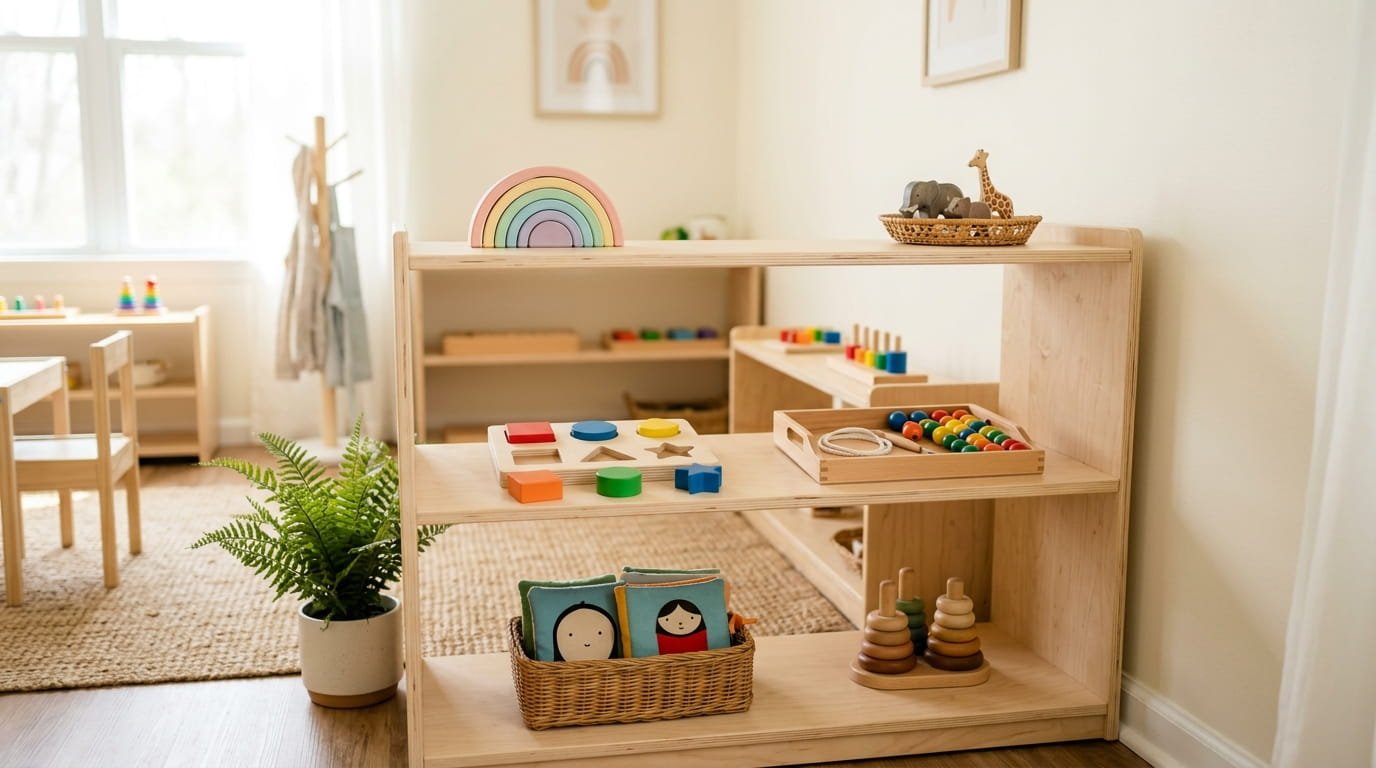
Here is where almost every guide on this topic, including the ones ranking above this page, states a number with no source behind it.
The common advice is to display six to ten activities. It appears everywhere. As far as I can establish it is practitioner convention rather than a research finding, and it is worth knowing that, because the one controlled experiment on the question points somewhere different.
In 2018, Dauch, Imwalle, Ocasio and Metz published a study in Infant Behavior and Development in which 36 toddlers played in an environment with 4 toys and, separately, with 16 toys. With four toys available, the same children played with each toy for longer, played in more varied ways, and played in more sophisticated ways. Fewer toys produced better quality play, not less play.
So a practical reading of both the convention and the evidence:
- 6 to 12 months: 3 or 4 activities. More than that is visual noise at this age.
- 12 to 24 months: 4 to 6. This is where most families overshoot, because the child seems to want more.
- 2 to 4 years: 6 to 8. The upper end of what the research supports, and plenty.
- 4 to 6 years: 8 to 12, by which point the child can also be involved in choosing what stays out.
- Store the rest. Roughly 80 percent away, 20 percent out, is a rule of thumb worth following.
If you are unsure, go lower. Nobody in the research or the practice literature suggests a child suffers from having too few well-presented activities available, and the study we do have suggests the opposite.
How Often to Rotate
Every one to three weeks is the usual answer, and infants tend to need it sooner than toddlers. But the calendar is the wrong trigger. Watch for these instead:
- An activity has been ignored for several days running.
- Your child completes it immediately and walks away, meaning it is now too easy.
- They tip it out without engaging, which usually means too hard or too many pieces.
- The shelf is consistently a mess by the end of each day, which usually means too much on it.
- They ask for something that is packed away, which is the clearest signal of all.
One thing that makes rotation far easier: keep the stored activities somewhere you can reach without effort. A rotation system that requires going into the loft does not happen.
The Six Zones, and Which Ones You Can Skip
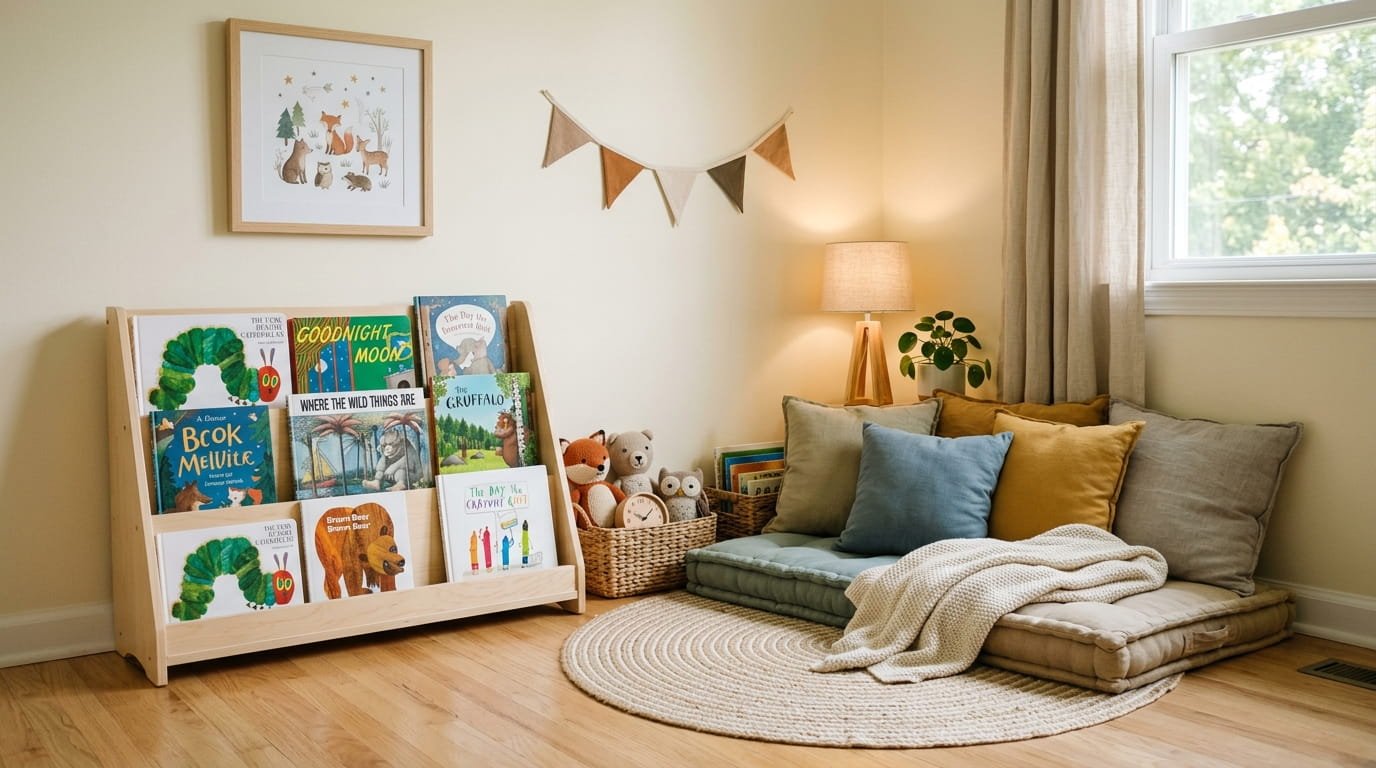
- A low open shelf. The only genuinely essential item. Anchored to the wall. Everything else is negotiable.
- A child-sized table and chair. Worth having, and see the height ratio below. A low coffee table or the floor with a tray works in the meantime.
- A soft spot for books. A cushion and a forward-facing book display or a basket. Does not need to be a designed nook.
- A practical life area. A tray with a jug and cloth, or a small dustpan. This tends to get more use than the pretty wooden materials.
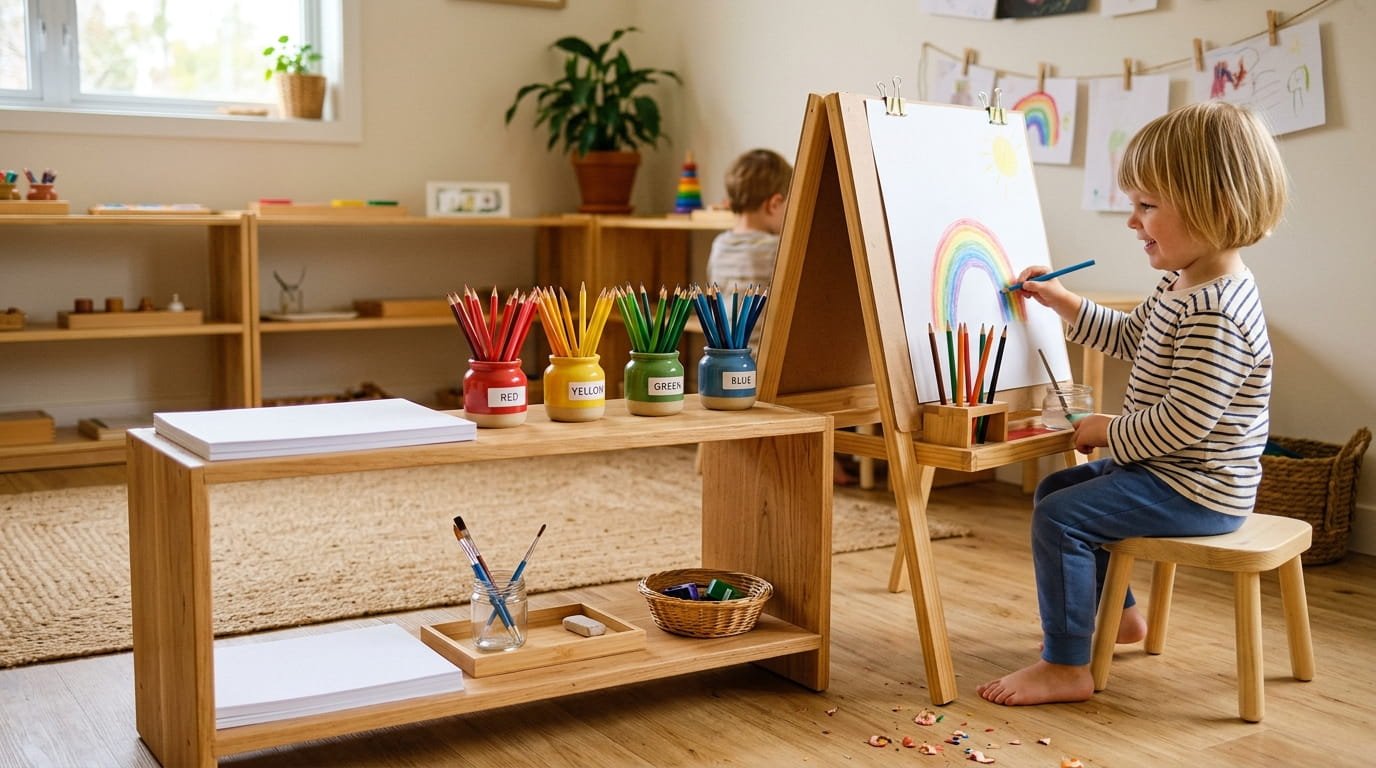
- An art station. Skippable as a fixed zone. A tray of materials in a cupboard, brought out, avoids a permanently chaotic corner.
- A movement zone. Genuinely skippable, and one competitor argues a Pikler triangle or climbing arch is actively wrong in a small room. A bench and a step stool cover the same ground. Clear floor is the movement zone.
If you have space and budget for two of the six, choose the shelf and the practical life tray.
Table and Chair Height: Use the Ratio, Not the Chart
Age-based height charts for children’s furniture disagree with each other, including between retailers selling to the same market, so use the geometry instead. It is more reliable and it takes thirty seconds.
- Seat height equals the distance from the floor to the bend behind your child’s knee when standing. Feet flat, knees at about 90 degrees when seated.
- Tabletop sits roughly 8 inches above the child’s knees when seated.
- Seat to tabletop gap of about 7 to 8 inches.
For rough orientation, a one to two year old is usually around a 14 inch table, and a two to five year old somewhere between 16 and 18 inches. Treat those as a starting point for measuring, not a specification, because published charts vary by several inches for the same age.
What to Buy, and What to Get Secondhand
Almost none of this needs to be bought new, and the writer with the most honest account of her own setup got her favourite child-sized shelf from Craigslist and her baskets from thrift shops and her mother’s old classroom. When she moved house and had no shelves at all, she lined baskets up on the floor and used that.
- The shelf. Secondhand, or an IKEA Kallax turned on its side, which is the most commonly used hack in this category. Anchor it. One known drawback: larger activities do not fit neatly into cube openings.
- Baskets and trays. Charity shops, and you do not need matching ones. Work does not have to sit on a tray at all, despite what the photographs imply.
- The table. Secondhand, or use a low coffee table. Measure using the ratio above rather than buying by age label.
- Materials. Buy few and buy well, and remember a puzzle you already own counts. Wooden does not automatically mean better.
- A shelf substitute. Boards on bricks, a turned-over crate, an old end table, or the hearth. All of these are real setups people use.
Three Questions Before You Buy Anything
Borrowed from the most level-headed writer on this subject, and worth keeping somewhere you will see it before checkout:
- Is my child already getting this from something we own?
- Is this a splurge, or is it genuinely beneficial? Both are allowed. Be honest about which.
- Is it worth investing in, meaning will it be used for months rather than days?
And the harder discipline underneath those: resist buying what is popular. A lot of what circulates in this niche is bought because it photographs well.
Small Spaces and Shared Rooms
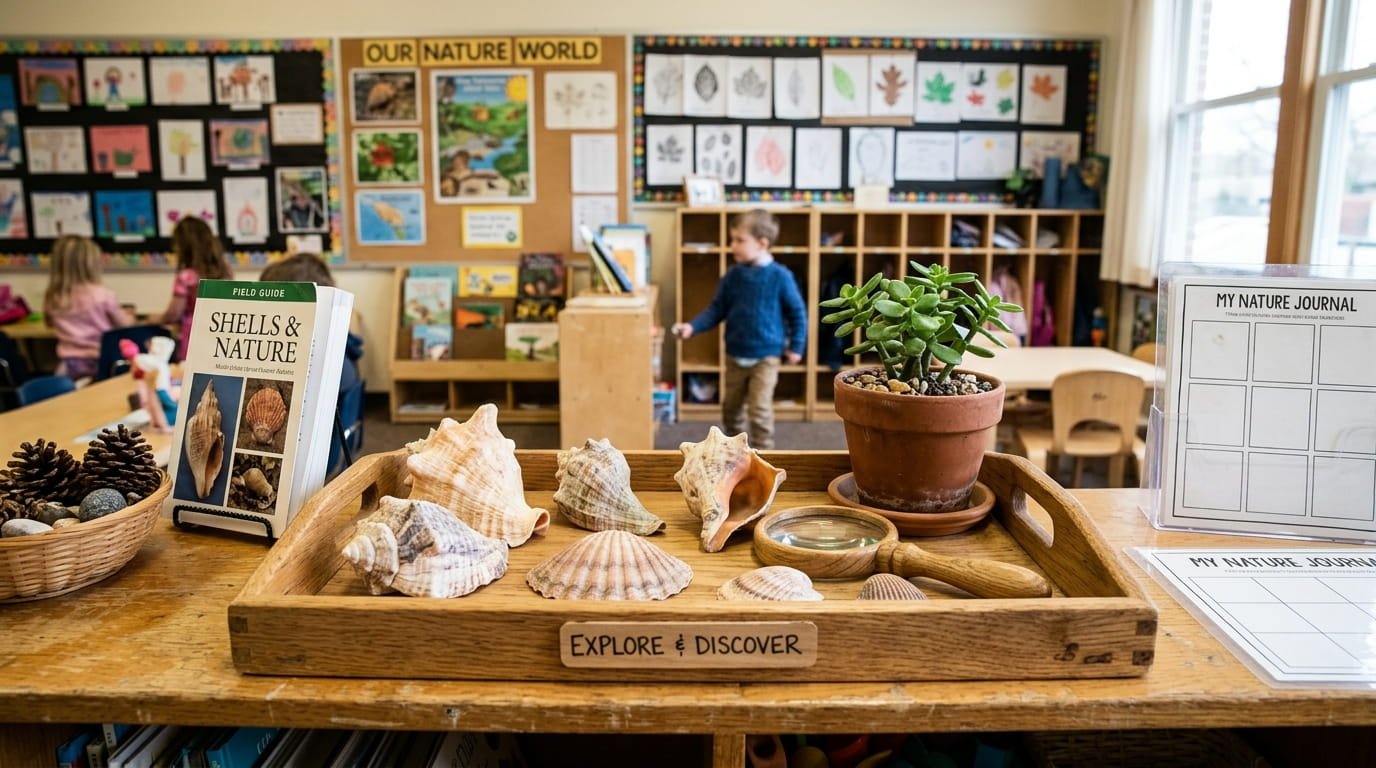
The specific measurements below come from a guide written for small flats, and they are the most concrete numbers I found anywhere on this topic.
- About 6 feet of wall is enough for a complete single-wall setup: shelf, book display, hooks.
- A 4 by 4 foot clear area is enough movement space for a toddler.
- Leave the floor empty on purpose. In a small room the instinct is to fill the floor, and doing the opposite is what makes the space usable.
- Go vertical. Wall shelves and hooks at child height cost no floor area.
- Use natural materials to reduce visual noise. The argument, which I find persuasive, is that bright plastic bins announce a mess zone while wood reads as belonging, so the corner does not take over the room visually.
For a shared space that is also an adult room, the workable pattern is one shelf that is unambiguously your child’s, and everything else stored in closed adult storage. A whole living room half-converted tends to satisfy nobody.
Presentation Beats Purity
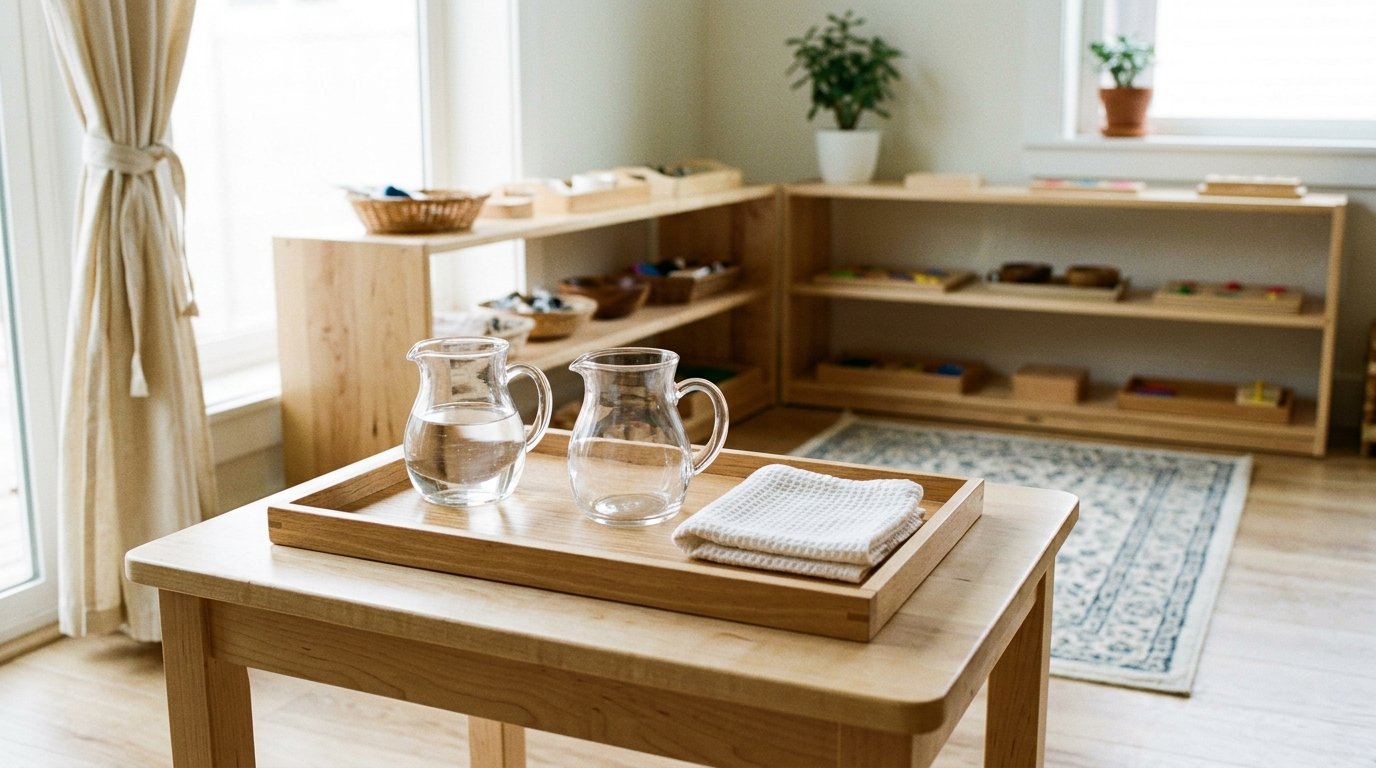
Most Montessori advice online was written for classrooms. A classroom has a trained teacher, twenty peers modelling behaviour and a structured three-hour work period. Your home has none of those, so copying the classroom is the actual mistake.
Which brings us to birthdays. Your child will be given plastic, licensed, noisy, thoroughly un-Montessori toys. Keep them. How something is presented matters more than what it is. A licensed character puzzle on a shelf with its pieces in a basket is doing the same work as a wooden one.
Three presentation ideas that are worth more than any purchase:
- Put loose parts in a container to the left of the activity. Left to right builds the directional habit used later for reading and writing.
- Deconstruct it before you shelve it. A puzzle with its pieces already tipped into a basket is an invitation. A completed puzzle is an ornament.
- Simplify for tidy-up, not just for play. A beading set with twelve beads can start with three. Fewer pieces means a clear-up your child can actually finish.
Let Your Child Move the Furniture
This one surprised me, and it comes with Montessori’s own authority behind it: children should be able to move the furniture. Lightweight, child-scaled furniture exists partly so a child can rearrange their own environment, and a child dragging a stool across the room is using it correctly.
Boundaries make it workable rather than chaotic. Three that people actually use: everything goes back at the end of the day; only these items may be moved, for safety; no more than three things moved at once.
It is worth sitting with the implication. Your carefully arranged corner is a proposal, and your child is entitled to a view about it.
What It Does Not Have to Look Like
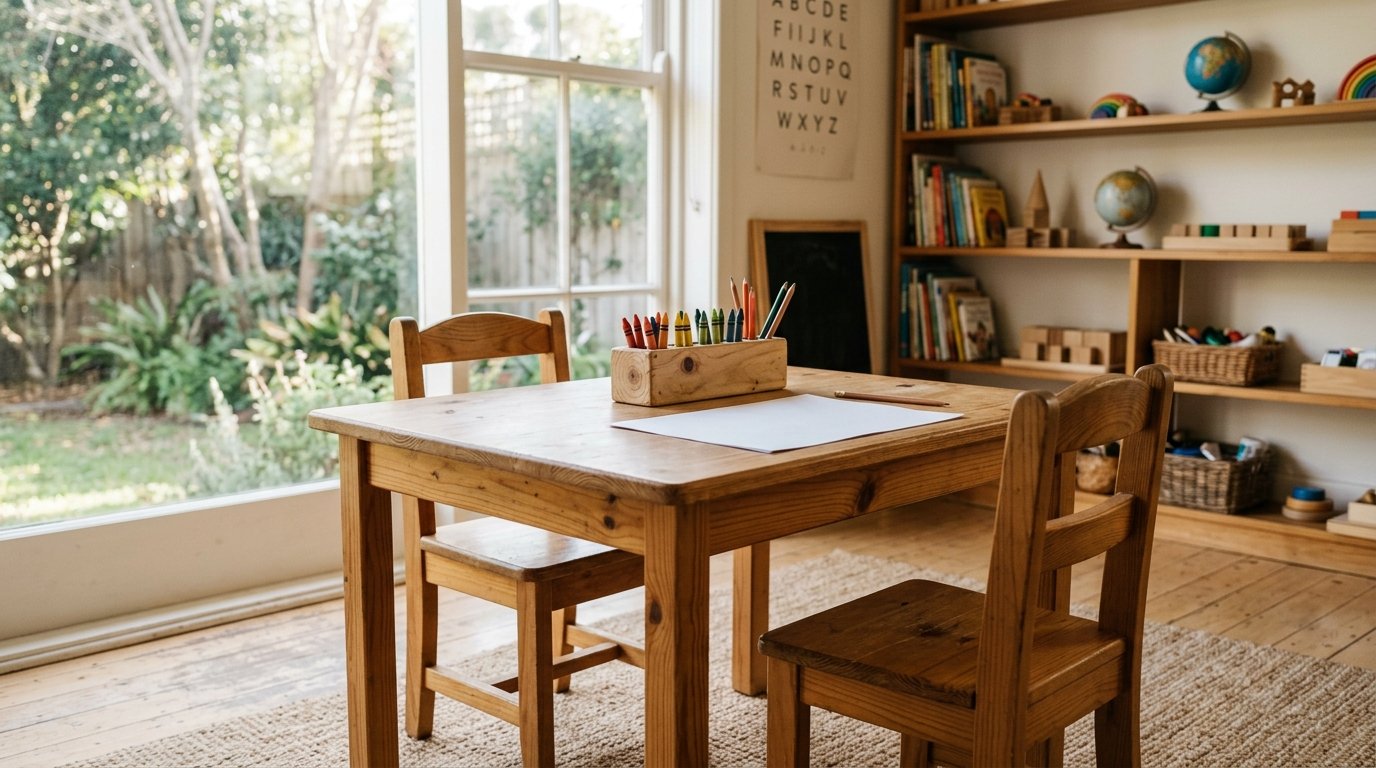
The beige, undecorated, colourless room is an aesthetic, not a method. There is a parody Instagram account devoted to mocking it, and a Montessori school network currently ranking for this keyword takes an open swipe at it.
The reasoning is worth knowing because it comes from how the materials are actually designed. The Pink Tower is a single colour so that size is the only variable a child has to attend to. Sandpaper letters use colour only to distinguish vowels from consonants. Infant mobiles use high contrast deliberately. Colour is used with purpose throughout, not avoided.
So: colour is welcome, visual noise is not. A room with a bright rug, your child’s own paintings on the wall and a red basket is entirely Montessori. A room with forty things on the shelf is not, regardless of how muted they are.
The Honest Criticisms of Montessori
Google shows ‘What is the biggest criticism of Montessori?’ in the People Also Ask box for this search, and no page currently ranking answers it. If you are about to rearrange your house around a method, you deserve to know what its critics say.
- The evidence base is thinner than advocates suggest. A widely cited 2017 review in npj Science of Learning by Chloë Marshall found supportive evidence but recurring methodological problems: small samples, selection bias, and children not randomly assigned. Her conclusion was that the useful question is which elements work, for whom, in what circumstances. A later Campbell systematic review found broadly positive effects, so this criticism is weaker now than it was, but it has not disappeared.
- The name is unpoliced. A school can call itself Montessori with no accreditation and no trained Montessori teachers. That makes research hard and parent choice unreliable, and it is a fair criticism of the movement rather than the method.
- The suppression of pretend play. Montessori excluded fairy tales and fantasy for young children. Angeline Lillard has defended this and argued the evidence for pretend play’s benefits is weaker than assumed, but her reading of that literature is itself contested. It remains a live academic disagreement, not a settled point.
- The original critique, still unanswered. In 1914 William Kilpatrick called Montessori’s model of child development inadequate and misleading, and argued it rested on unsystematic observation. Montessori chose not to reply.
- Cost and fit. Most Montessori schools are private and expensive, which filters by income. And a self-directed, loosely structured approach may not serve every child, particularly those who need explicit instruction or specialist support.
None of this is a reason not to put a low shelf in your living room. It is a reason to hold the method loosely, adapt it to the child in front of you, and be sceptical of anyone selling certainty.
Frequently Asked Questions
What is a Montessori playroom?
A space where a small number of activities sit on a low open shelf at the child’s height, so they can choose, use and return them without asking an adult. It is defined by accessibility and restraint rather than by any particular furniture or colour scheme. It does not need to be a separate room.
How many toys should be on a Montessori shelf?
Common practice is 6 to 8 for a toddler, and up to 12 for an older preschooler. Worth knowing that this convention has no research behind it, while the one controlled study on the question, Dauch and colleagues in 2018, found 4 toys produced longer and more complex play than 16. If in doubt, use fewer.
How often should I rotate the toys?
Every one to three weeks is typical, with infants nearer the shorter end. Better to rotate on behaviour than on the calendar: swap an activity out when it has been ignored for several days, or when your child finishes it instantly and walks away.
At what age do children outgrow a playroom?
The shelf-and-tray setup suits roughly 6 months to 6 years. After that most children want a desk, floor space for larger projects, and storage they manage themselves. The principle carries on; the furniture changes.
How do I set up a Montessori space for homeschooling?
Same shelf, longer work sessions, and one addition: a defined workspace at the right height with materials for the current topic within reach. Resist a school-room aesthetic. The reason classroom advice often fails at home is that home has no trained teacher, no peer group and no timetable, so build around your actual day rather than around a classroom.
Do I need to buy expensive wooden toys?
No. Presentation matters more than material. A licensed-character puzzle with its pieces in a basket does the same job as a wooden one. Buy the shelf secondhand, use charity shop baskets, and keep the money for two or three things that will be used for months.
What is the biggest criticism of Montessori?
Probably that the evidence base has been methodologically weak, with small samples and non-random assignment, though more recent systematic reviews are more favourable. Close behind: anyone can use the name without accreditation, so the label guarantees nothing. The section above sets out five substantive critiques with their sources.