
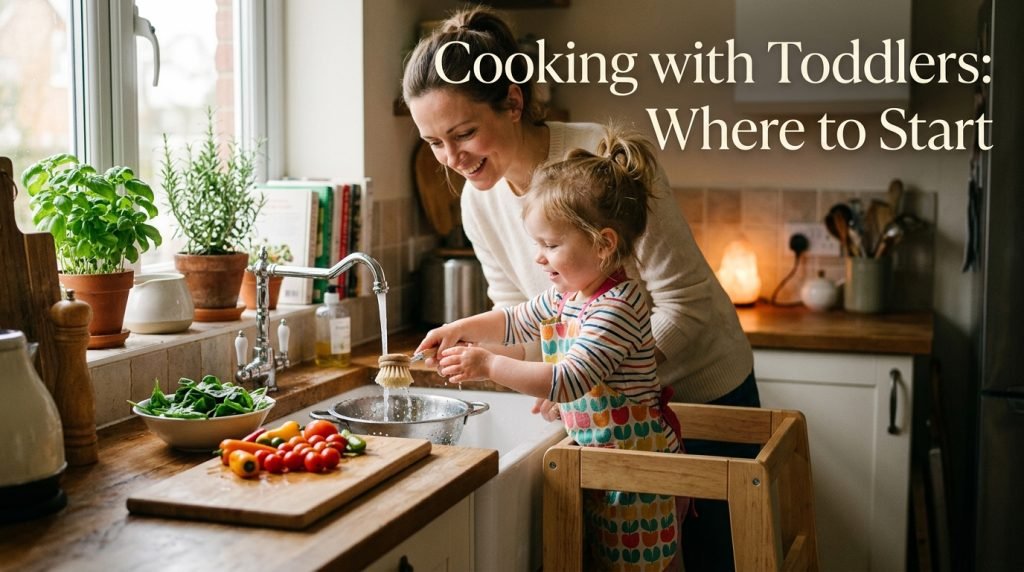
Short answer: start cooking with toddlers at around 18 months, with one job, for about ten minutes. Wash the fruit. That is the whole first session. The single most useful habit: do all the chopping, measuring and pouring before your child comes into the kitchen, so the only thing left is the part they can do. Most sessions that go badly go badly because a toddler is standing on a stool watching an adult find the scales. Expect mess, expect it to take three times as long, and expect them not to eat what you made.
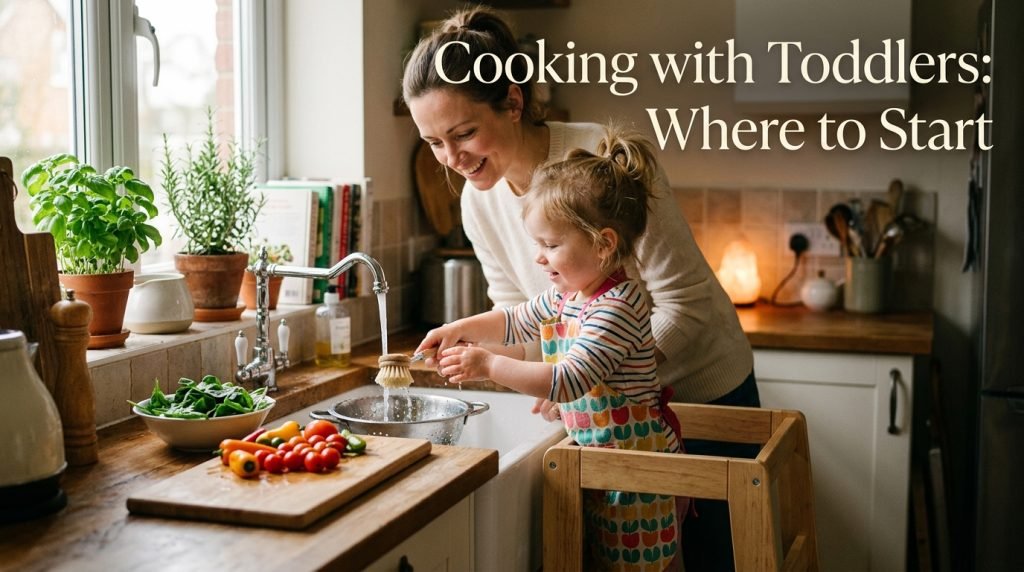
Most guides to cooking with toddlers treat a toddler as one kind of person. A fourteen month old and a three year old are barely the same species in a kitchen, so this is organised by what your child can actually do rather than by recipe.
Cooking With Toddlers
What They Can Actually Do, by Age
These bands come from extension service and public health task lists. Treat them as a starting point and watch your own child, who may be ahead or behind on any single item.
12 to 18 months. Washing fruit and vegetables in a bowl of water. Tearing lettuce and herbs. Putting things into a bowl. Carrying an unbreakable item from A to B. Mostly this is participation rather than cooking, and that is the correct amount.
18 months to 2 years. Stirring dry ingredients or thin batter. Pouring from a small jug you have pre-measured. Spreading soft things with a butter knife. Mashing cooled cooked fruit or vegetables. Shaking something in a sealed container. Pressing cookie cutters.
2 to 3 years. Measuring with cups and spoons, badly. Cutting soft foods such as banana or cooked potato with a child-safe knife. Whisking. Peeling a hard-boiled egg or a satsuma, which toddlers love and which is superb fine motor work.
3 to 4 years. Cracking eggs, with a bowl to fish shell out of. Using a peeler. Grating with a guard. Following a two or three step sequence without prompting. Setting a timer.
Notice that heat is not on any of those lists. Frying, boiling and the oven stay with you until well past toddlerhood, whatever a recipe says.
Set Everything Up Before They Come In
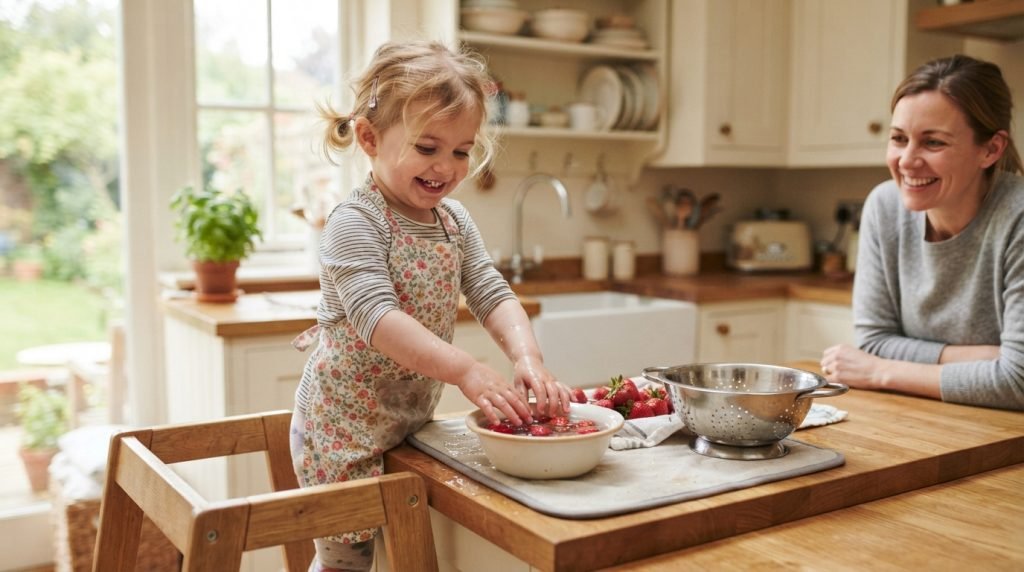
If you take one thing from this page, take this. It is the point several experienced people on this subject agree on, and it is the difference between a session that works and one that ends in tears.
Before your child enters the kitchen: chop everything, measure everything into small bowls, pour the liquids, get the tray out, put the bin within reach and lay a tea towel where the spill will be.
The reason is simple. A toddler standing at a counter watching an adult rummage in a cupboard has nothing to do, and a toddler with nothing to do in a kitchen will find something. Every minute of your preparation is a minute they are not waiting.
Then hand them one job at a time. Not the recipe. One job. When it is done, hand them the next one.
Your First Three Sessions
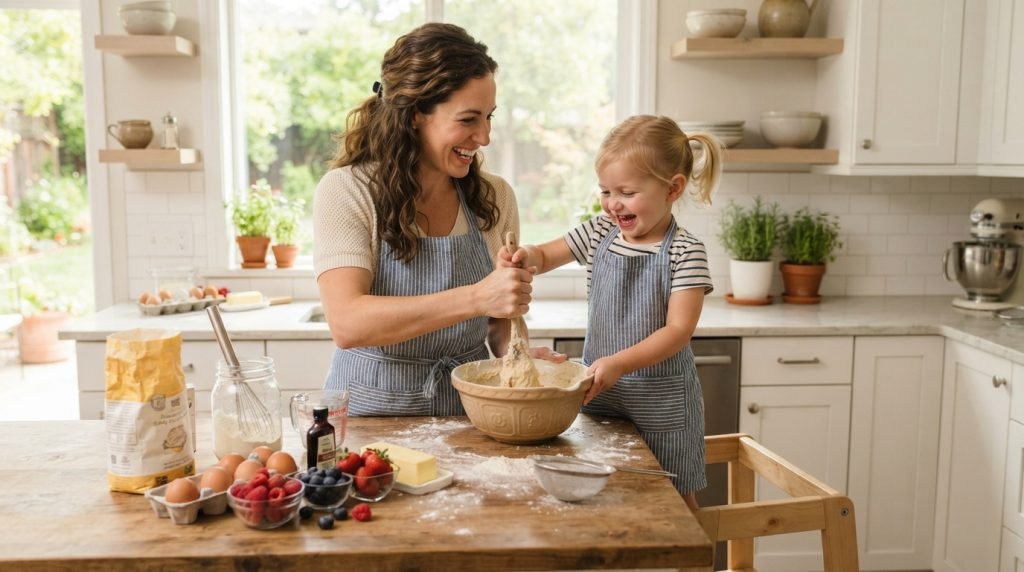
Nobody gives beginners an actual progression, so here is one. Each of these is ten minutes.
Session one: washing. A bowl of water, a colander and some strawberries or grapes. They wash, you watch. There is no failure state, nothing to burn and nothing to waste. The point is that they learn the kitchen is somewhere they are allowed to be.
Session two: pouring and stirring. You pre-measure oats, milk and a mashed banana into three small bowls. They tip each one into a big bowl and stir. You do everything else. They have now made something.
Session three: cutting. A banana, a nylon child knife and a chopping board. Show them once, slowly, then hand it over and stop talking. Cutting is the job toddlers want most and the one adults hover over most.
After three sessions you will know what your child actually enjoys, which is more useful than any recipe list. Some children want to stir forever. Some only want to cut. Follow that rather than a curriculum.
Six Things to Cook First
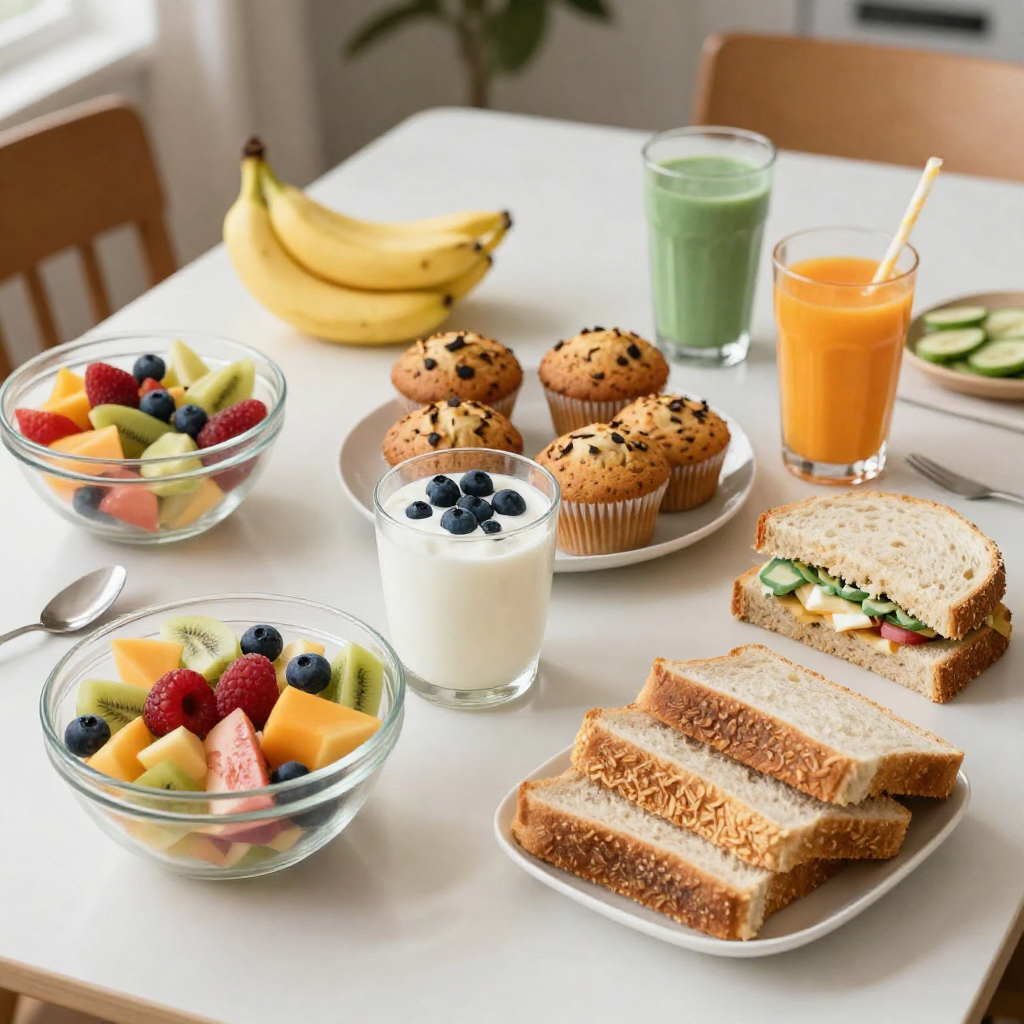
Chosen because there is a job in each one that a toddler can genuinely own, and because you find out quickly whether it worked.
- Fruit salad. Washing, then cutting soft fruit. The obvious first one and none the worse for it. Quarter the grapes lengthwise.
- Overnight oats. Pouring and stirring, no heat, and it is ready in the morning, which teaches waiting.
- Banana oat muffins. Mashing is the job. Note the raw batter rule below.
- Yoghurt with squashed fruit. Spooning and squashing. Good for the youngest end.
- Smoothies. They load the blender, you press the button. Immediate result, which matters at this age.
- Pizza on a wrap or muffin base. Spreading and arranging. The most popular one with two and three year olds because it looks like something when it is finished.
A note on no-bake energy bites, which appear on almost every list including the earlier version of this page. They are usually made with honey, whole nuts and dense raw oats, and all three matter for this age group. See the safety section. Made without honey, with nut butter rather than whole nuts, and rolled small and soft, they are fine.
Do You Need a Learning Tower?
This is the one purchase decision beginners face, and it deserves more than a passing mention.
A learning tower is a step stool with guard rails or enclosed sides that brings a child up to counter height. The advantage over a chair or a plain stool is real: it is much harder to fall backwards out of one.
- When: they are generally designed for around 16 to 18 months and up. The readiness test is whether your child can stand steadily and climb onto a platform with guidance, not their birthday.
- Cost: roughly $20 if you do the well-known IKEA stool hack, around $39 to $55 for standard folding models, and considerably more at the top end. The expensive ones are not safer, they are prettier and they fold better.
- Alternative: for a coordinated three or four year old, a wide two-step stool with close supervision is usually fine. For a younger toddler, a purpose-built tower is the safer choice.
And here is the thing nobody says. A learning tower solves the falling problem and creates a reaching problem. You have just given your child the entire worktop: the hob, the knife block, the kettle flex, the hot pan handle, the glass you left near the edge.
So before the tower arrives, move the knife block, turn pan handles inwards as a habit, and keep the tower away from the hob. The tower is not a safety device. It is a height device, and it changes what you have to think about.
The Safety Rules That Actually Matter
Your current safety list says keep knives out of reach and always supervise. Both true, both insufficient. These are the specifics.
- Cut everything to no larger than half an inch, which is the American Academy of Pediatrics guidance for young children. Quarter grapes lengthwise.
- No tasting raw dough or batter. Raw flour can carry E. coli and raw egg can carry salmonella, and the CDC advises against tasting any raw dough. This is the one that surprises people, because licking the spoon is half the appeal.
- No honey before age one, in any form. This includes honey that has been baked or cooked, because heat does not destroy the spores that cause infant botulism. Relevant if you have a younger sibling in the house or are cooking for a playdate.
- No whole nuts before four. Spread nut butter thinly rather than in chunks.
- Skip firm raw oats and granola-type textures for the youngest. Cooked soft oats are low risk. Dense raw oat balls are harder work than they look.
- Ask about allergies before a playdate, particularly with anything containing nut butter, egg or sesame.
- Nylon serrated child knife, not a real one. You will find popular posts encouraging real metal knives at two. The cutting motion is the developmental gain, not the sharpness.
- All heat is yours. No exceptions, whatever the recipe says.
The Mess, and How Long This Really Takes
- Three times as long. If it takes you ten minutes alone, budget thirty. Not because they are slow, but because you will be narrating and re-doing.
- Decide the mess is the price before you start. Resenting it halfway through is what turns a nice activity into a tense one.
- A tea towel on the floor catches most of it and takes two seconds.
- One child at a time, if you can. Two toddlers at a counter is a different and harder activity.
- Ten to fifteen minutes is a full session at two. You do not need to finish the recipe together.
- Clean up together, briefly. A small cloth and two minutes. It is part of the activity, not a punishment afterwards.
Does It Help With Fussy Eating?
Somewhat, and less than you will be told. This is worth being straight about, because the promise is oversold everywhere.
What holds up: children eat more of a dish they helped make, at that meal. In a 2014 study, children who helped cook a lunch ate about 76 percent more salad than those who did not, and reported feeling more positive and more in control afterwards. Those children were six to ten years old, though, so the numbers do not transfer straight to a two year old.
What does not hold up as well: that it durably changes what your child will try. A 2024 review of 23 children’s cooking programmes found that of the seven studies measuring willingness to taste new foods, only two showed a significant improvement.
So cook together because it is a good use of twenty minutes, because your child learns to handle real tools, and because they eat more of it that day. Do it expecting a fussy eater to be cured and you will be disappointed, and you will have been set up for that by everyone else writing about this.
Frequently Asked Questions
What age can a toddler start helping in the kitchen?
From around 12 to 18 months for simple washing and tearing, and around 18 months for stirring and pouring. Most families find 18 months to two years is when it starts to feel like cooking together rather than supervision.
What can a 2 year old do in the kitchen?
Stir, pour from a pre-measured jug, spread with a butter knife, mash cooked fruit, press cookie cutters, and cut soft foods such as banana with a child-safe knife. Measuring is possible and will be inaccurate, which does not matter.
Do I need a learning tower?
Not strictly, but it helps a lot from about 16 to 18 months and it is safer than a chair. Expect roughly $20 for an IKEA hack or $39 to $55 for a standard folding model. Remember it gives your child access to the whole worktop, so move the knives and keep it away from the hob.
What should I cook first with a toddler?
Fruit salad. Washing and cutting soft fruit, no heat, nothing to burn and nothing to waste. Ten minutes is a complete first session, and it is enough to find out whether your child enjoys this.
Can my toddler lick the spoon?
No. Raw flour can carry E. coli and raw egg can carry salmonella, and the CDC advises against tasting raw dough or batter. If you want something lickable, use a no-bake recipe with no raw egg, or heat-treat the flour first.
Is cooking with toddlers worth the mess?
Yes, if you go in expecting it. It builds real tool skills, it is a genuine practical life activity, and children eat more of what they helped make that day. Budget three times as long, keep sessions to ten or fifteen minutes, and put a tea towel on the floor.