
Short answer: a toddler morning routine works when it is short, always in the same order, and starts with your child properly awake rather than being hurried the moment their eyes open. Same order every day: wake, drink and eat, dress, out. Two choices only, never open questions. The thing most guides miss: if your mornings are consistently awful, look at bedtime before you look at the routine. The American Academy of Sleep Medicine recommends 11 to 14 hours of sleep a day for a 1 to 2 year old, including naps, and 10 to 13 hours for a 3 to 5 year old. Getting enough sleep is directly associated with better emotional regulation, which is precisely the thing that fails at 7am.

There are two different mornings people mean when they search for a toddler morning routine. One is getting out of the door for nursery on time. The other is filling a long morning at home with a child who woke at half past five. This covers both, and the useful news is that the same four things fix most of both.
Toddler Morning Routine
Start With Bedtime, Not the Morning
This is the part almost nobody leads with, including the two sleep companies that rank for this search.
A toddler who is not getting enough sleep will not be fixed by a better routine, a nicer chart or more patience. The American Academy of Sleep Medicine, in guidance endorsed by the American Academy of Pediatrics, recommends:
- Ages 1 to 2: 11 to 14 hours per 24 hours, including naps.
- Ages 3 to 5: 10 to 13 hours per 24 hours, including naps.
Meeting those numbers regularly is associated with better attention, behaviour, learning, memory and emotional regulation. Emotional regulation is the whole ballgame in the morning. A rested two year old can just about cope with the wrong colour cup. An undertired or overtired one cannot, and no routine design will change that.
So do this first. Work out what time your child actually needs to be up. Count backwards the number of hours in the band above, subtract the nap they are still taking, and see what bedtime that implies. If your child needs to be awake at 7am and is at the 12 hour end of the range with a one hour nap, that points at a bedtime around 8pm. Most families who are having genuinely terrible mornings find the gap is here, not in the routine.
Two honest caveats. Individual children vary a lot within those bands, and the bands are wide for that reason. And the popular idea that an early waker needs an earlier bedtime rather than a later one is something sleep practitioners say often but I could not point you to strong evidence for it. It is cheap to test for a week, so test it rather than taking anyone’s word for it.
The Order That Works, and Why
Keep the same sequence every single day. The predictability is doing more work than any individual step.
- Wake, then wait. Give it five or ten minutes before you ask for anything. A child who has been awake for two minutes cannot make decisions, and most morning battles start here. This is the single highest-value change on this page and it costs nothing.
- Drink and eat before dressing. A hungry toddler is not a reasonable toddler, and food is the least negotiable item, so put it where cooperation is highest.
- Dress after breakfast, not before, unless you are precious about the clothes. It also means one fewer thing to redo.
- Do the leaving bit last and identically every time. Shoes by the door, coat on the same hook, same order.
Why the fixed order matters more than the content: a toddler cannot yet hold a plan in their head, but they can absolutely recognise a pattern. Same order every day means they stop having to be told, which is the actual goal. A routine that varies is just a series of instructions.
What a Toddler Can Actually Do Alone, by Age
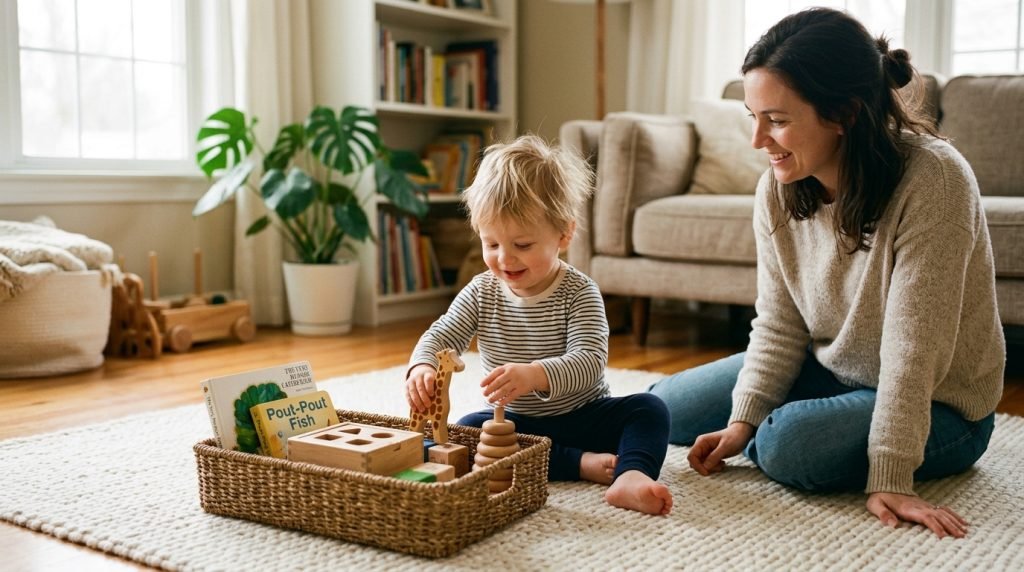
Ranges, not rules, and your child may be ahead or behind on any single item.
18 months to 2 years. Carry their own cup. Put a nappy in the bin. Push arms into a coat you are holding. Pick between two things you hold up. Fetch their shoes when asked.
2 to 3 years. Pull on elasticated trousers, usually backwards. Take off socks, which is much easier than putting them on. Wash hands with a step stool. Put a plate in the sink. Choose clothes from two laid-out options.
3 to 4 years. Dress almost entirely, with help on fastenings. Brush teeth with a follow-up brush from you. Put shoes on the right feet more often than not. Carry their own bag.
The point of this list is not to speed anything up. Doing it themselves is always slower. It is that a child who does three things unaided is a child who is participating rather than being processed, and participating children argue less.
A Visual Schedule Is Not a Sticker Chart
Almost every article on this subject recommends a reward chart. It is worth separating two things that get muddled together, because they do opposite jobs.
- A visual schedule is a strip of pictures showing the order of the morning: cup, plate, clothes, teeth, shoes. It tells your child what comes next. It replaces you as the source of instructions, which is exactly what you want.
- A sticker chart pays your child for complying. It adds an external reason to do something.
Keep the first. Be careful with the second, and here is why.
In a well known 1973 study, nursery school children who liked drawing were split into three groups. One was promised a certificate for drawing, one got the same certificate unexpectedly afterwards, and one got nothing. When researchers later watched free play, the children who had been promised a reward spent roughly half as much time drawing as the other two groups. Being paid for something they had freely enjoyed made them less interested in it.
A 1999 meta-analysis of 128 experiments found the same pattern: tangible rewards that are expected in advance reliably reduce intrinsic motivation. Notably, verbal encouragement generally increases it.
So the practical version, which is more nuanced than either ‘sticker charts work’ or ‘never praise’:
- A picture sequence on the wall is a good idea. It is information, not payment.
- A sticker for getting dressed is a contract, and contracts have to keep being honoured. What happens the week you stop is the problem.
- Noticing out loud is the strongest tool you have. ‘You put both shoes on by yourself’ is verbal, specific and unplanned, which is the combination the research supports.
- An occasional unexpected treat is fine. It was the promised reward that did the damage, not the reward itself.
Worth saying that plenty of families use sticker charts happily and their children are fine. This is about which tool to reach for first, not a rule.
The Morning Basket, and What It Is Actually For
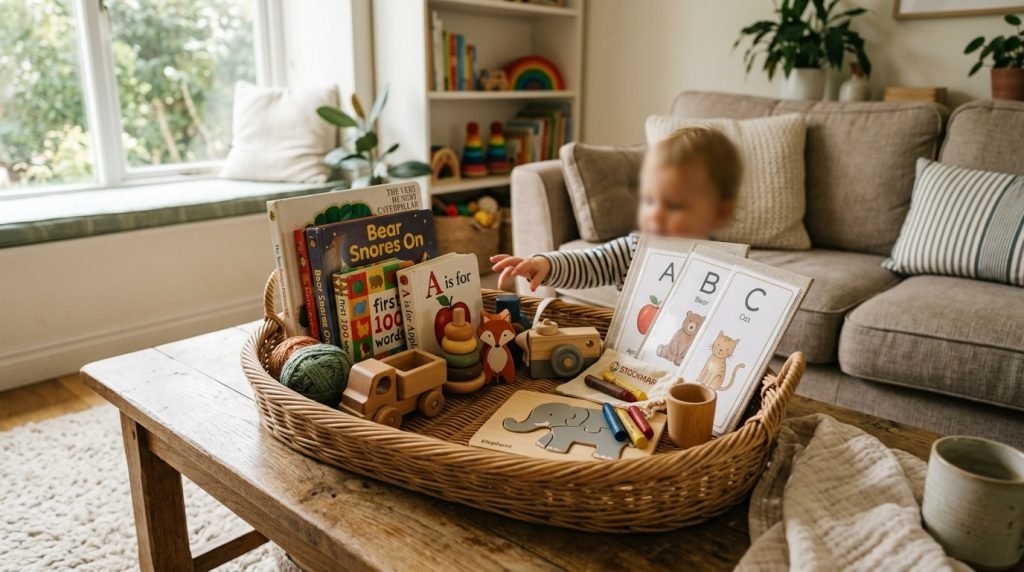
A morning basket is a small basket of books and activities that lives somewhere your child can reach, and that they go to at the same point each morning. Some people call them morning bins.
It is genuinely useful, but it is worth being precise about the problem it solves, because it is a specific one. A morning basket buys you twenty minutes. It is for the gap after breakfast when you need to make a packed lunch or drink a coffee, or for the hour between a very early waking and a reasonable start to the day.
What it is not is a fix for a chaotic morning. If you are late every day, the basket is not the answer and may make things worse by adding a step. Use it on the mornings you have time to fill, not the mornings you are trying to get out of the door.
The reason it works is the reason any of this works: it is in the same place, at the same point in the sequence, every day, so your child goes to it without being sent.
What to Put In It, and What to Leave Out
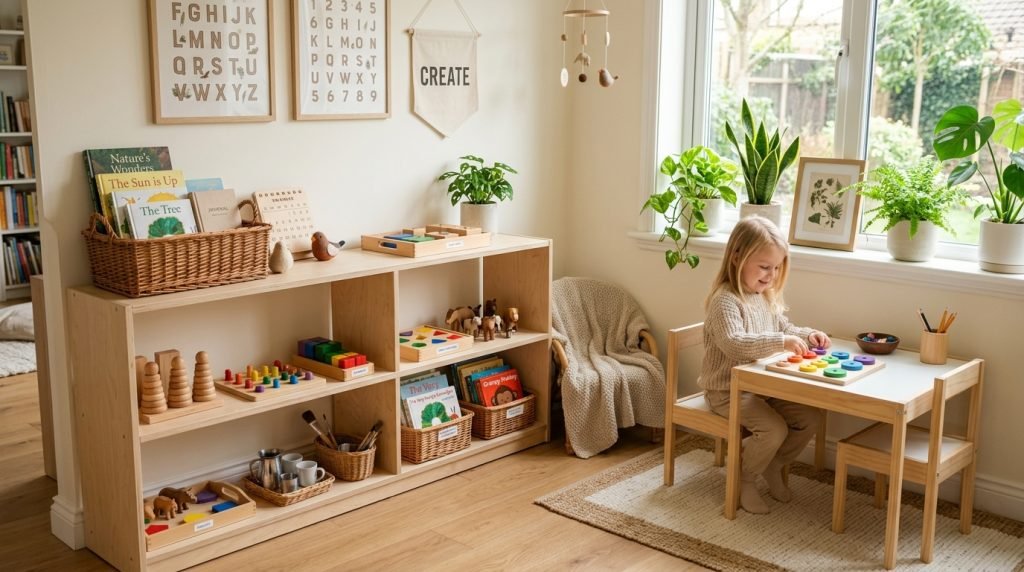
Six to eight things, rotated weekly. More than that and it becomes a toy box, which nobody tidies and nobody chooses from.
- Two or three board books, at least one they already love. Familiarity is what makes them go to it alone.
- One puzzle they can complete without you.
- A small container of something to sort, such as buttons, shells or coloured pegs, if they are past mouthing things.
- Paper and a few chunky crayons.
- Finger puppets or two small animal figures for narration.
- Something from outside, a pinecone, a conker, a handful of leaves. Free, seasonal, and the item children most reliably pick up.
- One thing that was not there last week. The rotation matters more than the contents.
One thing to take out, and this is a correction to the earlier version of this page. It previously recommended alphabet and number flashcards. Flashcards are not a Montessori material and they are not really a toddler material either. Montessori teaches letters through sandpaper letters, which a child traces with a finger so the sound and the movement are learned together, and through the three period lesson. That is a different activity from being shown a card and asked what it says.
If you want letters in the basket, use sandpaper letters or a set of objects that begin with one sound. If your child enjoys the flashcards, no harm is being done, but they are not the Montessori choice and they should not have been on the list on this site.
Two Sample Mornings
The nursery morning, aiming to leave at 8:15.
- 7:00 Wake. Nothing asked of anyone for ten minutes.
- 7:10 Milk or water, then breakfast. You eat too, sitting down, even briefly.
- 7:35 Dress. Two outfit options laid out the night before.
- 7:50 Teeth, then shoes and coat by the door.
- 8:00 Fifteen minutes of the basket while you finish. This is the buffer, and if you are running late it is the thing that goes.
- 8:15 Out.
The at-home morning, with a child who woke at 5:45.
- 5:45 Wake. Curtains, a drink, and low light. No screens, because it sets the terms for the whole day.
- 6:00 Basket in the living room while you sit nearby with a coffee. Twenty to forty minutes, and it will be a lot less on some days.
- 7:00 Breakfast together.
- 7:30 Dressed, and out into the garden or the street for a few minutes if you can. Morning light and movement help the rest of the day and the following night.
- 8:30 Whatever the day actually holds.
Both are illustrations rather than prescriptions. The only two things worth copying are the fixed order and the pause after waking.
When It Goes Wrong
- Check sleep first. A week of an earlier bedtime tells you more than a month of routine tweaks.
- Halve it. If the routine has eight steps, it is too long. Four is plenty at two years old.
- Move the hard thing earlier, not later. Cooperation is highest right after food and lowest right before leaving.
- Two choices, never an open question. ‘This one or this one’ rather than ‘what do you want to wear’. An open question at 7am is an invitation to a twenty minute negotiation.
- Do the fighting the night before. Clothes out, bag packed, shoes by the door. Almost every morning problem is a last-night problem.
- Accept that some mornings are just bad, particularly when a child is ill, teething or has recently dropped a nap. A routine that survives being abandoned occasionally is a good routine.
Frequently Asked Questions
What time should a toddler wake up?
There is no correct time. What matters is total sleep. The American Academy of Sleep Medicine recommends 11 to 14 hours a day including naps for ages 1 to 2, and 10 to 13 hours for ages 3 to 5. Pick the wake time your family needs, then work backwards to a bedtime that gets your child into that range.
How do I get my toddler to cooperate in the morning?
Leave five to ten minutes between waking and asking for anything, keep the same order every day, and offer two choices rather than open questions. Most resistance is either a sleep problem or a pace problem, and both are fixable without any negotiation.
Do routine charts work for toddlers?
A visual schedule, meaning a strip of pictures showing what comes next, is worth using and works from around two. A sticker chart that rewards compliance is a different thing, and research on tangible expected rewards suggests they can reduce a child’s own motivation for something they already enjoyed. Start with the picture sequence.
What is a morning basket?
A small basket of books and activities kept where your toddler can reach it, used at the same point every morning. It is best understood as a way to buy yourself twenty minutes, either after breakfast or during a very early waking. Six to eight items, rotated weekly.
What should a 2 year old’s morning look like?
Wake, ten quiet minutes, drink and breakfast, dressing from two laid-out options, teeth, then either out of the door or a stretch with the basket. Four or five steps in the same order every day is plenty at two.
My toddler wakes at 5am. What do I do?
First check total sleep against the 11 to 14 hour guidance and try adjusting bedtime for a week, since this is cheap to test. Meanwhile, keep the light low, avoid screens, and have the basket ready the night before so the early hour has somewhere to go. Very early waking is common between one and three and often passes on its own.