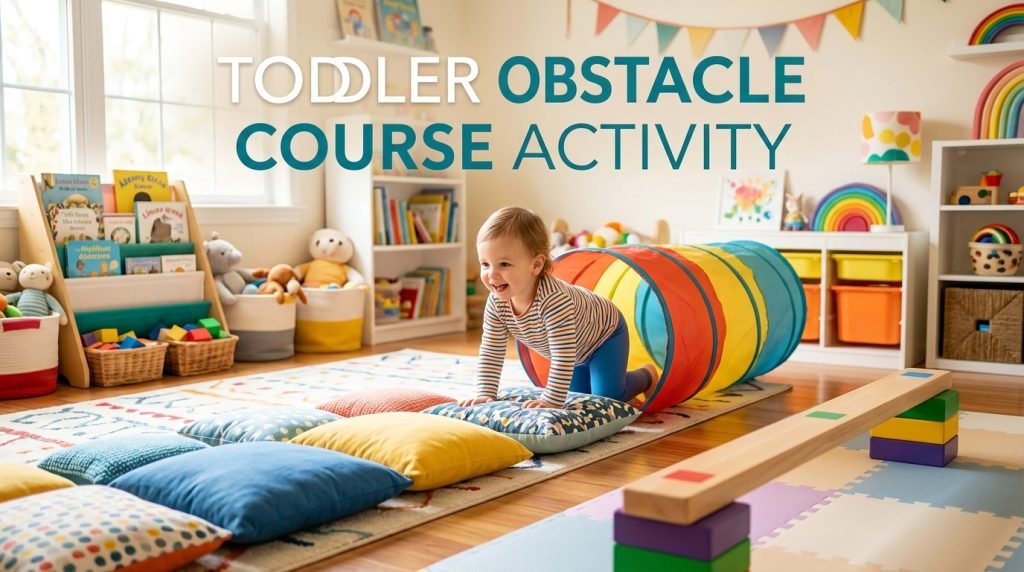
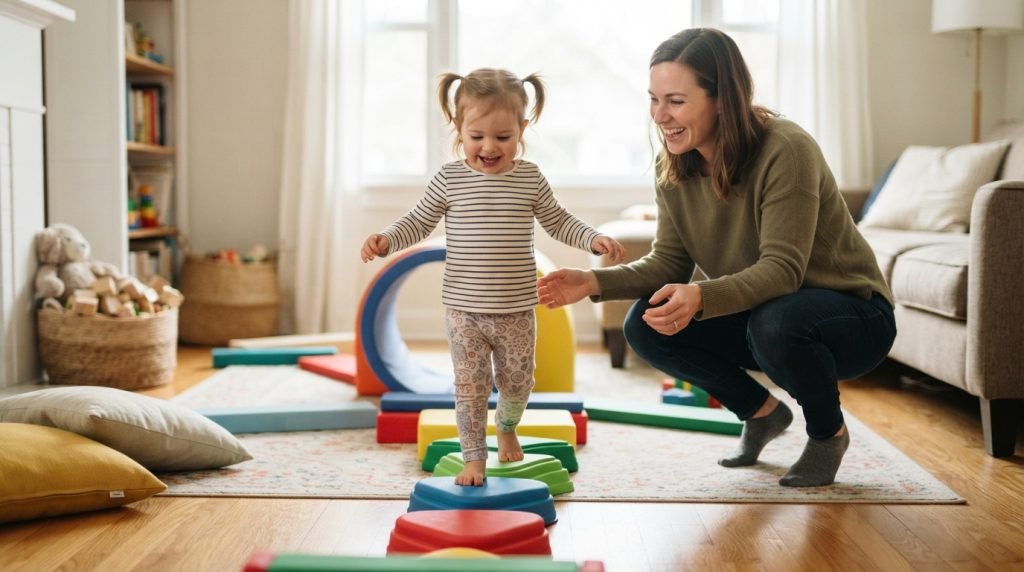
Short answer: a good indoor obstacle course for toddlers needs only four stations. Crawl through something, step over something, balance along a line, throw something into a basket. Use a blanket over two chairs, a row of cushions, a strip of painter’s tape and a laundry basket, and you are done in about four minutes. The bit most guides miss: match the stations to what your child can physically do. A 14 month old cannot jump, and jumping in place usually appears around age 2, so half the standard station list is wasted on a younger toddler. The World Health Organization recommends 180 minutes of physical activity a day for children aged 1 to 4, which is a lot to find indoors, and this is one of the better ways to bank a chunk of it.
An indoor obstacle course for toddlers is the highest-value rainy day activity there is, because it costs nothing, takes minutes to build, and works on the thing toddlers most need indoors, which is movement. The trick is choosing stations your child can actually complete, and that changes a lot between 14 months and three years.
Indoor Obstacle Course for Toddlers
How Much Movement a Toddler Actually Needs
The World Health Organization’s guidance for children aged 1 to 4 is at least 180 minutes of physical activity spread across the day, at any intensity, and it says more is better. Three hours.
The same guidance adds two things worth knowing. Children should not be restrained in a pushchair or highchair for more than an hour at a time. And sedentary screen time should be no more than an hour a day for 3 to 4 year olds, with less being better.
Three hours is a genuinely hard number to hit on a wet Tuesday in a flat. That is the actual case for an obstacle course. It is not an enrichment activity, it is a way of getting through a chunk of a requirement your child has, in a form they will voluntarily repeat.
Match the Stations to What They Can Actually Do
This is the part almost every obstacle course article skips, and it is why courses fall flat.
Gross motor skills arrive in a fairly predictable order. Around 15 to 18 months children start managing stairs with help and walking backwards. By 24 months most can run with the occasional tumble, kick a ball forward, jump in place or off a low step, throw overhand, and balance on one foot for a second or two.
So a jumping station is pointless at 14 months and satisfying at 26 months. A one-foot balance station is unreasonable before about two and a half. Crawling, on the other hand, works from the very beginning and never stops being fun.
The rule of thumb: include one station your child finds easy, two they can just about do, and one that is currently slightly beyond them. The easy one builds momentum, the middle two are the actual work, and the hard one is what they will come back to tomorrow. Individual children vary enormously, so use the bands below as a starting point and watch your own child rather than the label.
Stations for 12 to 18 Months
At this stage walking is still new. Keep everything low, and expect them to crawl parts of a course they could walk.
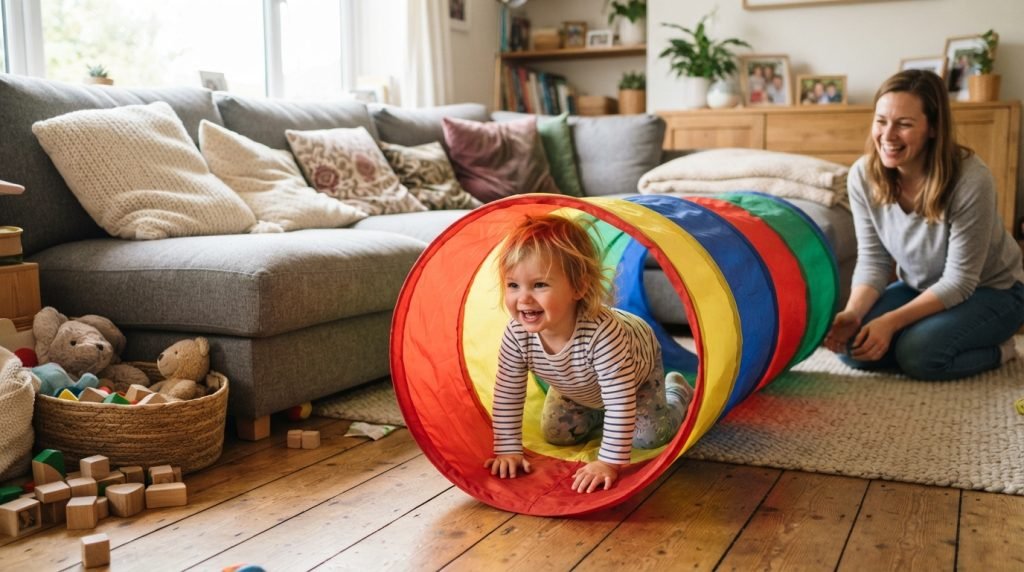
Blanket tunnel. A blanket over two dining chairs. The single best station at every age, and the only one you never outgrow.
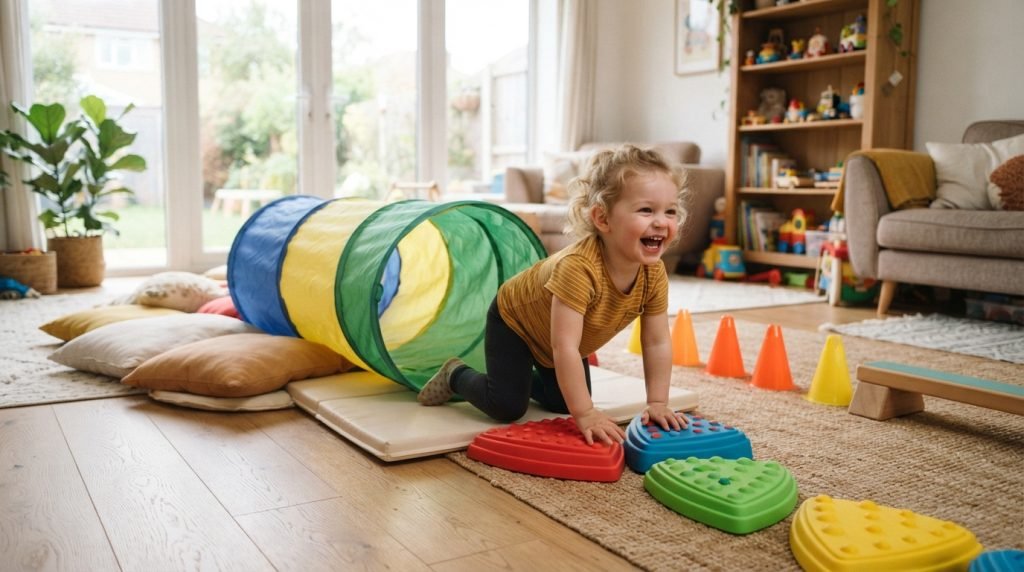
Cushion path. Sofa cushions laid flat in a line to walk or crawl across. Uneven surfaces are real balance work.
Step over the broom. A broom handle flat on the floor, or a rolled towel. Stepping over a low obstacle without looking down is a genuine skill at this age.
Basket drop. A laundry basket and some soft balls. Dropping in is the version they can do now. Throwing comes later.
Crawl up one stair and back down. With you beside them, on carpet. Stairs with assistance is exactly the 15 to 18 month milestone.
Stations for 18 to 24 Months
Walking is confident, running is arriving, and they can now follow a two-step instruction, which means the course can have a sequence.
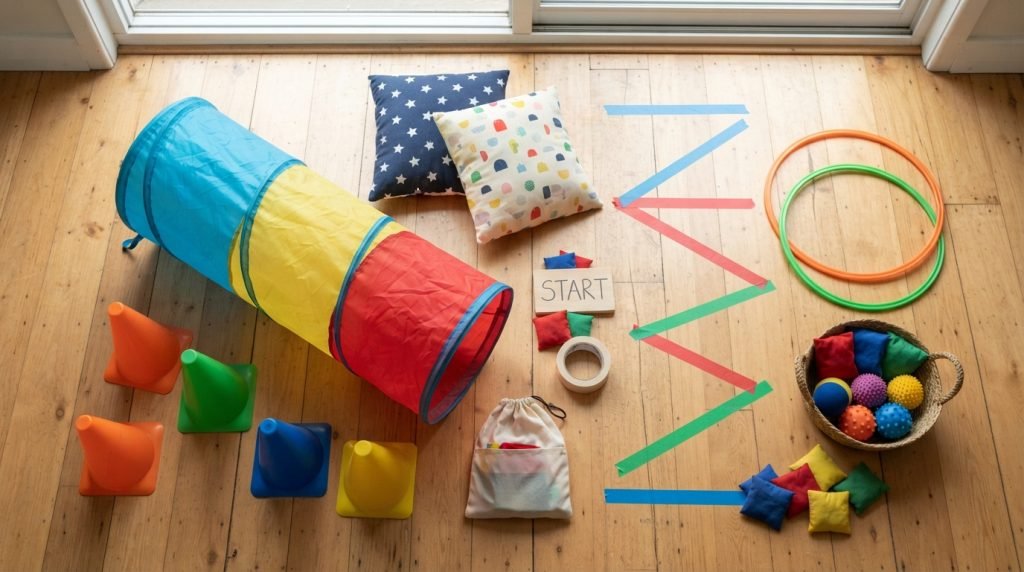
Tape line walk. A strip of painter’s tape on the floor to walk along. Start with a straight line, then try a wiggly one.
Cushion stepping stones. Cushions spaced so they have to step from one to the next rather than walk across.
Under the table, round the chair. Two instructions in a row. The sequencing is the point as much as the movement.
Carry the teddy. Complete the course holding something. Carrying an object while walking is harder than it sounds and it is good bilateral work.
Walk backwards to the door. Walking backwards appears around 15 to 18 months and toddlers find it hilarious.
Stations for 2 to 3 Years
Now you can add jumping, throwing and single-leg balance, and they will want the course to be harder.
Jump off the low step. One stair, or a sturdy low box, onto a cushion. Jumping off a low step is a 2 year old skill and it is usually the favourite station in the whole course.
Jump the river. Two lines of tape a hand’s width apart, jumped over. Widen it as they improve.
Overhand throw into the basket. Now they can actually throw rather than drop. Move the basket further away over time.
Balance on one foot at the flag. Two seconds is a success. Hold their hand at first.
Animal walks between stations. Bear walk, crab walk, bunny hops. This is the station that turns a course into a game and it stretches well past three.
Setting It Up When You Have No Space
Most guides assume a hallway and a playroom. If you have neither, this still works.
Go vertical instead of long. Four stations in one room beats eight in a house you do not have. Under the table, over the cushion, along the tape, into the basket.
Use the hallway as the whole course. A corridor is genuinely ideal. One tunnel at one end, a basket at the other, tape down the middle.
Make it a loop, not a line. A loop of three stations run four times gives you twelve station-completions in the same floor space, and toddlers love repetition anyway.
Build it on the sofa. Cushions off, climb up, slide down, crawl under the cushion pile. This is the classic for a reason.
Keep the kit in one bag. Tape, two soft balls, a small blanket. If setup takes more than four minutes you will stop doing it, and that is the real constraint.
Safety, Briefly and Properly
Nothing to climb above hip height. Theirs, not yours.
Check what is in the landing zone. The corner of a coffee table two feet from a jumping station is the actual hazard, not the jump.
Anchor or avoid tall furniture. If a station involves pulling on, climbing near or crawling under a bookcase or chest of drawers, tip-over is a real risk. Anchored furniture or a different station.
Bare feet or grippy socks, not smooth socks. Plain socks on a wooden floor undo everything else you have done.
Test the chair tunnel yourself. Push it. If the chairs slide when you lean on them, they will slide under a toddler.
Never a coffee table as a balance beam. Tape on the floor does the same developmental job at a tenth of the risk.
Stay in the room. Not supervising from the kitchen. This is a climbing and jumping activity.
Keeping It Interesting After Day Three
The honest failure mode is not safety or setup. It is that they love it twice and then ignore it.
Change one station, not the whole course. Familiarity is most of the appeal. Swap the basket for a bucket and it is a new course to them.
Let them build it. From about two and a half they will design a course, and theirs will be better attended to than yours.
Add a job. Deliver the post, feed the animals at each station, collect a block from each stop. A purpose beats a challenge at this age.
Time it, badly. Counting out loud while they go. Not a stopwatch, just your voice going up.
Do it with them. You crawling through the blanket tunnel is worth more than any station design.
Put it away and bring it back in a fortnight. Rotation works on courses exactly as it works on toys.
Frequently Asked Questions
How do you make an obstacle course for a toddler?
Pick four stations: something to crawl through, something to step over, something to balance along, and something to throw into. A blanket over two chairs, a rolled towel, a strip of painter’s tape and a laundry basket will do all four. Keep setup under four minutes so you will actually repeat it.
How much exercise does a toddler need?
The World Health Organization recommends at least 180 minutes of physical activity a day for children aged 1 to 4, at any intensity, spread through the day. It also advises against restraining a child in a pushchair or highchair for more than an hour at a time.
What age can a toddler do an obstacle course?
From about 12 months, as soon as they are moving confidently. Keep it to crawling, stepping over low objects and dropping balls into a basket at that age. Jumping and throwing stations make sense from around 2, since jumping in place usually appears around then.
Can I do this in a small flat?
Yes, and a hallway is close to ideal. Use three stations in a loop and run it several times rather than trying to build a long course. Cushions off the sofa, tape on the floor and a basket at the end need almost no floor space.
My toddler loses interest halfway through. Is that normal?
Completely. Two year olds are not doing a circuit, they are doing whichever station they like. Let them repeat the tunnel eleven times and ignore the rest. The movement is the goal, not the sequence.
Is it better to do this outside?
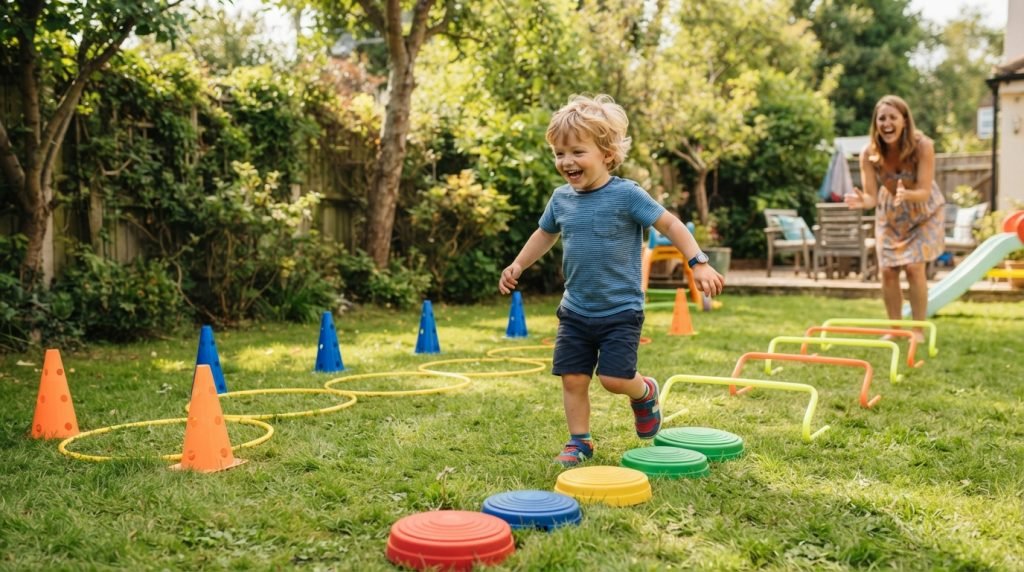
Outside is great when you have it, and you can add cones, hula hoops and stepping stones. But the search for an obstacle course usually happens because going outside is not an option, and indoors is where the harder problem is. Everything above works in a living room.