
Short answer: First Orchard by HABA is the one to buy first. It is genuinely rated for age 2, everyone plays on the same side, and nobody loses. The filter that matters more than the age on the box: can your child lose this game? If yes, it is not a two year old’s game, whatever the packaging says. At 2, children are in what psychologists call parallel play. Following rules, taking turns and coping with losing usually arrive between 4 and 5. So a board game at this age is really a set of appealing pieces plus a grown-up narrating whose turn it is, and that is fine. Judge it on the pieces.
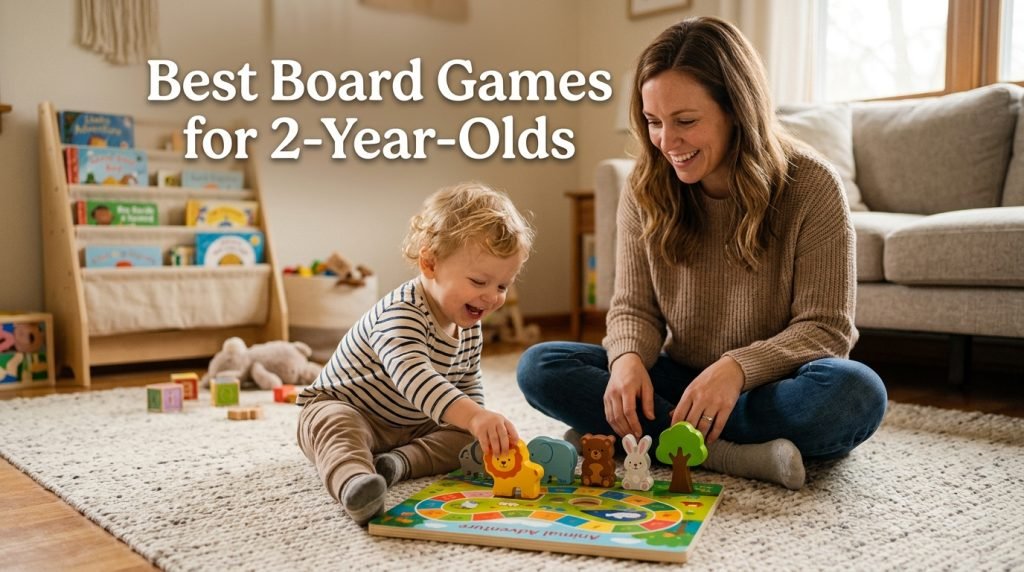
Most lists of board games for toddlers have a problem you can check in thirty seconds: they recommend games whose own boxes say 3+ or 4+. This page separates the ones actually rated for age 2 from the ones everybody recommends anyway, and says which is which.
Board Games for Toddlers
Can a 2 Year Old Really Play a Board Game?
Yes, but not in the way you are picturing, and knowing the difference will save you money.
In the standard account of how children’s play develops, a 2 to 3 year old is in parallel play. They play happily alongside you, in the same space, with the same objects, but not really with you in a coordinated way. Cooperative play, which is where following agreed rules, waiting your turn and handling losing all live, usually shows up around 4 to 5.
A board game asks for cooperative play. Your two year old has parallel play. That mismatch is the whole story, and almost every disappointing game purchase for this age comes out of it.
What that means practically is that at 2, the box is not really a game. It is a die that is satisfying to throw, some wooden fruit that is satisfying to pick up, and you saying whose turn it is. The turn-taking is being modelled by you rather than performed by them. That is genuinely valuable, and it is also completely different from playing a game.
The One Question That Sorts Good From Wrong
Before you look at the age on the box, ask this: can my child lose this?
If a game has losing in it, it needs a child who can be disappointed and carry on. That is a four year old skill. If a game has no losing, everything else about it is negotiable.
This is not a theory I invented. Look at Peaceable Kingdom’s range and you can see it in the design. Their games for the youngest players appear to have removed winning and losing altogether, while games that are otherwise just as simple get a 3+ rating the moment your team can fail. One reviewer noticed exactly this about their game Friends and Neighbors, which is a very easy matching game but is rated 3+, and reasoned that it is because the team can lose.
So the hierarchy of what to look for at 2, in order:
- No losing. Cooperative, or no win condition at all.
- Big pieces worth handling. Wooden fruit, chunky animals, a soft die. The pieces are the actual attraction.
- Under ten minutes. Not fifteen. Not ‘a short game’. Ten.
- One rule, not three. Roll, then take the thing that matches. That is the ceiling.
- Movement, if your child does not sit. Some of the best games for this age are barely board games and involve hopping.
- No small parts, given plenty of two year olds still mouth things.
Why Most Toddler Game Lists Recommend the Wrong Games
Because nobody checks the box. I include the earlier version of this page in that, and it is worth being specific about what was wrong with it, because the errors are the standard ones.
It recommended five games to parents of two year olds. Count Your Chickens is rated 3+ by Peaceable Kingdom. Busy Busy Bake Shop is rated 4+, is a game about placing four donuts in a row before a mouse steals them, and was described here as a game about collecting ingredients before closing time, which is not what it is. And My First Animal Lotto could not be confirmed as a real product under that name at all. There are several animal lotto games from different publishers, but not one by that title.
Only First Orchard was correct. That is the pattern across this whole category: plausible-sounding titles, unchecked ages, descriptions written from the name rather than from the game.
So the practical advice is: check the publisher’s own listing before you buy. Retailer age labels get copied around and go stale, and the age on the box is the only one the designer chose.
Confirmed for Age 2
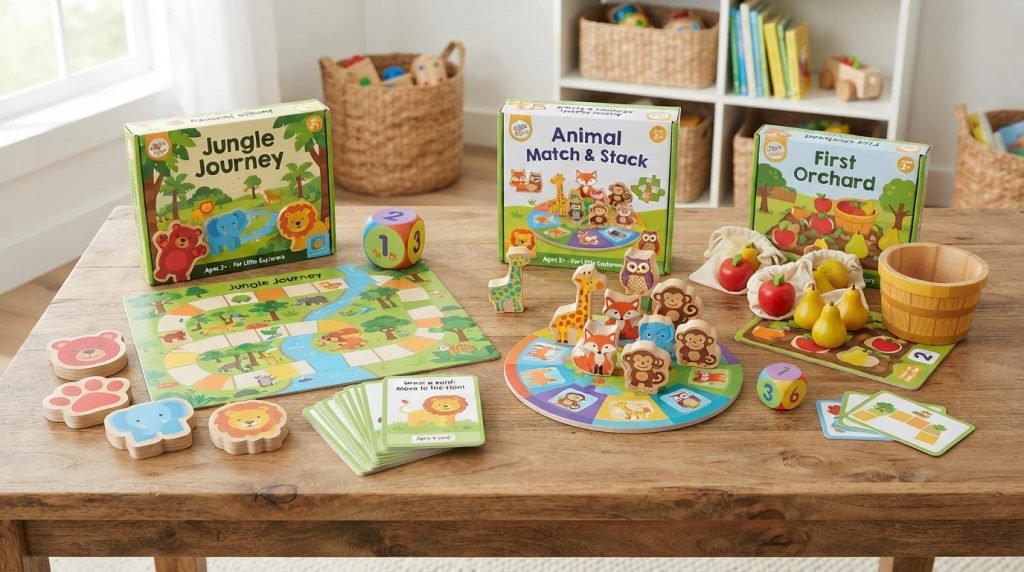
Publisher age ratings confirmed for these. This is the safe list.
- First Orchard by HABA (My Very First Games, age 2+, 1 to 4 players, around 10 minutes). Roll the die, pick that colour of fruit off a tree. Roll the raven and it moves one step closer. Everyone harvests together before the raven arrives, so the game is the opponent and no child loses. Chunky wooden fruit that is a pleasure to hold. If you buy one game at 2, buy this one.
- Monkey Around by Peaceable Kingdom (movement game, no losing). Cards prompt physical silliness: hop, walk backwards, walk on tiptoes, be an animal. Perfect for a child who will not sit at a table, and it works up to about 4, so it stretches. Widely described as usable slightly before 2.
That is a short list, and the shortness is the honest answer. Two really solid, genuinely age-2 board games is roughly what exists. Everything below is either commonly recommended at 2 without a confirmed rating, or is a good game to own for later.
Commonly Recommended at 2, Check the Box
These come up constantly on parent lists for two year olds and by all accounts play well at that age. I have not confirmed each one’s official rating against the publisher, so check before you buy. Descriptions are of how the games actually work.
- Roll and Play by ThinkFun. A large soft fabric die and colour-matched action cards. Roll, draw the matching colour, do the thing. Frequently named the single best first game for this age, and the soft die is the right object for a toddler.
- Here, Fishy, Fishy! by Peaceable Kingdom. Roll a colour, catch that colour fish with a little rod, earn a puzzle piece. Colour matching plus real fine motor work plus a fishing rod, which is most of what a two year old wants. Reviewers commonly ignore the wrong-colour penalty, which tells you the rules are looser than the box.
- Acorn Soup. Match the recipe card, spoon the tokens into the pot, count and sing. Excellent for one-to-one correspondence and it doubles as pretend play. One warning worth knowing: missing pieces appear to be a recurring complaint, so open it before you wrap it as a gift.
- Where’s Bear? One person stacks and hides the bear, the other finds it. Several ways to play, lots of language, and it works with mixed ages, which matters if you have two children.
- The Happy Marshmallow Game. Draw a card, pick the matching marshmallow, thread it on a stick, then roast them all on the fire at the end. Colour matching, fine motor, and a pretend-play finish. Good for a child who needs help getting into imaginative play.
- Get Up for Pup. Colour matching plus movement, with the dogs scattered around the room so it gets them going. Another one for the child who will not stay at a table.
Worth Buying, But Wait
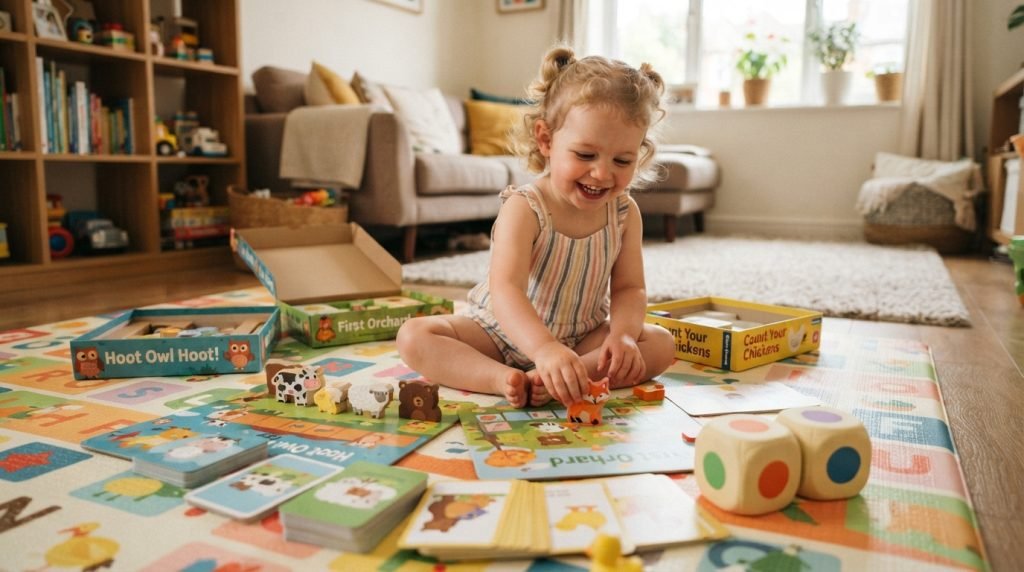
These are good games. They are just not two year old games, and buying them now means they sit in a cupboard while your child is not ready and are forgotten by the time they are.
- Count Your Chickens by Peaceable Kingdom (rated 3+, 2 to 4 players). Cooperative counting, help the hen gather her chicks. Buy it at 3, and it is a genuinely lovely first counting game.
- Friends and Neighbors by Peaceable Kingdom (rated 3+). Simple matching about helping people and naming feelings. Mechanically easy enough for a 2 year old, but the team can lose, which is the reason for the rating.
- Don’t Break the Ice (rated 3+). Fiddly to set up and you will be doing all of it, but the tapping is very satisfying. Reasonable to try slightly early.
- Busy Busy Bake Shop by Peaceable Kingdom (rated 4+, 2 to 5 players). Throw the dice, use tongs to place wooden donuts, get four in a row before the mouse swipes them. The tongs are lovely fine motor work but this is a 4 year old’s game and it was wrongly listed here for 2 year olds before.
- Building Site by HABA. Fair warning: at least one experienced reviewer found it complicated and boring and gave it away. Worth borrowing rather than buying.
HABA or Peaceable Kingdom?
These two publishers make most of the good games at this age, and they are not interchangeable.
- Peaceable Kingdom is the better first purchase. Their youngest range appears to have no winning or losing at all, and the games lean towards movement, matching and cooperation. Start here for a child who has never played a game.
- HABA is generally a step more demanding, with slightly more structure and a little more to grasp. First Orchard is the exception and the best entry point in their range. Come here once your child has enjoyed a Peaceable Kingdom game.
That distinction is not marketing, it is a real difference in design philosophy, and it is the most useful thing to know before you spend anything.
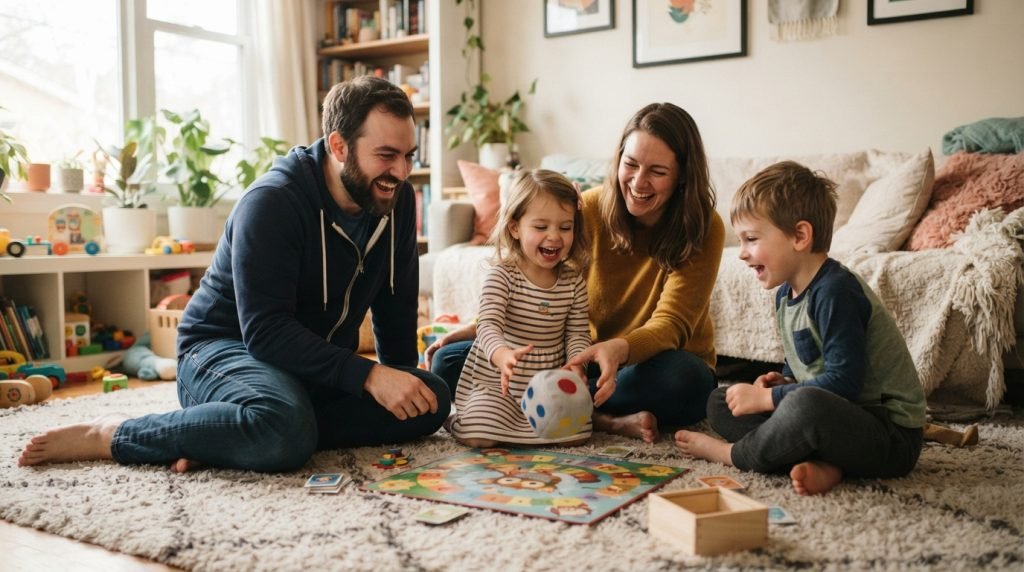
Playing Without It Collapsing
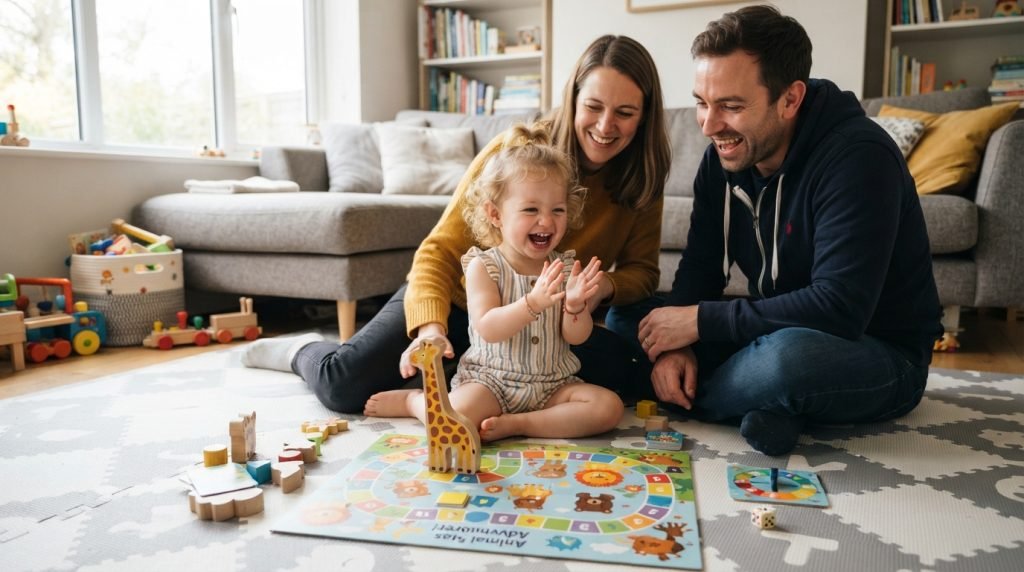
- Introduce it one to one first. If you have an older child, teach the two year old alone before you all play, or the older one will spend the first game watching you explain things.
- Change the rules freely. Drop the penalty, drop the scoring, drop the win condition. The published rules were written for the top of the age range.
- Do not track who wins. There is no benefit at 2 and a real cost.
- Stop while they are still enjoying it. Mid-game, on a good turn. Ending early is what makes them ask again tomorrow.
- Narrate the turn-taking rather than enforcing it. ‘My turn, then your turn’ out loud, every time. That is the actual lesson, and it takes months.
- Keep it out of reach between games. Not because of tidiness. Because a game with pieces missing stops being playable, and at 2 the pieces go everywhere.
- Expect a good week and a bad week. Two year olds change fast. A game that flopped in March can be a favourite in May.
When They Only Want to Play With the Pieces
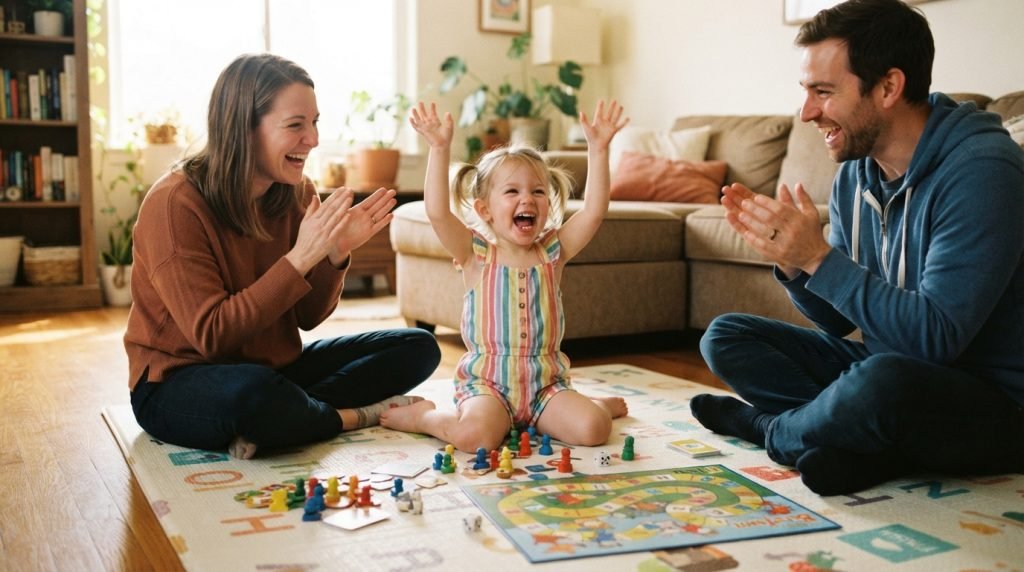
This is the most common outcome and it is not a failure.
Your child will tip out the wooden fruit and sort it, or put every marshmallow in the pot and stir, or line the fish up in a row. They will not roll the die. They will not wait for you. And that is a perfectly good use of the toy.
Sorting by colour, filling and emptying, one-to-one matching and pretend cooking are exactly the things a two year old is built to practise. The game is just a nicely made set of materials for doing them. Let it happen, join in on their terms, and try the rules again in a few weeks. Nothing is being wasted.
If it helps, reframe the purchase. You are not buying a game your child will play. You are buying a good set of pieces that will one day become a game.
Frequently Asked Questions
Can a 2 year old play board games?
Yes, with adjustments. At 2 children are in parallel play, so they will play alongside you rather than truly with you, and you will be doing the turn-taking on their behalf. Choose cooperative games with no losing, keep it under ten minutes, and expect them to sometimes just play with the pieces.
At what age can kids play board games properly?
Following rules, taking turns and coping with losing generally arrive between 4 and 5, when cooperative play develops. Before that, games work best when nobody can lose. Simple competitive games become realistic around 4.
What is the best first board game for a toddler?
First Orchard by HABA. It is rated 2+, everyone plays against the game rather than each other so no child loses, the wooden fruit is satisfying to handle, and it takes about ten minutes. If your child will not sit still, choose Monkey Around by Peaceable Kingdom instead.
How do you teach a toddler to take turns?
By saying it out loud every single time, for months. ‘My turn, then your turn.’ Do not enforce waiting, model it. Cooperative games help because there is nothing to lose by waiting. Reliable turn-taking is a four year old skill, so patience with the timeline matters more than any technique.
Are cooperative games better for toddlers?
Yes, clearly, at this age. A cooperative game has no losing, so it removes the one demand a two year old genuinely cannot meet. Peaceable Kingdom’s youngest range appears to have dropped winning and losing entirely, and HABA’s First Orchard has everyone harvesting together against the raven.
Why do game lists recommend games rated for older children?
Because the age on the box often goes unchecked, and retailer listings copy each other. Several games that appear on almost every two year old list are rated 3+ or 4+ by their own publishers. Check the publisher’s own page before buying, since that is the rating the designer chose.