
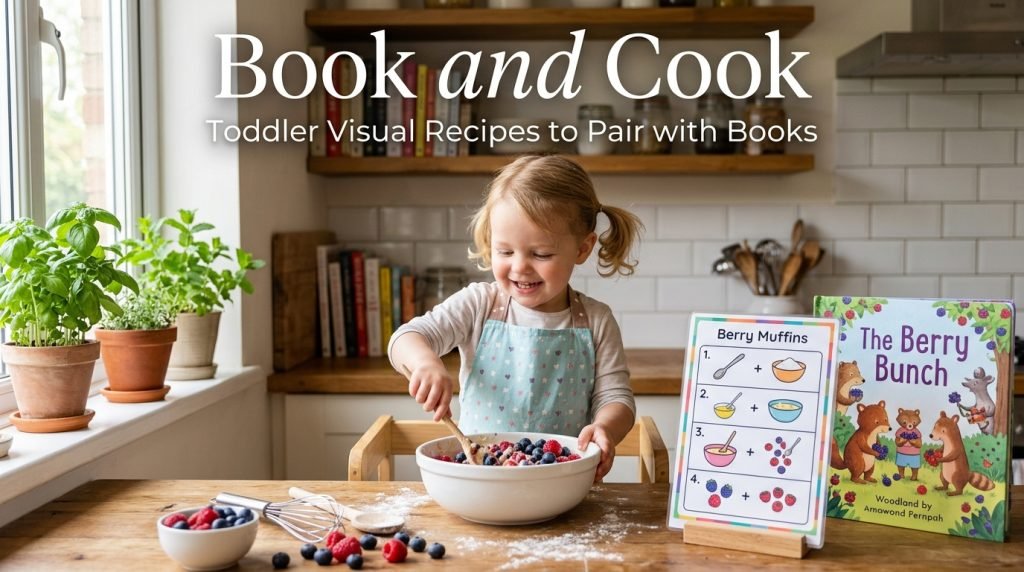
Short answer: read the book first, then cook one thing from it, and keep the whole session under twenty minutes. The three easiest pairings to start with are The Very Hungry Caterpillar by Eric Carle with a fruit plate, Thundercake by Patricia Polacco with the cake whose recipe is printed in the back of the book, and Soup Day by Melissa Iwai with vegetable soup. The safety rule that matters most: the American Academy of Pediatrics says to cut food for young children into pieces no larger than half an inch, and to keep high-risk foods away until at least four. That rules out several of the snacks these activities are usually built around, including whole grapes, raw carrot sticks, cheese chunks, nuts and popcorn.
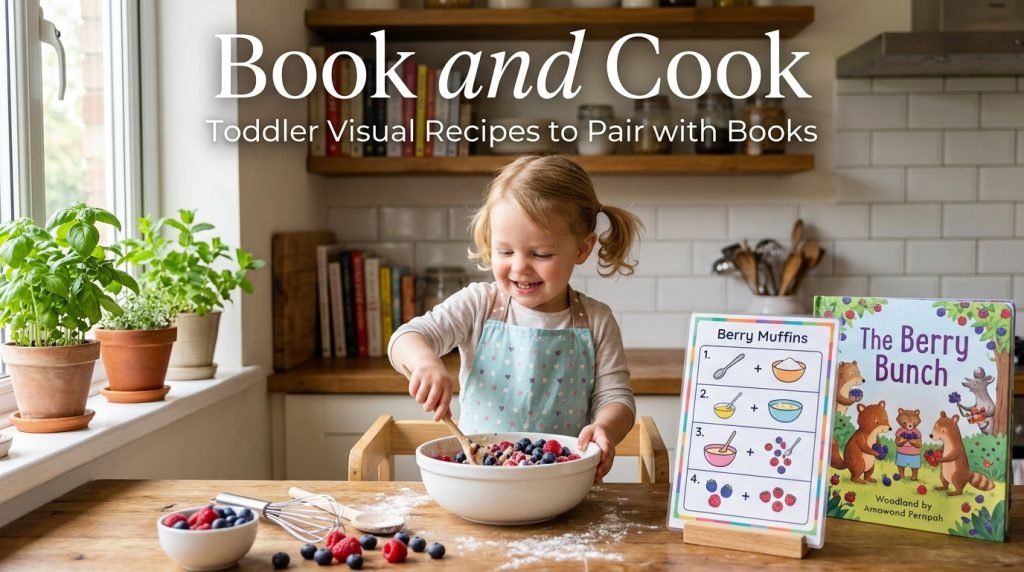
Almost every list of cooking activities with books for kids is a list of cute ideas with no ages, no recipes and no safety information at all. Some of the most-shared suggestions online involve feeding raw carrot, whole grapes or gummy sweets to two year olds, which is exactly what paediatricians tell you not to do.
This page does it the other way round. Safety first, then what your child can actually manage at their age, then the books, then four visual recipes you can copy.
Cooking Activities With Books for Kids
What a Visual Recipe Actually Is
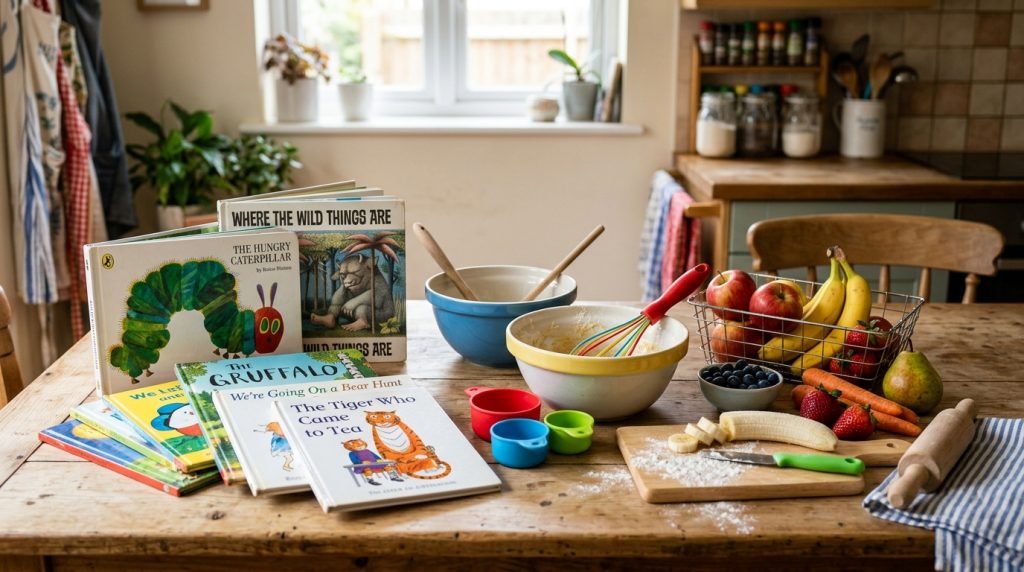
A visual recipe is a recipe card that uses pictures instead of words, so a child who cannot read yet can follow the steps without an adult reading each one aloud. One step per row, one picture per step, in order.
The idea did not come from parenting blogs. It comes from special education and speech and language therapy, where picture-based supports are used with children who are pre-literate or non-speaking. Visual supports in that field have a solid evidence base for reducing anxiety and increasing independence. Whether they measurably help a typically developing three year old is not something anyone has tested, so treat it as a sensible borrowed technique rather than a proven intervention.
The reason it works in practice is simple. Without a card, your child is waiting for you to say the next instruction, and the activity is yours. With a card, they can see what comes next, and the activity becomes theirs.
To make one:
- Three to five steps, no more. A twelve-step card is a card nobody finishes.
- One picture per step, in a vertical column, numbered.
- Photograph your own ingredients rather than using clip art. Your bowl, your spoon, your kitchen. Children recognise their own things.
- Show quantities as objects, not measurements. Three strawberries, not 40 grams. Two spoons of yoghurt, and use the actual spoon in the photo.
- Laminate it, or slide it into a plastic sleeve. It will get wet on the first attempt.
- Put it at their eye level, propped against something, not flat on the counter where it disappears under a bowl.
The Foods to Leave Out, and This Part Matters
Choking is a leading cause of death in young children. Most children who die from choking are under five, and around two thirds are babies under one. That is the reason this section comes before the fun part rather than after it.
The American Academy of Pediatrics advises keeping high-risk foods away from children until at least four years old, and cutting everything else into pieces no larger than half an inch. Round, firm foods such as grapes and hot dogs can be served, but only if chopped completely.
The AAP avoid-or-modify list for young children:
- Whole grapes (quarter them lengthwise)
- Raw vegetables such as carrot sticks (cook soft, or grate)
- Raw fruit chunks such as apple pieces (grate, or cook soft)
- Nuts and seeds, sunflower seeds especially
- Thick chunks of nut butter (spread thinly instead)
- Popcorn
- Chunks of cheese and string cheese
- Chunks of meat, meat sticks and sausages, hot dogs
- Hard, gooey or sticky sweets, and marshmallows
- Chewing gum
Look down that list and then look at the snacks these activities usually suggest. Veggie faces made with raw carrot and cubes of cheese. Apple rings topped with seeds. Grape caterpillars. Bear caves built from nut butter with a gummy bear on top. All of them are extremely popular, all of them are aimed at toddlers, and all of them contain something off that list.
Three more things worth knowing:
- Do not let them taste raw dough or batter. This is the one that surprises people, because licking the spoon is half the appeal of baking with a child. Raw flour can carry E. coli and raw egg can carry salmonella. The CDC is unambiguous about it, and young children are among those most at risk of the serious kidney complication that can follow an E. coli infection. If you want a lickable version, use a no-bake recipe or heat-treat the flour first.
- Ask about allergies before other children are involved. If the activity is a playdate or a group, ask first, and be careful with anything containing nut butter, egg or sesame.
- Keep the heat entirely yours. Frying, boiling and the oven are adult jobs, whatever the recipe says. Your child can do everything up to the point where it gets hot.
What Your Child Can Actually Do, by Age
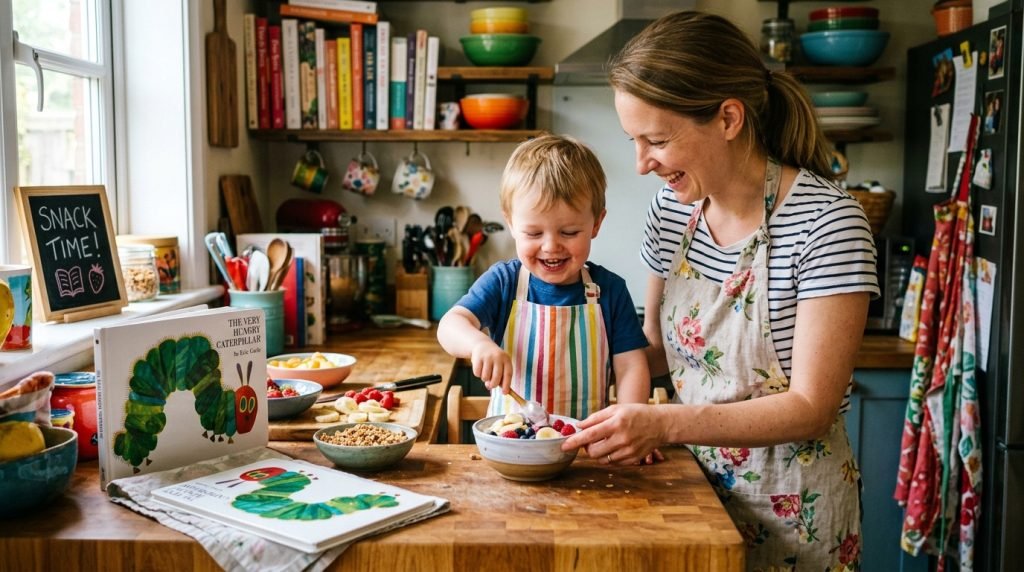
These bands come from extension-service and public-health guidance rather than from any single authority, and every list phrases them slightly differently. Treat them as a starting point and judge your own child, who may be ahead or behind on any given skill.
Two to three years old. Washing fruit and vegetables. Tearing lettuce and herbs. Stirring dry ingredients or thin batter. Pouring from a small jug. Spreading soft things with a butter knife. Mashing cooled cooked fruit or vegetables. Shaking something in a sealed container. Pressing cookie cutters. Tasting, smelling and handling ingredients, which is genuinely the point at this age.
Three to four years old. Everything above, plus measuring with cups and spoons, cutting soft food such as banana or cooked potato with a child-safe knife, whisking, and pouring into wide-mouthed containers.
Four to five years old. Everything above, plus a serrated child knife on flat firm food, a peeler, a grater, a hand mixer with you next to them, and a heat source at a low surface with close supervision.
On knives, one honest note. You will find popular Montessori posts encouraging real metal knives for two year olds. I would not, and the mainstream guidance does not. A nylon serrated child knife or a wavy crinkle cutter will cut a banana perfectly and will not open a finger. The developmental gain is in the cutting motion, not in the sharpness of the blade.
14 Books and What to Cook With Them
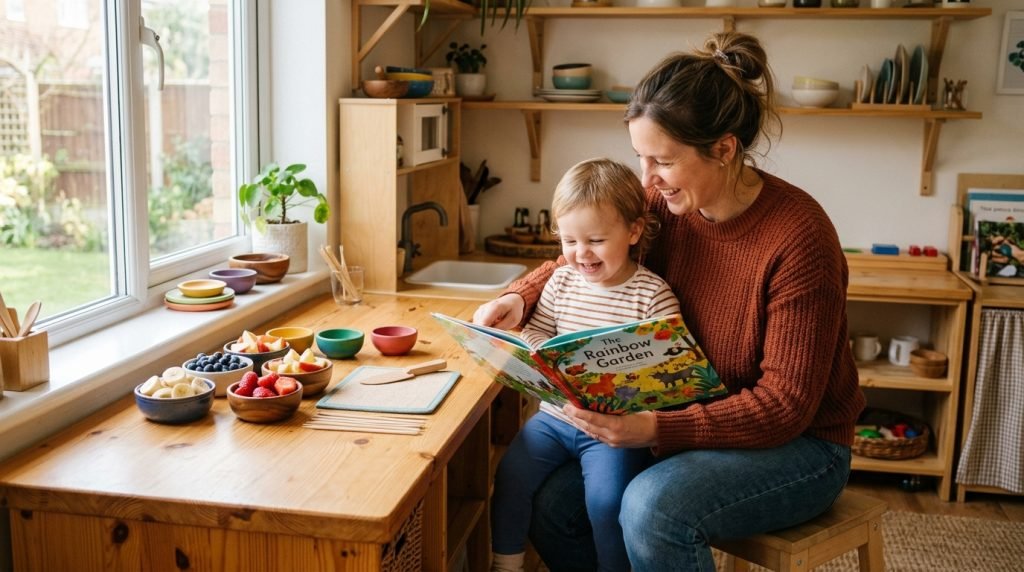
Authors named, because a list without authors is a list you cannot actually use in a library. Worth checking editions and authors yourself before you buy.
- The Very Hungry Caterpillar by Eric Carle. A fruit tasting plate using the fruits in the book. Quarter the grapes, grate the apple. The obvious starting point and none the worse for it.
- Soup Day by Melissa Iwai. Vegetable soup, and the recipe is printed in the back. Your child scrubs and chops the soft vegetables, you do the pot. Excellent for naming shapes as you cut.
- Thundercake by Patricia Polacco. A grandmother helps a child through a fear of thunderstorms by baking. Recipe in the back. Sifting flour is the job most children want.
- Fry Bread by Kevin Noble Maillard. Recipe in the back. Children make and shape the dough, the adult does all the frying, no exceptions.
- Round as a Tortilla by Roseanne Thong. Quesadillas. Assembling their own is the whole appeal, and it doubles as a shapes activity.
- Blueberries for Sal by Robert McCloskey. Blueberry yoghurt. For under-fours, squash the blueberries into the yoghurt rather than leaving them whole and round.
- Bread and Jam for Frances by Russell Hoban, illustrated by Lillian Hoban. Bread and jam, obviously, but the book is really about a child who refuses to eat anything else, which makes it the best read-aloud on this list for a fussy eater.
- Pancakes, Pancakes! by Eric Carle. Pancakes from scratch. The book walks through every ingredient’s origin, so it is a whole food-systems lesson disguised as breakfast.
- Dim Sum for Everyone by Grace Lin. Dumplings. Folding wrappers is superb fine motor work. Be realistic about time.
- Lemons Are Not Red by Laura Vaccaro Seeger. Hand-squeezed lemonade. One of the best practical life activities there is, and a citrus squeezer is a toddler’s favourite tool.
- Stone Soup, several versions, Marcia Brown’s being the classic. Everyone contributes one vegetable to a shared pot. The best of these for a group or a nursery.
- Green Eggs and Ham by Dr. Seuss. Scrambled eggs coloured with a little spinach blitzed in. Adult cooks, child stirs and is delighted.
- Dragons Love Tacos by Adam Rubin, illustrated by Daniel Salmieri. Taco assembly. The book’s salsa joke gives you a natural way to talk about tasting something new.
- If You Give a Mouse a Cookie by Laura Numeroff, illustrated by Felicia Bond. Cookies. The most common pairing on the internet. Read the raw dough warning above before you do this one.
Three Books With the Recipe Printed Inside
This is the most useful category and almost nobody groups it. When the recipe is in the book, reading and cooking stop being two activities you have joined together and become one thing. You turn to the back page, and the story tells you what to do next.
- Thundercake by Patricia Polacco. Recipe at the back.
- Fry Bread by Kevin Noble Maillard. Recipe at the back.
- Soup Day by Melissa Iwai. Recipe at the back. There is also Pizza Day by the same author.
Those three are confirmed. There are certainly more, and it is worth asking your librarian, because it is a category almost no publisher advertises on the cover.
Four Visual Recipes to Copy
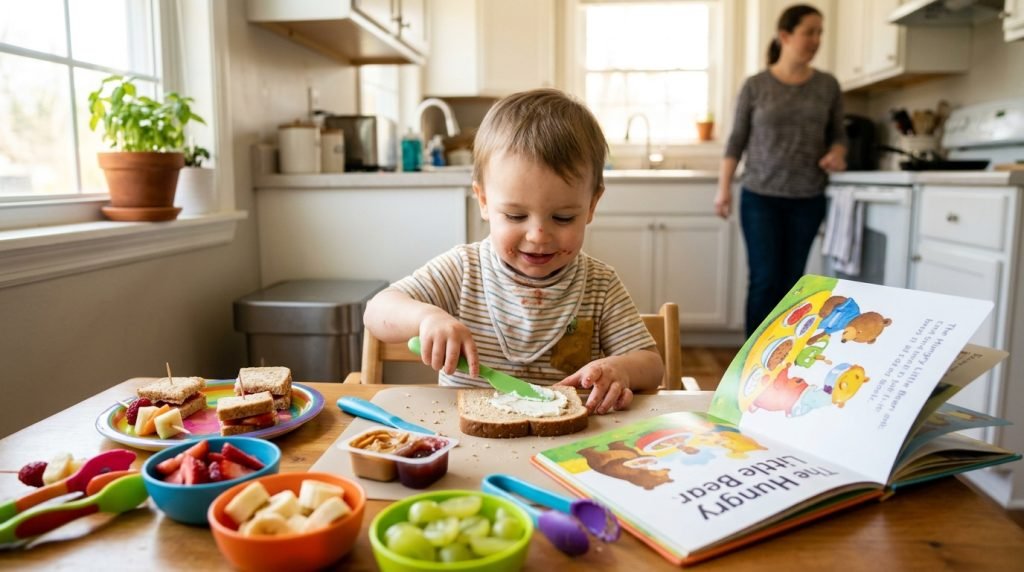
Photograph each step with your own equipment and put the pictures in a numbered column. These four are deliberately short, safe for under-fours, and involve no heat and no raw dough.
1. Caterpillar Fruit Plate for The Very Hungry Caterpillar
- Wash the strawberries.
- Grate one apple.
- Quarter four grapes the long way.
- Arrange in a line.
- Add two raisins for eyes.
2. Bear Toast for any bear book
- Spread the toast thinly with cream cheese.
- Cut two banana slices for ears.
- Add three blueberries, squashed flat, for eyes and nose.
3. Squashed Berry Yoghurt for Blueberries for Sal
- Spoon two spoons of yoghurt into the cup.
- Add six blueberries.
- Squash them with the back of the spoon.
- Stir until it turns purple.
4. Everybody’s Soup for Stone Soup
- Scrub one potato.
- Cut it with your child knife.
- Put it in the bowl.
- Do the same with a carrot.
- Give the bowl to your grown-up to cook.
Note what the last step of the soup card does. It hands the heat over explicitly, as part of the recipe, so the boundary is built into the activity rather than being a rule you enforce.
Does It Really Help With Picky Eating?
Partly, and less than you will read elsewhere. Every page on this subject claims cooking together fixes fussy eating. The evidence is more interesting than that.
What is well supported: children eat more of a food they helped prepare, in that sitting. In a 2014 study in Appetite, 47 children were given the same lunch, half having helped cook it. The children who cooked ate 76 percent more salad, 27 percent more chicken and about 24 percent more calories. They also reported feeling more positive and more in control afterwards, which is arguably the more important finding.
Two honest caveats on that study. The children were six to ten years old, not toddlers, so you cannot straightforwardly apply the numbers to a three year old. And the research was carried out at a Nestlé research centre, which does not make it wrong but is worth knowing.
What is not well supported: that this durably changes what your child is willing to try. A 2024 systematic review of 23 children’s cooking programmes found that of the seven studies measuring willingness to taste the foods being taught, only two showed a significant improvement. The other five found nothing. On liking specific foods, four of eleven found an effect.
So the honest version is this. Cooking together reliably gets more food eaten today and reliably makes your child feel capable. It is a decent bet, not a cure, for fussy eating. If a parent has been told cooking together will fix a fussy eater and it does not, they conclude they have failed at something that was oversold to them. Which is why it is worth saying plainly.
Running the Session Without It Falling Apart
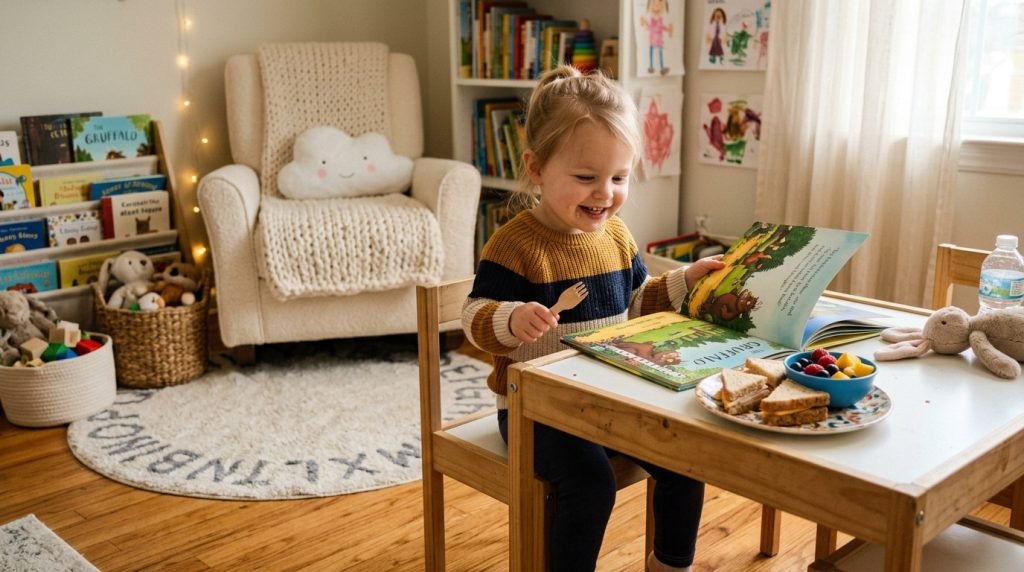
- Read the book first, all the way through. Do not stop to explain the cooking. The story is not a preamble to the activity.
- Prepare everything before you call them in. Ingredients out, measured, in small bowls. The single biggest cause of a session going wrong is a child waiting while you rummage.
- Twenty minutes, maximum. Under-fours are done well before you are.
- One job that is entirely theirs. Not a share of every job. One thing they own start to finish.
- Expect it to be wrong and leave it wrong. A lopsided caterpillar made by your child is worth more than a straight one you corrected.
- Let them not eat it. Handling and smelling a new food is a real step, and demanding a bite at the end turns the whole thing into a negotiation. New foods often need many exposures before a child will try them.
- Clean up together, briefly. Two minutes with a small cloth. It is part of the activity, not a punishment after it.
Frequently Asked Questions
What can a 3 year old do in the kitchen?
A three year old can wash produce, tear herbs and lettuce, stir, pour from a small jug, spread with a butter knife, measure with cups and spoons, and cut soft food such as banana or cooked potato with a child-safe knife. Heat, sharp blades and raw dough stay with the adult.
How do you combine reading and cooking with kids?
Read the book through first, then cook one simple thing from it, ideally with a picture-based recipe card so your child can follow the steps without being told each one. Keep it to three to five steps and under twenty minutes. Books with the recipe printed inside, such as Thundercake or Soup Day, make this almost automatic.
Does cooking with kids help picky eaters?
It helps somewhat, and less than commonly claimed. Children reliably eat more of a dish they helped make at that meal, but a 2024 review of 23 cooking programmes found only two of seven studies showed a lasting improvement in willingness to taste new foods. Worth doing, but not a fix.
What foods should toddlers not help with?
Avoid or modify whole grapes, raw carrot sticks, raw apple chunks, nuts and seeds, popcorn, cheese chunks, marshmallows, sticky sweets and thick nut butter. The AAP advises keeping these from children until at least four, and cutting all food into pieces no larger than half an inch. Also skip raw dough and batter entirely, including tasting.
Can my child lick the spoon when we bake?
No. Raw flour can carry E. coli and raw egg can carry salmonella, and young children are at higher risk of serious complications. The CDC advises against tasting any raw dough or batter. If you want something lickable, choose a no-bake recipe or heat-treat the flour first.
What is a visual recipe?
A recipe card that uses photographs instead of words, one picture per step, so a child who cannot read can follow it independently. The technique comes from special education, where picture-based supports are well established. Use three to five steps, photograph your own kitchen, and show amounts as objects rather than measurements.