
Short answer: for a preschooler, the moon is the single best space topic, because it is the only part of space they can actually go outside and check. Start with Faces of the Moon by Bob Crelin or The Moon and You by E. C. Krupp. And here is the thing no other list mentions: a 2008 study analysed 772 moon illustrations across 80 children’s books and found one in five was scientifically wrong. Being shelved as nonfiction guarantees nothing. Also worth knowing: only 2 out of 32 kindergarteners in one study could name a single planet before being taught, so if your four year old cannot either, that is completely normal.
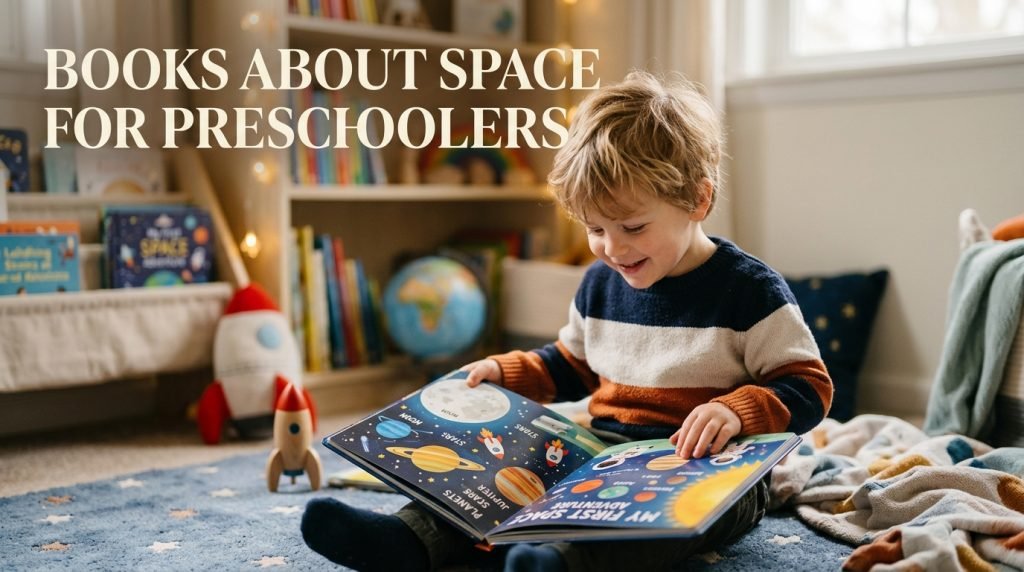
There are two kinds of space books preschool list online and neither does the other’s job. Preschool teacher blogs recommend books for being fun and colourful, and not one of them mentions whether the science is right. The Planetary Society has a list written by an actual planetary scientist that judges books almost entirely on accuracy, but it is written for space enthusiasts and has not been meaningfully updated in years.
This list does both. Eighteen books, each flagged fiction or nonfiction, with the known problems named rather than glossed over.
Space Books for Preschoolers
Should a Four Year Old Know the Planets?
No, and there is unusually clean evidence on this.
A 2021 study of 32 kindergarteners found that before any teaching, only 2 of them could name a single planet. Several offered their own town or school when asked to name one. Not one child could say where the Sun is at night. Twenty-five of the thirty-two thought the Sun was smaller than the Earth.
So if your child cannot recite the planets, they are entirely typical. Naming planets is rote vocabulary, not understanding, and there is a real difference. The same study is encouraging on the other side of the ledger: after proper teaching, those children reached around 85 percent accuracy. Astronomy is developmentally appropriate at four to six. Memorised planet lists are not the part that matters.
What Preschoolers Can Actually Grasp About Space
Worth knowing what the formal expectations actually are, because they are lower than most parents assume. In the US science standards, the earliest space content appears in first grade, and it asks only that children use observations of the sun, moon and stars to describe patterns. There is no solar system content at all until around fifth grade.
- Graspable now: the moon and that its shape changes. Day and night. That the Sun is a star. That stars come out at night. That the Sun moves across the sky. Rockets and astronauts as people who do a job.
- Graspable with help: that things look smaller when they are further away, which is the seed of everything about scale.
- Not graspable yet, and that is fine: why the moon has phases, which is formally a middle school topic and which plenty of adults get wrong. Gravity. What the Earth is made of. The solar system as a system.
The practical takeaway: the moon is the best subject for this age, because it is the one piece of space a child can go outside, look at, and check against the book. Everything else is taken on trust.
The Accuracy Problem Nobody Mentions
In 2008, researchers analysed 772 moon illustrations across 80 children’s books, including twenty years of Caldecott Medal winners. They found that 20 percent of the illustrations were scientifically wrong. Among crescent moons specifically, 32 percent were wrong. Among gibbous moons, 24 percent.
The most interesting finding was not the error rate but the pattern. Every single incorrect drawing was consistent with the belief that moon phases are caused by the Earth’s shadow falling on the moon. That is the single most common astronomy misconception there is, and children’s books are quietly reinforcing it, page by page.
The researchers’ own conclusion is worth quoting to yourself in a bookshop: being classified as nonfiction does not guarantee the content is accurate.
One more skew from that study: 52 percent of all moon images were full moons. A child reading widely would reasonably conclude the moon is usually round.
Beyond the moon, a few things are worth a sceptical glance, though I want to be straight that these are reasoned criticisms rather than counted findings, since nobody has run the equivalent study:
- The asteroid belt drawn as a dense field of tumbling rocks. In reality the average gap between mile-wide asteroids is around 1.9 million miles, roughly eight times the distance from Earth to the moon. About fifteen spacecraft have flown through without needing to dodge anything.
- The Sun coloured yellow. It is white. It looks yellow from the ground because of how our atmosphere scatters light, which is also why it looks orange at sunset.
- Planets drawn in a neat line at even spacing. They are essentially never aligned, and any diagram that fits on a page has compressed the distances by a factor of thousands.
None of this means throw the book away. It means the book is a starting point for a conversation, not an authority.
The Pluto Problem, and One Book to Check
Pluto was reclassified as a dwarf planet in 2006. Any book printed before then teaches nine planets, and plenty printed after do too, because reissues are not always updated.
This is a real enough problem that the standard US library weeding manual names it directly, warning that astronomy books listing Pluto as a planet open a credibility gap, and recommending that any astronomy book more than five years old be reviewed.
A specific warning, because this book appears on almost every preschool space list including the earlier version of this one. There’s No Place Like Space by Tish Rabe was originally published in 1999 and visits nine planets. A revised edition covering eight exists. If you buy it, check the edition, because the two are otherwise nearly identical and sold side by side.
The elegant solution to the whole issue is Pluto’s Secret by Margaret Weitekamp, which tells the reclassification as a story about science correcting itself. That is a better lesson than any planet list.
18 Space Books, With the Problems Flagged
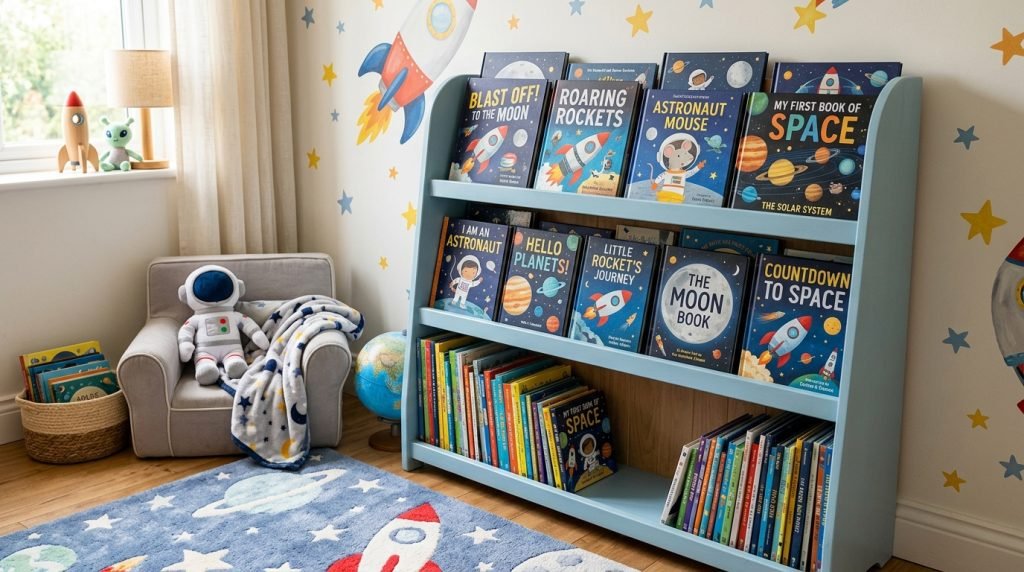
Publication years are approximate and worth checking, particularly on anything old enough to predate 2006.
Nonfiction, moon and stars first, since that is the graspable end:
- The Moon and You by E. C. Krupp. The one book in the 2008 study that scored 100 percent accurate across all eight phases. Older, and worth seeking out.
- Faces of the Moon by Bob Crelin. Die-cut pages that show the phases properly. The best moon book for this age.
- Twinkle, Twinkle, Little Star, I Know Exactly What You Are by Julia Kregenow. The nursery rhyme rewritten to be astronomically correct. Written by an astronomer, and genuinely funny.
- ABCs of Space by Chris Ferrie and Julia Kregenow. Alphabet format, real science underneath.
- Hello, World! Solar System by Jill McDonald. Board book, simple, and specifically endorsed by the planetary scientist whose list ranks on this SERP. A safe first buy.
- Earth! My First 4.54 Billion Years by Stacy McAnulty. Earth narrates its own history. There are Sun and Moon companions.
- Pluto’s Secret by Margaret Weitekamp. The reclassification, told as science working properly.
- Comets, Stars, the Moon, and Mars by Douglas Florian. Poems and collage. Beautiful and not dumbed down.
- The Moon Book by Gail Gibbons. Specify the revised edition, since the original is from the 1990s.
- National Geographic Little Kids First Big Book of Space by Catherine Hughes. Photograph-led, good for a child who wants real pictures.
- 8 Little Planets by Chris Ferrie. Eight, correctly, and the number is right there in the title.
Fiction, where there is essentially no astronomy to get wrong:
- The Darkest Dark by Chris Hadfield. An astronaut’s own story about being afraid of the dark. The best of the astronaut books.
- Mae Among the Stars by Roda Ahmed. Mae Jemison as a child. Quietly excellent.
- Astro Girl by Ken Wilson-Max. Warm, and the ending is better than you expect.
- Mousetronaut by Mark Kelly. Written by an actual astronaut. Fun rather than educational, which is fine.
- Touch the Brightest Star by Christie Matheson. Interactive night sky. Good for the youngest end.
- Roaring Rockets by Tony Mitton. Rhyming, energetic, for a three year old who wants noise.
- On the Launch Pad by Michael Dahl. A counting book with a rocket. Two subjects at once.
Two Beloved Books That Get the Moon Wrong
Both of these were named in the 2008 study, and I am not telling you to avoid them. I am telling you what to say while you read them.
Papa, Please Get the Moon for Me by Eric Carle. The crescents change size across the book, stars are visible through the unlit part of the moon, and a phase sequence on the title page runs backwards. The jacket describes the book as educationally sound. It is a wonderful book and the artwork is glorious. Read it, and when you go outside, notice together that you cannot see stars through the dark part of the moon.
Moonbear by Frank Asch. Contains a ‘three quarter moon’ that is actually drawn as a partial lunar eclipse, plus phases mislabelled in the text.
The useful framing for a child is not that the book is wrong. It is that books are made by people, people make mistakes, and the sky is always there to check against. That is a more valuable lesson than any fact about Jupiter.
How to Read a Space Book With a Preschooler
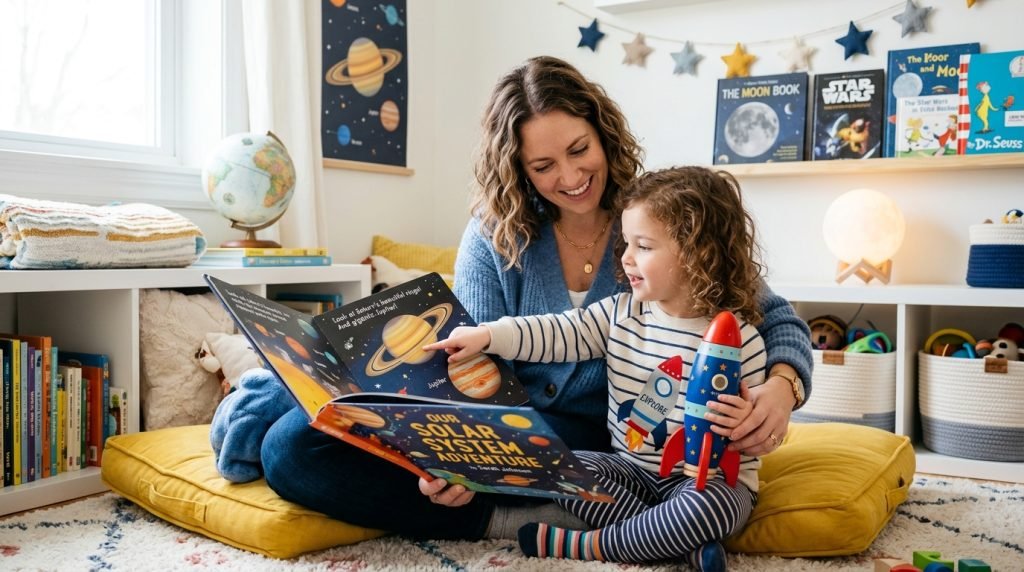
- Ask what they notice before you explain anything. Their observation is more useful than your fact.
- Say ‘let’s check tonight’ whenever possible. It turns the book into a prediction, which is the whole of science.
- Do not correct every inaccuracy. Pick one, once, and only if they are interested.
- Skip the planet-naming pages if your child is not engaged by them. There is no obligation, and the standards do not expect the solar system for years.
- Follow the astronaut thread if that is what grabs them. People doing a job is a very graspable idea. Planets orbiting at unimaginable distances is not.
- Reread. Same as any other book at this age.
The Best Space Resource Is Not a Book
It is the moon, and it is free.
Look at it together on the same evening each week and notice the shape has changed. Draw it on a calendar. Notice it is sometimes up in daylight, which surprises most children and quite a few adults. That single habit teaches pattern observation, which is exactly what the first formal science standard asks for, and it does it better than any picture book because your child gathered the evidence themselves.
Add a torch and a ball if you want. Hold the ball up, shine the torch from the side, and let them walk around it. That is moon phases, demonstrated, and it takes ninety seconds.
Frequently Asked Questions
Should a 4 year old know the planets?
No. In one study of 32 kindergarteners, only 2 could name a single planet before being taught, and none knew where the Sun goes at night. Naming planets is memorisation rather than understanding. Wonder, observation and the moon matter far more at this age.
What should I teach a preschooler about space?
The moon and how its shape changes, day and night, that the Sun is a star, and that astronauts are people with a job. Skip the solar system as a system, why phases happen, and gravity. Formal science standards do not expect solar system content until around fifth grade, and phases until middle school.
What are good space books for 3-year-olds?
Hello, World! Solar System by Jill McDonald as a board book, Touch the Brightest Star by Christie Matheson for interactivity, and Roaring Rockets by Tony Mitton if they want noise and rhythm. At three, keep it short and physical.
Are children’s space books accurate?
Often not. A 2008 analysis of 772 moon illustrations across 80 books found 20 percent were scientifically wrong, and every error matched the same misconception about the Earth’s shadow causing phases. Being shelved as nonfiction is not a guarantee. Check the publication date too, since anything before 2006 lists nine planets.
Which books still say Pluto is a planet?
Anything printed before 2006, and some reissues since. The one to watch is There’s No Place Like Space, whose original 1999 edition visits nine planets while a revised edition covers eight. Check which you are buying. Pluto’s Secret handles the whole question well.
My child only wants the astronaut books, not the science ones.
Let them. People doing a job is far more graspable at four than orbital mechanics, and interest in astronauts is a perfectly good route into interest in space. The science books will still be there in two years.