
Chapter books for kids are a great way to help young readers move from simple picture books to longer stories. The right book can make reading feel exciting rather than difficult, especially when children find characters they enjoy and stories they want to continue.
Short answer: the three first chapter books for kids that work most reliably are the Mercy Watson series by Kate DiCamillo for reading aloud from about four, The Princess in Black by Shannon and Dean Hale for four to seven, and Narwhal and Jelly by Ben Clanton for a child starting to read alone at five or six. Most children are ready to listen to a chapter book a full two years before they can read one, and those are two different shopping trips. Look for short chapters, full-colour illustrations on most pages, and a series rather than a standalone, so a child who loves it has somewhere to go next.
Most lists of first chapter books are just lists. What is missing is the thing that decides whether a book works: whether your child is meant to be listening to it or reading it, and how much illustration is on the page. Get those two right and almost any decent title lands. Get them wrong and Charlotte’s Web sits unfinished on the shelf for a year.
Being honest about the category: a lot of early chapter books are poor. Thin plots, ugly art, licensed characters stapled onto nothing. The 22 series below are the ones that consistently hold up, split by job, with authors so you can actually find them.
First Chapter Books for Kids
When a Child Is Ready for Chapter Books
There are two readiness questions and they have different answers, which is where most parents get tangled.
For listening, most children are ready between three and a half and five. The requirement is not reading skill, it is holding a thread across a break. If your child can remember what happened in a story yesterday and ask about it today, they are ready for a chapter book read aloud, even at four.
For reading alone, most children are ready between five and a half and seven, once they can decode short sentences without sounding out every word. A child who is still working hard at decoding has nothing left over for plot, and a chapter book will feel like homework.
- They ask what happens next after you stop reading.
- They can sit for ten to fifteen minutes of story with no pictures to look at on every page.
- They retell parts of a story in their own words, even out of order.
- They have favourite characters and refer to them outside of reading time.
- For reading alone only: they read a short easy reader fluently rather than laboriously.
If a chapter book falls flat, the usual cause is a jump in illustration density rather than vocabulary. Which brings us to the thing nobody explains.
The Illustration Ladder Most Book Lists Skip
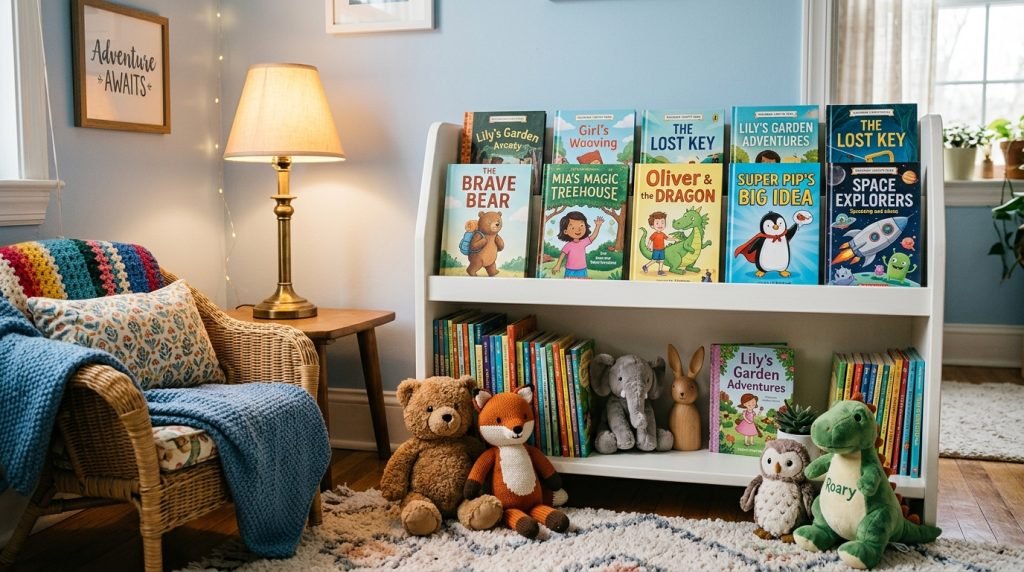
Chapter books are not one category. They form a ladder defined by how much art is on the page, and children climb it in order. This matters more than piece counts or word counts, and it is the single most useful thing I can tell you.
- Rung one: full colour on nearly every page. These feel like a picture book with chapters. Narwhal and Jelly, Unicorn and Yeti, Press Start!. The child is not really coping with less art yet, just with a longer story.
- Rung two: two-colour art. Often black and white plus one accent colour. Jada Jones is the clearest example. This is the deliberate transition rung, and it is the one most parents skip without realising it.
- Rung three: black and white line drawings, one or two per chapter. Mercy Watson, The Princess in Black, Nate the Great. Illustration still supports the story but no longer carries it.
- Rung four: a picture at each chapter opening and nothing else. Magic Tree House, The Boxcar Children. Effectively a novel.
If your child stalls, drop back a rung rather than trying a different story at the same level. A child who abandons Magic Tree House will often devour Narwhal and Jelly the same week, and be ready for Magic Tree House three months later.
Read-Aloud and Read-Alone Are Different Jobs
A book you read aloud can be two or three years beyond what your child could read themselves, because you are doing the decoding. That means the read-aloud pile should be chosen for story, humour and vocabulary, and the read-alone pile should be chosen for decodability and confidence.
Buying one pile and expecting it to do both jobs is the most common mistake here. The read-alone books will bore you both at bedtime, and the read-aloud books will defeat a new reader.
Best First Chapter Books to Read Aloud

hosen for reading to a child of roughly four to seven. Ages are guidance, not rules.
- Mercy Watson by Kate DiCamillo, illustrated by Chris Van Dusen. A buttered-toast-obsessed pig. Short chapters, genuinely funny for adults too, and the illustrations are gorgeous. The single most reliable first read-aloud. Ages 4 to 7.
- The Princess in Black by Shannon and Dean Hale, illustrated by LeUyen Pham. A princess with a secret monster-fighting identity. Fast, funny, and it works for children who reject anything princess-shaped. Ages 4 to 7.
- Frog and Toad by Arnold Lobel. Technically an easy reader, but the four-book collection reads beautifully aloud and the friendship stories land at any age. Ages 3 to 6.
- Cornbread and Poppy by Matthew Cordell. A mouse odd couple, warm and beautifully drawn, from a Caldecott winner. Ages 4 to 7.
- My Father’s Dragon by Ruth Stiles Gannett. A 1948 adventure with maps and a boy rescuing a baby dragon. Longer chapters, so better at five or six. Ages 5 to 8.
- Dory Fantasmagory by Abby Hanlon. A wildly imaginative youngest child with an invisible friend. Recognisable to any parent of a fourth child. Ages 5 to 8.
- The Cobble Street Cousins by Cynthia Rylant. Quiet, gentle, seasonal. Good for a child who finds the funny ones overstimulating. Ages 5 to 8.
- Clementine by Sara Pennypacker. A bright, impulsive girl who is always in trouble for the wrong reasons. Ages 6 to 8.
- Charlotte’s Web by E. B. White. The classic read-aloud, and worth waiting for. Do not start here; finish here. Ages 5 to 9.
- The Boxcar Children by Gertrude Chandler Warner. Four orphaned siblings making a home in a railway carriage. Plain prose, enormous appeal, and the first book stands alone. Ages 5 to 8.
Best First Chapter Books for Reading Alone
Chosen for a child doing the decoding themselves. Grade bands follow publisher guidance, and the heavily illustrated ones come first.
- Narwhal and Jelly by Ben Clanton. Full colour, part comic, very short. The best possible first solo chapter book. Grades K to 2.
- Unicorn and Yeti by Heather Ayris Burnell. Full colour, simple sentences, from Scholastic’s Acorn line, which is built for exactly this stage. Grades K to 2.
- Fly Guy by Tedd Arnold. A boy and his pet fly. Short, silly, and hugely effective with reluctant readers. Grades K to 2.
- Press Start! by Thomas Flintham. Video game format on the page. If your child would rather be on a screen, start here. Grades 1 to 2.
- Diary of a Pug by Kyla May. Diary format, full colour, low word count per page. Grades 1 to 2.
- Owl Diaries by Rebecca Elliott. Diary format again, purple and pink art, very popular with five and six year olds. Grades 1 to 2.
- Unicorn Diaries by Rebecca Elliott. The same author and format if Owl Diaries lands. Grades 1 to 2.
- The Bad Guys by Aaron Blabey. Nearly a graphic novel and completely absurd. Converts children who claim to hate reading. Grades 2 to 3.
- Nate the Great by Marjorie Weinman Sharmat, illustrated by Marc Simont. A deadpan child detective. Black and white art, so a step up. Grades 1 to 3.
- Cam Jansen by David A. Adler. A girl with a photographic memory solving mysteries. Grades 2 to 4.
- Amelia Bedelia by Peggy Parish. A housekeeper who takes every instruction literally. Read the original series, not the newer reboot. Grades 1 to 3.
- Flat Stanley by Jeff Brown. A boy flattened by a noticeboard, posted around the world. Grades 2 to 3.
Series That Never Run Out
When a child finally latches onto something, the best thing you can hand them is a very long shelf. Two of these have more instalments than your child can finish before outgrowing them, which is a feature.
- Magic Tree House by Mary Pope Osborne. Time travel, over 30 books, plus non-fiction Fact Trackers companions and graphic novel versions. The most useful series on this list for building reading stamina.
- The Boxcar Children by Gertrude Chandler Warner. Over 160 instalments. Endless, cheap secondhand, and reliably gentle.
- Dragon Masters by Tracey West. Very popular, very long. Not literature, and children do not care.
- Ranger in Time by Kate Messner. A search-and-rescue dog travelling through history. Genuinely well written and quietly educational.
- The Kingdom of Wrenly by Jordan Quinn. Light fantasy, long series, easy reading level.
- Unicorn Academy by Julie Sykes. Twelve books plus spin-offs. Ages 6 to 9.
What Makes a Good First Chapter Book
My criteria, stated openly so you can disagree with them:
- Chapters short enough to finish one at bedtime. Five to eight pages. A chapter you cannot finish teaches a child that stories are exhausting.
- Illustrations on most pages, at least at the start of the ladder.
- A character worth caring about, doing something, rather than a concept being explained.
- Humour that is actually funny, not just labelled as funny. You will be reading this aloud.
- Part of a series, so success has somewhere to go.
- Real book design. Decent paper, readable type, generous margins. Cramped text puts new readers off before the first sentence.
What I Would Skip, and Why
Being useful here means being willing to say what not to buy.
- Licensed character tie-ins. Books built from a cartoon or film rarely have a story underneath. Children will read them and get nothing.
- Anything sold mainly on potty humour. It works once. It does not build a reader.
- Boxed sets of twelve unknown titles for a low price. Almost always thin filler. Buy one book from a series first.
- Classic novels bought early because they are classics. Charlotte’s Web and The Wind in the Willows are wonderful and will be resented at four.
- Anything with dense, small, unbroken text, however good the reviews. At this stage the page layout is the book.
How to Read a Chapter Book Aloud Without Losing Them
- Do one chapter, then stop, even when they beg. Ending while they still want more is what makes them ask for it tomorrow.
- Recap in one sentence before you start. ‘Yesterday Mercy got out of the house.’ It costs five seconds and rescues the thread.
- Read the illustrations too. Pause and let them look. On rungs one and two this is half the book.
- Do the voices. You will feel ridiculous. It roughly doubles engagement.
- Let them hold something. Drawing or fiddling during a read-aloud is not inattention, and for many children it is what makes sitting still possible.
- Do not quiz them. One genuine question beats five comprehension checks.
When They Lose Interest Halfway Through
Abandon the book. This is the part most parents resist and it matters more than anything else on this page. Finishing a book your child has stopped enjoying teaches them that reading is an obligation, which is precisely the association you are trying to avoid.
Put it away without ceremony, drop back a rung on the illustration ladder, and try again in a month. If a child abandons three books at the same rung, the rung is wrong rather than the books. And if they abandon a book but keep talking about the characters, read them the ending yourself. They wanted the story, not the reading.
Building the Collection Without Buying Twenty Books
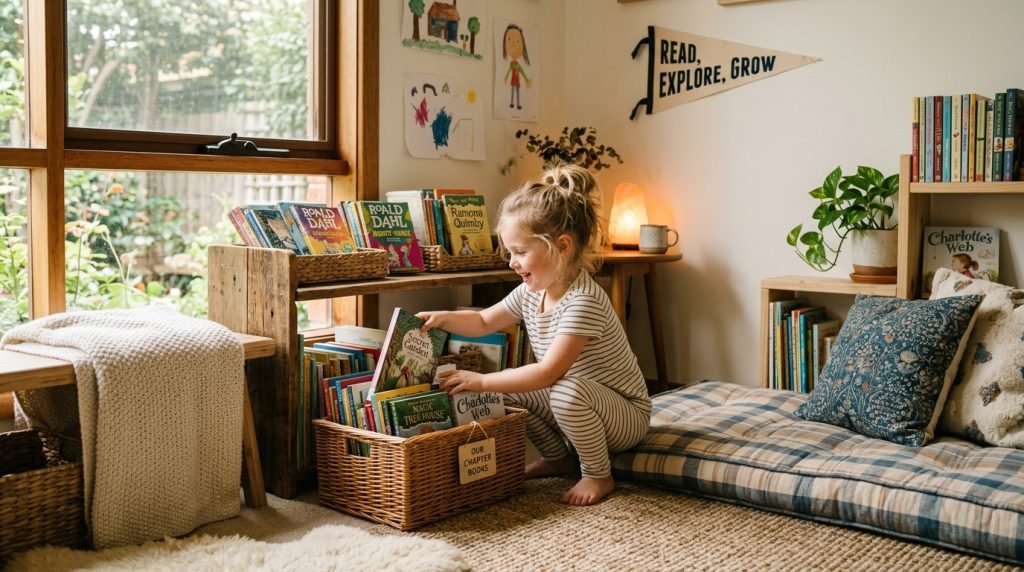
None of this needs to be expensive, and buying twenty books at once is the fastest way to end up with eighteen unread ones.
- Reserve six from the library, read them over a fortnight, and buy only the ones your child asks for again.
- Buy the series secondhand. Long series like The Boxcar Children and Magic Tree House are everywhere in charity shops and on ThriftBooks for very little.
- Buy book one, never the boxed set, until you know a series has landed.
- Keep the current book somewhere visible, face out, at your child’s height. A book in a pile is a book that is not read.
- Keep an outgrown rung available. A six year old will happily reread Narwhal and Jelly, and rereading builds fluency faster than new books do.
Frequently Asked Questions
At what age do kids start chapter books?
Most children can enjoy a chapter book read aloud from around four, and start reading one alone between five and a half and seven. The two milestones are years apart and that is completely normal, because listening comprehension develops well ahead of decoding.
What is a good chapter book for a 4 year old?
For a four year old this means reading aloud. Start with Mercy Watson by Kate DiCamillo or The Princess in Black by Shannon and Dean Hale. Both have short chapters and illustrations on most pages, which is what a four year old needs to stay with a longer story.
What are the most popular first chapter books for kids?
The titles that appear on nearly every list are Mercy Watson, The Princess in Black, Magic Tree House, Narwhal and Jelly, Frog and Toad, Nate the Great and The Boxcar Children. Popularity is a reasonable signal at this stage, because these have survived decades of children voting with their attention.
How long should a first chapter book be?
Look for 60 to 100 pages total with chapters of five to eight pages. Total length matters far less than chapter length, because the chapter is the unit a child actually experiences.
Should my child read chapter books alone or should I read aloud?
Both, from different piles. Read aloud from books above their reading level to build vocabulary and appetite, and let them read easier, heavily illustrated books alone to build fluency and confidence. Keep reading aloud long after they can read alone.
My child refuses chapter books. What now?
Drop back to full colour illustrated titles like Narwhal and Jelly or The Bad Guys, which are close to comics, and stop calling them chapter books. Refusal at this stage is nearly always about the density of the page rather than the length of the story.