
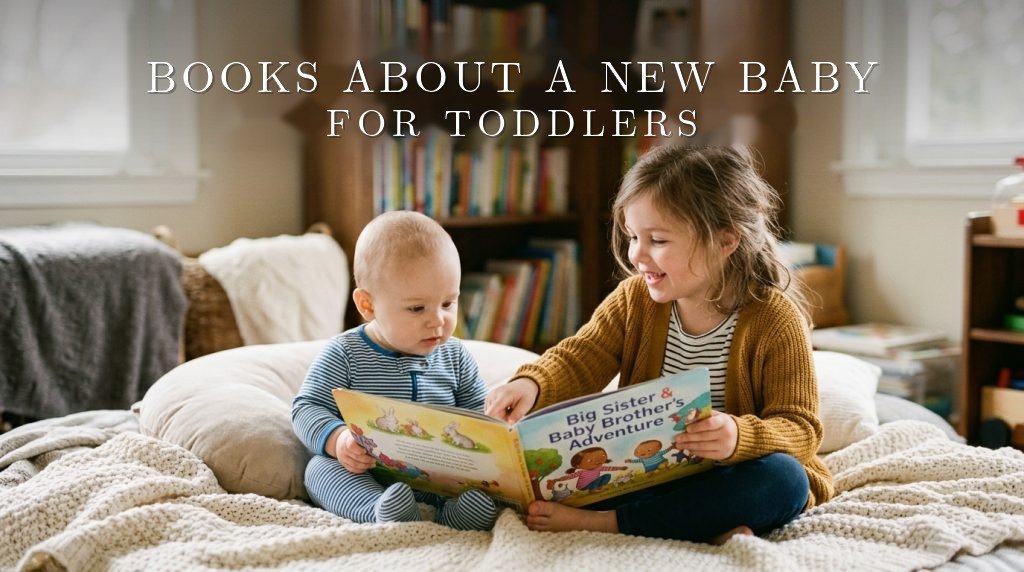
Books About a New Baby for Toddlers
Why a Picture Book Works Better Than a Conversation
Sustaining a focused conversation with a toddler is close to impossible. They wander off, change subject, and answer questions about pregnancy with observations about tractors. A book solves this by holding the topic still. The pages do not move on until you turn them, and the same book can be read forty times, which is roughly how many repetitions a two-year-old needs before an idea sticks.
There is a second, quieter benefit. Most parents do not have the right words ready. When your child asks where the baby is, or whether you will still love them, an improvised answer at bedtime is rarely your best one. A well-written children’s book has already found the language (simple text, repetition, age-appropriate vocabulary), and you get to borrow it.
Books also build emotional vocabulary before it is needed. A child who has heard a story character say they feel left out has a word for the feeling when it arrives. That is the real work these books do, and it happens weeks before the birth.
When to Start Reading These Books to Your Toddler
Start in the second trimester, or about two to three months before your due date. Earlier than that and the wait is meaninglessly long for a child with no grasp of time; much later and you lose the repetition that makes the idea real. If your toddler is under two, lean towards the shorter window, closer to six or eight weeks, and towards board books rather than longer picture books.
It helps to think of the transition in three phases and read for the phase you are in:
- Pregnancy. The baby exists but is invisible. Books about the bump, growth, and waiting.
- Birth and hospital. Where you will go, who will look after your toddler, when you come back.
- Coming home. What the newborn actually does, and how your child feels about it.
Most families make the mistake of stopping at phase one. The books that matter most are usually the ones you read after the baby is already home, when the abstract has become a loud, permanent reality.
Books That Explain Pregnancy and Where the Baby Is

These are the first ones to reach for, and the ones most likely to prompt the follow-up question every parent dreads.
- What’s in Your Tummy Mummy? by Sam Lloyd. A lift-the-flap book with unforced rhymes. The gentlest possible introduction to the idea that there is a baby inside. Best for 18 months to three years.
- Nine Months: Before a Baby Is Born by Miranda Paul. Follows the pregnancy month by month. Useful when your child wants facts rather than reassurance.
- Mama’s Belly by Kate Hosford. Quieter and more emotional, centred on a child waiting and wondering whether there will be enough love to go round.
- What’s in There?: All About Before You Were Born by Robie H. Harris. The most direct on how a baby grows. Read it yourself first so you know what you are agreeing to explain.
- There’s Going to Be a Baby by John Burningham. A boy imagining what his baby brother might grow up to be. Lovely illustrations and a slower pace; better for a three- or four-year-old.
A warning worth having in advance: these books reliably trigger questions about how the baby got there in the first place. Decide on your answer before you open the book, not during it.
Books About Becoming a Big Brother or Big Sister

This is the category that does the identity work of turning a demotion into a promotion. Your child is not losing their position as the only child, they are gaining the title of big sibling.
- I’m a Big Sister and I’m a Big Brother by Joanna Cole. The standard recommendation, and deservedly so. Simple, warm, and concrete about what an older sibling can actually do to help. Two matched versions.
- The Rachel Fuller series. Waiting for Baby, My New Baby, You and Me! and Look at Me!. Four short board books that carry a child through pregnancy, arrival, and settling in. Short, slightly disjointed sentences that work well for under-threes, and unusually, the illustrations show breastfeeding, which most children’s books avoid.
- One Special Day: A Story for Big Brothers and Sisters by Lola M. Schaefer. Specifically about being gentle with a newborn. Essential if your toddler is boisterous.
- Za-za’s Baby Brother by Lucy Cousins. Animal characters, bright artwork, and an honest look at how much attention the baby takes.
- How to Be a Baby . . . by Me, the Big Sister by Sally Lloyd-Jones. A comic list of everything babies cannot do. Children find it genuinely funny, which makes the message land sideways.
Books That Explain What a Newborn Can and Cannot Do

This is the most underrated category and the one most new sibling book lists skip. Toddlers often expect a playmate. What arrives is a person who sleeps, feeds, and cries, and the gap between expectation and reality is where a lot of early sibling disappointment comes from.
- *The All About Babies series by Polly Zielonka: Itty Bitty Newborn, When Will Baby Play? and Curious and Crawling. Each covers what a baby can do at a given stage. Particularly useful if you have no friends or family with a real infant* to show your child.
- Peppa and the New Baby. Not literature, but if your toddler is devoted to Peppa Pig it will get read, and it does explain what babies can and cannot do plus how a sibling can help.
- We’re Having a Baby: Adapting to a New Baby (Big Steps). Plain and practical. Short on charm, strong on the concrete logistics of the first weeks.
Setting the expectation that a newborn will mostly sleep and cry is not pessimism. It is the single kindest piece of preparation you can offer, because it means your toddler is not disappointed on day one.
Books That Make Room for Jealousy and Mixed Feelings

The best books about a new baby for toddlers are not relentlessly cheerful. A child who is told only that the baby will be wonderful learns that their own jealousy is something to hide.
- The New Small Person by Lauren Child. The standout. A boy finds his new sibling an unwelcome interruption, and the book lets him feel that for most of its length. Acceptance arrives gradually, which is how it actually works.
- Sophie and the New Baby by Laurence Anholt. Deals directly with everything changing at once. Better for three- and four-year-olds.
- Angelina’s Baby Sister by Katherine Holabird. Angelina gets angry that nobody is paying her any attention. Often lands better read a few weeks after the birth, once your child recognises the feeling.
- You Were the First by Patricia MacLachlan. Pure reassurance for the firstborn: you were first, and that does not change.
If you only buy one book from this list, make it one from this section. Sibling rivalry is not prevented by positive messaging. It is softened by a child knowing their difficult feelings are ordinary.
Books for Families That Do Not Look Like the Default
Most new sibling books assume a baby arriving from a mother’s bump into a two-parent household. If that is not your family, the standard list can feel like a poor fit.
- Harper Becomes a Big Sister by Seamus Kirst. A sibling arriving through adoption, into a family with two dads. Also unusually good on the first few weeks from the older child’s point of view.
- New Baby by Sarah Shaffi and Isabel Otter, illustrated by Lucy Farfort. Recent, warm, and more representative in its illustrations.
- I Love My Little Brother by Serene Chia. Features an Asian family and the ordinary business of adjusting to a younger sibling.
- God Gave Us Two by Lisa Tawn Bergren. A polar bear family awaiting another cub, for families who want a faith-based framing.
Books About the Hospital, the Birth, and Coming Home
The logistics frighten toddlers more than the baby does. Where is Mummy going? Who is putting me to bed? Is she coming back? Very few children’s books answer these plainly.
- We’re Having a Baby (Big Steps). The most direct on where Mummy goes, who looks after you, and what happens when she returns with the baby.
- Welcome With Love by Jenni Overend. The only widely available picture book set at a home birth, and the only one that depicts labour. Matter-of-fact about the sounds and sights, including the placenta. If your child will be present at the birth, this one is close to essential; if not, read it yourself before deciding.
How to Read These Books With Your Toddler

The book matters less than what you do with it. Fifteen to twenty minutes a day is plenty, and the same book repeated is better than a new one each night.
- Stop at the pictures and ask what the character is feeling, rather than reading straight through.
- Name the feeling out loud. “He looks cross that nobody is playing with him.” You are handing your child emotional vocabulary.
- Connect it to your family by name, “that is like when our baby comes”, but not on every page.
- Let your toddler choose. If they want the same board book eleven nights running, that is the repetition doing its job.
- Do not correct a negative reaction. If your child says they do not want the baby, that is useful information, not a problem to fix.
- Keep reading after the birth. These books are more useful in week three than in month seven of pregnancy.
Beyond Books: Five Things That Helped More Than Reading Did
Honesty: no picture book truly prepares a child for the shift in family dynamics. Reading is preparation, not insurance. These five things did more of the actual work in our house.
- A baby doll of their own. The single most effective thing we did. While you change the newborn, your toddler changes theirs. It converts a spectator into a participant.
- A sibling gift to open on the day. A small bag holding a big-sibling shirt, a book and a water bottle, opened while you are at the hospital. It marks the day as theirs too.
- Real helper jobs. Choosing the baby’s outfit, fetching a nappy, stroking a foot to settle them. Small, genuine tasks beat praise.
- Busy boxes. A few sealed boxes of novel activities, opened only during feeds. Buys you twenty minutes and removes a daily flashpoint.
- One-to-one time, protected. Twenty minutes with your full attention, phone away, several times a week. It does not need to leave the house.
Where to Find These Books Without Buying Eighteen of Them
Start at the library. Reserve six or eight of these titles, read them over a fortnight, and watch which ones your child asks for again. Those are the two or three worth owning. It costs nothing and your child’s preference is a better guide than any list, including this one.
When you do buy, choose board books for under-threes. Picture books with paper pages will not survive a two-year-old, and a torn favourite at the wrong moment is a bigger problem than it sounds. Secondhand copies of these titles are easy to find, since every family only needs them for about a year.
Frequently Asked Questions
How do I prepare my 2-year-old for a new baby?
Keep it concrete and repetitive. A two-year-old cannot process nine months, so anchor the new baby to visible events: when the bump grows, when the cot appears. Read the same two or three board books repeatedly rather than many books once, give them a baby doll to care for, and name feelings as they come up. Start about two months before your due date.
When should I tell my toddler about the new baby?
Most families tell their children early in the pregnancy, so they hear it from you rather than overhearing it, and so tiredness and sickness have an explanation. For the focused book-reading, the second trimester is the practical starting point.
How do I talk to my toddler about where babies come from?
Answer the question actually asked, in one sentence, without elaborating. Nine Months: Before a Baby Is Born by Miranda Paul and What’s in There? by Robie H. Harris both do the explaining for you at a toddler-appropriate level. Toddlers rarely want the full picture; they want to know the baby is safe and will come out.
Will reading books stop sibling jealousy?
No. Sibling jealousy is a normal response to a genuine loss of attention, and no book prevents it. What books do is make it discussable, so your child expresses it in words rather than in behaviour. Expect some regression in sleep, toileting or clinginess, regardless of how well you prepared.
How many of these books do I actually need?
Two or three. One about pregnancy, one about being a big sibling, and one that makes space for difficult feelings. Borrow widely, buy narrowly.
Should I keep reading them after the baby arrives?
Yes, and this is the step most families skip. A book about jealousy means little to a child who has not felt it yet. Read the same titles again in the first month home and watch how differently your toddler responds.