

Short answer: the most widely recommended Montessori floor bed is the Sprout Birch Montessori Floor Bed, at roughly $320 for crib size and $490 for twin, in Baltic birch with GREENGUARD Gold certification and a 450 lb limit. If you want a rail included, the Piccalio bedBED is about $499 in crib size. And if you want to test whether your child takes to it before spending anything, a firm mattress on the floor is a legitimate floor bed, from about $100. Most families make the move between 16 and 20 months. For a baby under 12 months, read the safety section below before you decide anything.
There are two problems with most floor bed guides. They either sell you one bed, or they describe the concept without naming a single product or price. This one names seven beds with current prices, gives you the mattress dimensions you will need, and states the safety position accurately rather than reassuringly.
Prices below were checked on the manufacturers’ own sites in August 2026. Furniture pricing moves, so confirm before ordering.
Montessori Floor Beds
What a Floor Bed Actually Is, and How It Differs From a Toddler Bed
A Montessori floor bed is a sleeping surface low enough that a child can get on and off it unaided and safely. That is the whole definition. It can be a low wooden frame, a house-shaped frame, or a mattress on the floor.
The difference from a toddler bed is not mainly height, it is intent. A toddler bed is designed to contain a child, usually with rails, and to be got into with help. A floor bed is designed for free access and egress, meaning the child decides when to get up. That single design choice is the point of the whole thing: it supports independence, and it means a child who wakes can go and find a book rather than shouting for you.
There is a regulatory consequence to that difference, and it is worth knowing before you buy.
The Safety Position, Stated Precisely
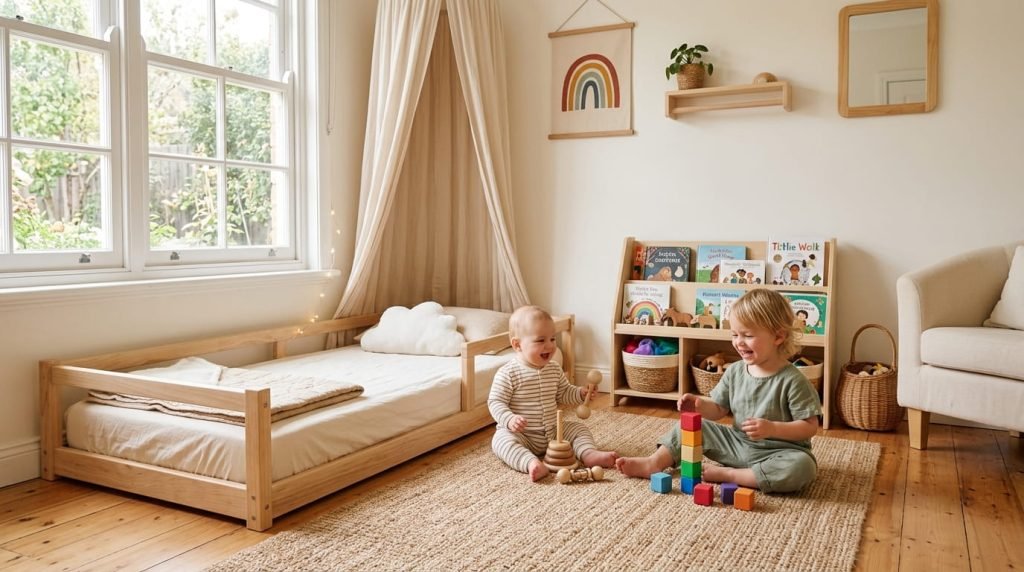
Most Montessori writing on this topic is either reassuring or silent. Here is what the actual authorities say, without stretching it in either direction.
The American Academy of Pediatrics guidance for babies up to one year is: place the baby on their back for every sleep, use a firm, flat surface that does not indent under the baby, no incline greater than 10 degrees, keep soft objects and loose bedding out, and room-share without bed-sharing for at least the first six months. For the sleep surface itself, the AAP says to use a crib, bassinet, portable crib or play yard that meets CPSC safety standards.
The important and frequently misreported part: the AAP does not mention floor beds at all, in either direction. It does not endorse them and it does not warn against them. What is true is that a floor bed is not one of the sleep surfaces the AAP lists for infants. Anyone telling you the AAP approves floor beds, or that it has warned against them, is adding something that is not there.
The CPSC position is more concrete. 16 CFR 1217 is the federal safety standard for toddler beds, and it mandates ASTM F1821. A toddler bed is defined there as a bed sized for a full-size crib mattress, intended for free access and egress by a child of at least 15 months weighing no more than 50 lb. So:
- A crib or toddler-size floor bed matching that description falls inside the federal standard, and a reputable maker will say so. Piccalio, for example, certifies its crib size to ASTM F1821.
- A twin, full or queen floor bed falls outside it. There is no federal children’s bed standard at those sizes. That is not an accusation against any manufacturer, it is simply the regulatory gap, and it is why certifications like GREENGUARD Gold and independent lab testing carry more weight on the larger sizes.
- Crib mattresses are separately regulated under 16 CFR 1241, which includes a mandatory firmness test.
The honest summary: for a toddler over 15 to 18 months, a well-made floor bed in a properly childproofed room is a mainstream, widely used choice. For a baby under 12 months, you are making a decision that sits outside published AAP guidance, and that is a conversation to have with your own paediatrician rather than with a blog. This page is not medical advice and I am not a clinician.
What Age to Start
Classic Montessori practice permits a floor bed from birth, and some families do it successfully. In practice, most parents who have tried both land between 16 and 20 months.
The reason is mobility combined with judgement. A baby who cannot crawl stays where you put them. A newly mobile ten-month-old can leave the bed and explore a dark room, which means the entire room must be as safe as a crib at a stage when the child has no sense of danger. By around eighteen months, a toddler grasps the idea of staying in bed even when they choose to ignore it.
Manufacturers’ own minimum ages are a useful sanity check. Piccalio rates its crib size 15 months and up and its twin 24 months and up. That is the industry telling you something.
What Size Mattress You Need
Standard US mattress dimensions, in inches:
- Crib and toddler: 52 x 28. These are the same size, because a toddler bed is defined as taking a full-size crib mattress. Federal minimum for a crib mattress is 51 5/8 x 27 1/4.
- Twin: 38 x 75. The most common floor bed size, and the one most families buy if they want the bed to last.
- Full: 54 x 75. Worth considering if you plan to lie down with your child, which is a genuine reason many parents choose it.
- Queen: 60 x 80. Available from some makers, and occasionally chosen for a shared room.
Buy the mattress to fit the frame exactly. Gaps between the mattress and the frame sides are a genuine entrapment risk, and it is the specific hazard the CPSC identifies in its crib mattress rulemaking. If a mattress slides around, it is the wrong mattress.
How Thick and How Firm the Mattress Should Be
Two separate things, and it is worth keeping them separate because one is regulated and one is not.
Firmness is the regulated part. Crib mattresses must pass a mandatory firmness test. The AAP’s requirement is qualitative but clear: firm, flat, and it must not indent under the baby’s weight. A soft or memory-foam mattress is the wrong choice for a young child regardless of what the bed frame is.
Thickness is manufacturer guidance, not regulation. Sprout recommends 4 to 8 inches for its frame. Busywood recommends around 7.9 inches for theirs. Follow the guidance for the frame you actually buy, because a mattress that is too thick for a given frame can sit above the side rails and defeat them.
There is a related mistake worth avoiding: buying a thick premium mattress because it seems kinder, and thereby raising the fall height back up. On a bed whose entire purpose is being low, a ten-inch mattress works against you.
The Wall Gap Rule Almost Nobody Publishes
This is buried in a manufacturer’s own use instructions and I have not seen a single blog repeat it, which is odd, because it is the most specific safety guidance available for this product category.
Sprout’s instructions state that for a child under 18 months, a low or scooped side of the bed should sit at least 12 inches from the wall, and a high side should be either less than 1.5 inches from the wall or more than 12 inches from it. The logic is entrapment: a gap of a few inches between bed and wall is exactly the size a small child can wedge into, while a gap under 1.5 inches is too narrow to enter and one over 12 inches is easy to get out of.
So the instinctive move, pushing the bed almost but not quite against the wall, is the one to avoid. Either flush against it, or clearly away from it.
Rails, Half Rails, or None
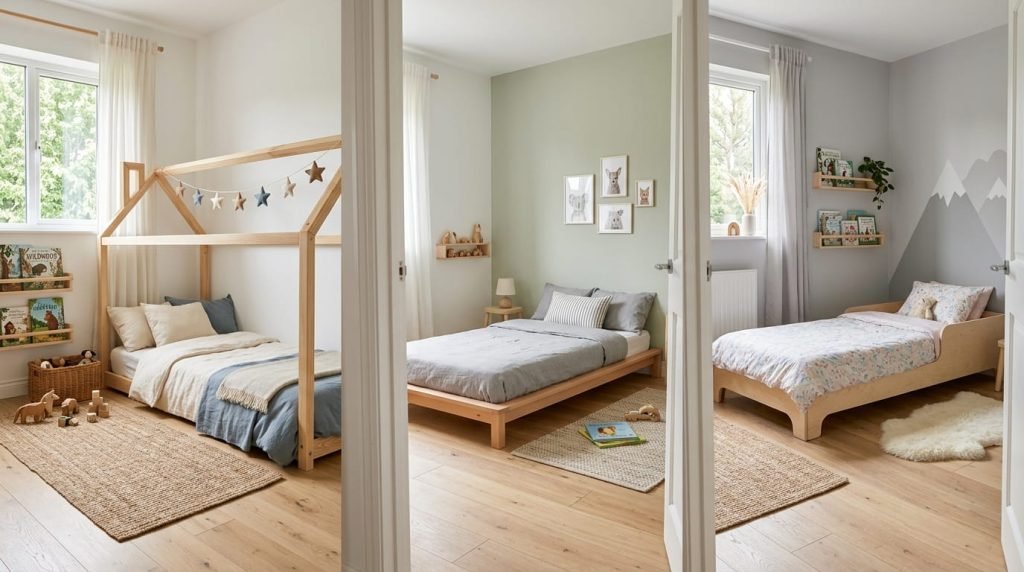
Purists argue that rails contradict the point, since the child should be free to leave. In practice most families want something for the first months.
- No rails suits a child over about two who has already been sleeping low, and it is the most orthodox choice. Sprout takes this approach, offering four different side configurations instead of rails.
- One removable rail is the pragmatic middle. Piccalio includes one and sells extras from about $69. Use it on the open side for a few months, then take it off.
- A partial or half rail covers the top half of the open side, so the child cannot roll out where their head is but can still climb out at the foot.
- A full surrounding rail is really a crib, and if that is what you want, buy a crib. It is cheaper and federally regulated.
The corner placement matters more than the rail. Two walls remove two edges at no cost, subject to the gap rule above.
The Seven Beds Worth Considering
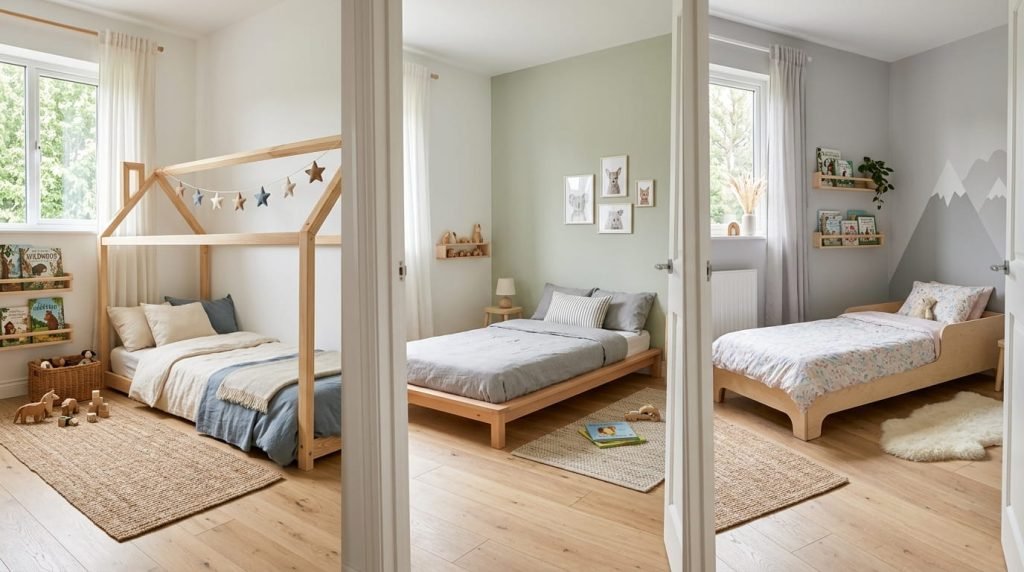
Prices are the manufacturers’ own, checked August 2026, and are for the base configuration. Re-check before ordering.
- Sprout Birch Montessori Floor Bed. Crib $320, twin $490, full $690. Baltic birch plywood, no-VOC finish, GREENGUARD Gold, made in Utah, 450 lb limit, mattress 4 to 8 inches. No rails; instead four side configurations. The most commonly recommended bed in this category. One caveat: I saw a lower figure on the product page than the collection page, so confirm the price for the size you want.
- Piccalio bedBED. Crib and toddler $499, twin $699. FSC birch plywood and solid pine, 0-VOC finish. One removable safety rail included, extras from $69. Certified to ASTM F1821 in crib size, GREENGUARD Gold. Flips over to become a raised bed later. Crib 15 months plus, twin 24 months plus. The pick if you want a rail and a certification.
- Montoddler Montessori Floor Bed. Crib $295, twin $495, full $620, queen $950. Finnish birch plywood, water-based finish, 400 lb limit, sits 2.5 inches off the floor. No rails on this model. Cheapest of the dedicated Montessori makers at crib size. Note their list prices are shown as permanently discounted, so treat the sale price as the real price.
- Busywood floor bed with rails. Crib $632.50, twin $666, full $699, queen $724. Alder wood, water-based finish, front rail fits either side, recommends a 7.9 inch mattress. Two things no roundup mentions: slats are a paid add-on, and it ships from Europe in 7 to 19 business days. Worth knowing before you order.
- Nestig Wave Kids Bed. From about $899. FSC Brazilian pine, made to order, converts to a twin as the child grows, several colourways. The pick if you want it to look like furniture rather than a Montessori product.
- Pottery Barn Kids Avery Bookrack Bed. From about $699. FSC wood, GREENGUARD Gold, tested in a CPSC-accredited lab. Has an integrated bookrack, which suits a small room where the bed has to do two jobs.
- Babyletto Rizo. From about $999. Finnish spruce with a bouclé upholstered surround, removable toddler rail, GREENGUARD Gold. The upholstered option, and the most expensive here.
Two cheaper routes worth knowing. IKEA KURA is a reversible bed at around $299 that can be flipped upside down to give a very low surface, which is a well-known workaround. And several Etsy makers produce solid wood house frames from roughly $390, though you are trusting an individual maker rather than a tested product.
The Cheapest Option, and Why It Is a Real Option
A firm mattress on the floor is a Montessori floor bed. Not a compromise, not a placeholder. Dr Montessori’s own recommendation was a low mattress, and the wooden frames came much later as a commercial category.
A firm crib or toddler mattress starts at around $100, and a certified organic option is available at around $237. Doing it this way for a couple of months tells you whether your child takes to sleeping low before you commit $500 to a frame, and a surprising number of families never buy the frame.
Two practical points if you go this route. Keep the mattress firm and flat, since that is the part that actually matters for safety. And air it regularly by standing it up, because a mattress lying directly on carpet with no airflow underneath is worth checking periodically for damp. That is a maintenance consideration rather than a documented hazard, but it costs nothing to check.
Setting It Up Safely
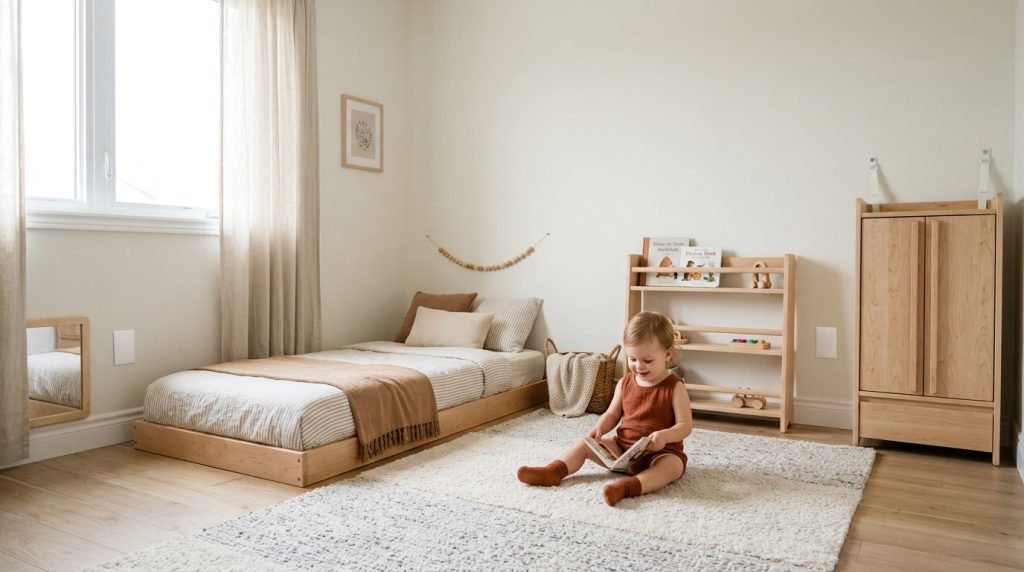
A floor bed means your child can leave the bed unsupervised, in the dark. The whole room now has to be as safe as the crib was. This is the part that takes an afternoon and matters more than which frame you bought.
- Anchor every piece of furniture to the wall, including anything low enough that it looks harmless. Assume all of it will be climbed.
- Cover every socket and remove or shorten every cord, including blind cords and baby monitor cables.
- Soft flooring across the whole room, not just beside the bed.
- Apply the wall gap rule from above: flush to the wall, or clearly more than 12 inches away.
- Nothing above the bed. No shelf, no frame, no canopy, no mobile.
- A safety gate at the doorway or a door handle cover, so a night waking keeps them inside a room you have made safe rather than reaching stairs.
- Check the mattress fits the frame with no gaps at the sides. This is the entrapment risk the CPSC actually names.
Is a Floor Bed Right for Your Family?
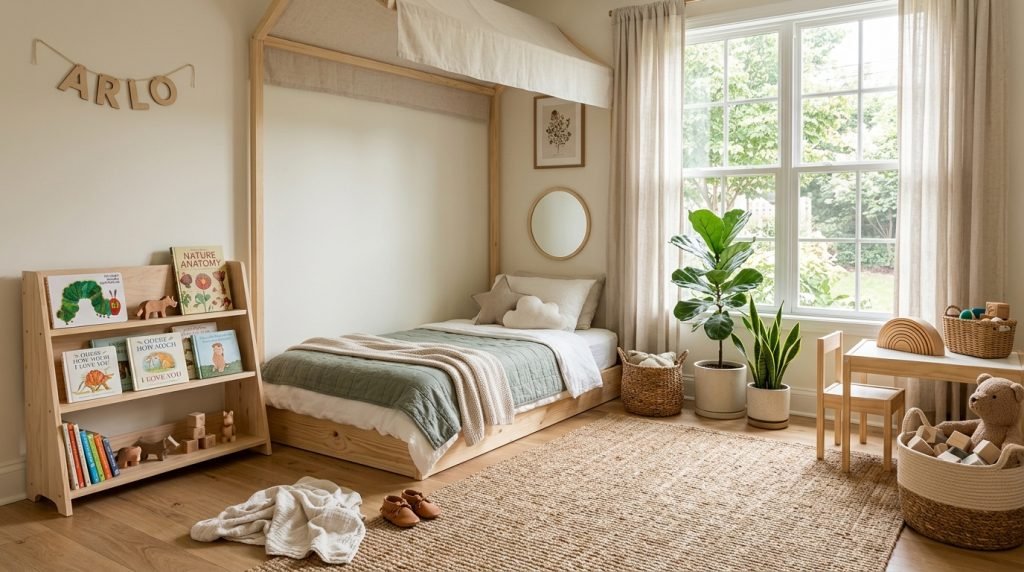
Sometimes the answer is no, and no other page on this topic seems willing to say it.
A floor bed suits you if your child is over about 16 months, you can genuinely childproof the whole room, and you are comfortable with a transition period of a few weeks where they get up repeatedly. It also suits parents who want to lie down with a child at bedtime, which is easier at floor height than at cot height.
It suits you less if you rent and cannot anchor furniture, if the room contains something you cannot make safe such as a window at floor level or a radiator you cannot cover, or if your child shares with a sibling whose sleep will be wrecked by a wandering toddler. And if your child is under a year, the honest position is that you are outside published AAP guidance and should talk to your paediatrician rather than to the internet.
There is no Montessori failure in using a cot until two. The principle is a prepared environment suited to the child in front of you, and a safe cot in an unsafe room beats a floor bed in one.
Frequently Asked Questions
What age is right for a Montessori floor bed?
Most families move between 16 and 20 months. Manufacturers’ own minimums support that: Piccalio rates its crib size 15 months and up and its twin 24 months and up. Classic Montessori practice allows a floor bed from birth, but for a baby under 12 months you are outside published AAP safe sleep guidance and should discuss it with your paediatrician.
Are Montessori floor beds safe?
For a toddler over about 15 to 18 months in a fully childproofed room, a well-made floor bed is a mainstream choice, and crib-size models can be certified to the federal toddler bed standard ASTM F1821. The risk is not the bed, it is the room, because the child can now leave the bed unsupervised. For infants, note that the AAP does not list floor beds among its recommended infant sleep surfaces, and it does not mention them either way.
What is the difference between a Montessori floor bed and a toddler bed?
A toddler bed is designed to contain a child, usually with rails. A floor bed is designed for free access and egress, so the child chooses when to get up. Confusingly, the federal definition of a toddler bed also includes free access and egress, so a crib-size floor bed can legally be a toddler bed. The practical difference is height and intent.
What size mattress do I need?
Crib and toddler are both 52 x 28 inches. Twin is 38 x 75, full is 54 x 75, queen is 60 x 80. Buy to fit your frame exactly, because gaps at the sides are the specific entrapment hazard the CPSC identifies.
How thick should the mattress be?
Follow your frame maker’s guidance. Sprout recommends 4 to 8 inches, Busywood around 7.9 inches. Firmness matters more than thickness: it must be firm and flat and must not indent under your child. Avoid thick memory foam, and remember that a very thick mattress raises the fall height on a bed whose whole purpose is being low.
Do I need rails?
Not necessarily. Placing the bed in a corner removes two edges for free. If you want a rail for the first few months, Piccalio includes one removable rail and sells extras from around $69. A full surrounding rail is effectively a crib, and buying an actual crib would be cheaper and federally regulated.
What is the cheapest Montessori floor bed?
A firm crib or toddler mattress placed directly on the floor, from around $100. It is a legitimate floor bed, not a stopgap, and it lets you find out whether your child takes to sleeping low before spending $300 to $700 on a frame.