
Montessori language activities run in a deliberate order. First spoken language and real vocabulary, from birth. Then sound games, from around two and a half, played with the sound a letter makes and never its name. Then sandpaper letters, after three, introduced two or three at a time in lowercase. Then the moveable alphabet, from around three and a half, where children build words before they can read them. Then reading, which usually follows about six months after they start composing words. The one technique that makes all of it work is the three-period lesson, and it takes two minutes to learn.
Most articles on this topic are one of two things. Either a teacher-facing curriculum overview that takes an hour to read, or a list of matching activities with no sense of where they sit. Neither tells a parent what to do first.
This is the sequence, in order, with ages, plus the one presentation technique that underpins the lot. It also corrects something the earlier version of this article got wrong, which I will come to.
Montessori Language Activities
The Sequence, and Why the Order Matters
Montessori language work is not a set of interchangeable activities. It is a progression, and skipping ahead is the usual reason a child stalls.
- Spoken language and vocabulary, from birth onwards. Never stops.
- Sound games, from around 2.5. Hearing the individual sounds inside words.
- Sandpaper letters, from around 3. Attaching a symbol to a sound already known.
- The moveable alphabet, from around 3.5 to 4.5. Building words from sounds.
- Reading, from around 4 to 5. Object boxes, then the reading series.
Two things run alongside the whole way. Hand preparation, through practical life and sensorial work, which readies the hand for writing long before a pencil appears. And sound games, which continue and deepen even after letters arrive rather than stopping.
Ages here are approximate and drawn from practitioner sources. I could not find official per-material ages published by AMI or AMS, so treat them as guidance rather than milestones.
Stage 1: Spoken Language and Real Vocabulary
The foundation, and the stage most likely to be rushed past. A child who cannot hear and produce a rich range of words has nothing for the letters to attach to.
- Name things precisely. Not flower, but daffodil. Not dog, but spaniel. Montessori vocabulary work is deliberately specific, because precision is what makes language useful.
- Object baskets by theme. Breakfast things, bath things, things that go, clothing, nature finds. Real objects, five or six at a time.
- Narrate everything during care routines. Nappy changes and dressing are minutes of one-to-one language several times a day.
- Sing, rhyme and recite poetry. Rhythm and rhyme prepare the ear for hearing sound units inside words.
- Ask open questions, do not quiz. ‘Where did you find the acorn?’ beats ‘What colour is this?’ Quizzing tests; open questions generate language.
- Emotional vocabulary counts. Frustrated, disappointed, relieved. Naming feelings is language work.
The Three-Period Lesson
This is the technique that makes every vocabulary activity on this page work, and almost nothing written for parents explains it. It takes two minutes to learn and it will change how you introduce anything.
Three periods, in order, with specific words:
- First period: naming. The words are ‘This is.’ ‘This is a triangle.’ Say nothing more. No explanation, no question, no elaboration. Three objects at most in one session.
- Second period: recognition. The words are ‘Show me.’ ‘Show me the triangle.’ ‘Can you put the triangle on the table?’ This is the longest period by far, with lots of repetition and movement. Stay here as long as your child is enjoying it, across days if needed.
- Third period: recall. The words are ‘What is this?’ Your child names it. Only ask this when you are fairly confident they will succeed.
The discipline is in the second period. Most of us name a thing once and immediately ask ‘what is it?’, which turns a lesson into a test. If your child cannot answer in the third period, you have not failed and neither have they. You simply return to the second period and do more ‘show me’.
Stage 2: Sound Games, and How to Actually Play I Spy
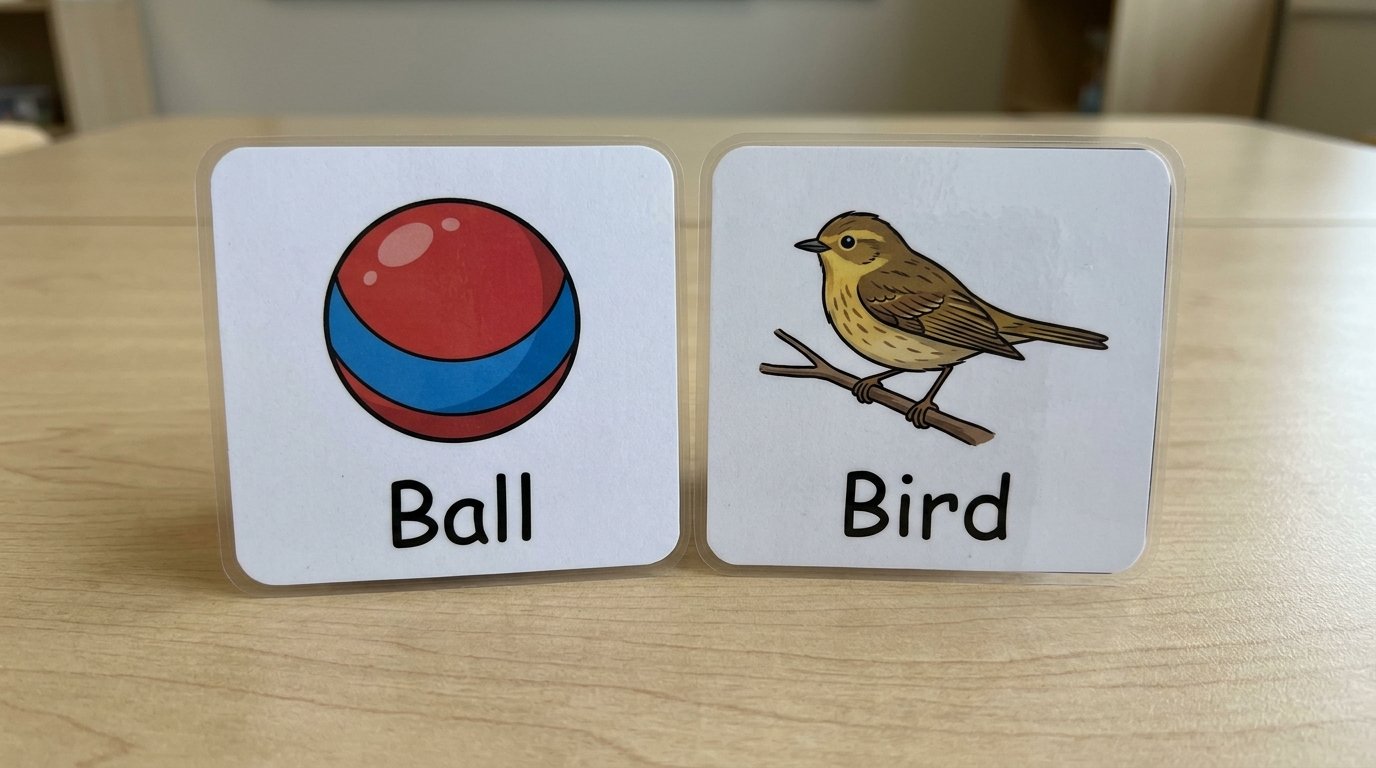
From around two and a half. This is phonemic awareness, meaning hearing the separate sounds inside a spoken word, and it is entirely oral. No letters at this stage at all.
Say the sound, not the letter name, and keep it clipped. ‘fff’, not ‘fuh’ and certainly not ‘eff’. That clipped pronunciation matters, because ‘fuh’ introduces a vowel sound that is not in the word.
- Stage one: one object in your hand. ‘I spy something beginning with fff. A f-f-fork.’ You say both the sound and the answer. Your child is only listening. Do this for weeks.
- Stage two: two or three objects on a mat. ‘I spy something beginning with mmm.’ Now they choose.
- Stage three, around 3.5: the whole room. Or outdoors, or a busy picture in a book.
- Then ending sounds. ‘I spy something ending with t.’
- Then middle sounds, which are hardest.
- Then full segmentation. ‘What sounds do you hear in cat?’
One rule worth respecting: stage one should contain no reference to letters, sandpaper letters or reading. The whole point is training the ear before the eye.
Stage 3: Sandpaper Letters, and Why Sounds Not Names
From around three, once your child can reliably hear beginning sounds. Sandpaper letters are letters cut from rough paper mounted on smooth boards, so a child traces the shape with two fingers while saying the sound.
The single most important point on this page: Montessori teaches the sound a letter makes, not its name. You trace the letter and say ‘sss’, not ‘ess’. Letter names come later, after sounds are secure.
The reasoning is practical. To read and write, a child needs to know that this shape makes this sound. The name ‘double-u’ tells you nothing about the sound /w/, and for many letters the name actively obstructs blending. A child who knows names can recite the alphabet and still not read a three-letter word.
- Introduce two or three at a time, not the whole alphabet.
- Not in alphabetical order. Group letters that look and sound different from each other. A commonly used opening set is c, m, a, t, then s, r, i, p, then b, f, o, g.
- Trace, then say. The tracing is the point. It builds the muscle memory for writing at the same time as the sound association.
- Use the three-period lesson to introduce them. This is exactly what it is for.
- Keep playing sound games alongside. They do not stop when letters begin.
Lowercase First, and the Cursive Question
Lowercase first, and the reason is straightforward: roughly 93 percent of what we read and write is lowercase. Capitals and punctuation come later in the sequence, after a child is writing simple words and sentences.
On cursive versus print: Montessori’s original intent was cursive first, and many Montessori schools still do that. The argument is that cursive letters are formed in one continuous movement, which suits a young hand, and that cursive letters look less alike than printed ones. But it genuinely varies by school and by country, and materials are sold in both. If your child is at a Montessori school, match whatever they use. If you are working at home, either is defensible.
Stage 4: The Moveable Alphabet, and Writing Before Reading
From around three and a half to four and a half. The moveable alphabet is a set of loose cut-out letters, traditionally with vowels and consonants in contrasting colours, that a child lays out on a mat to build words from the sounds they hear.
Here is the idea that surprises most parents. In Montessori, writing comes before reading. Not handwriting, but composing. A child can hear the sounds in ‘cat’ and select c, a, t long before they can form those letters with a pencil, and long before they can look at the written word and read it back.
The reason is that the two tasks are not equally hard. Building a word is analysis: break the spoken word into sounds and find each one. Reading a word requires analysis and then synthesis: identify each sound and blend them back into a word you recognise. Children typically begin reading around six months after they start composing words with the moveable alphabet, and that gap is normal rather than a delay.
Practically: say a word slowly, let your child find the letters, and do not correct the spelling. ‘kat’ is a correct analysis of the sounds in cat. The spelling comes later.
Stage 5: Object Boxes and the Pink, Blue and Green Series
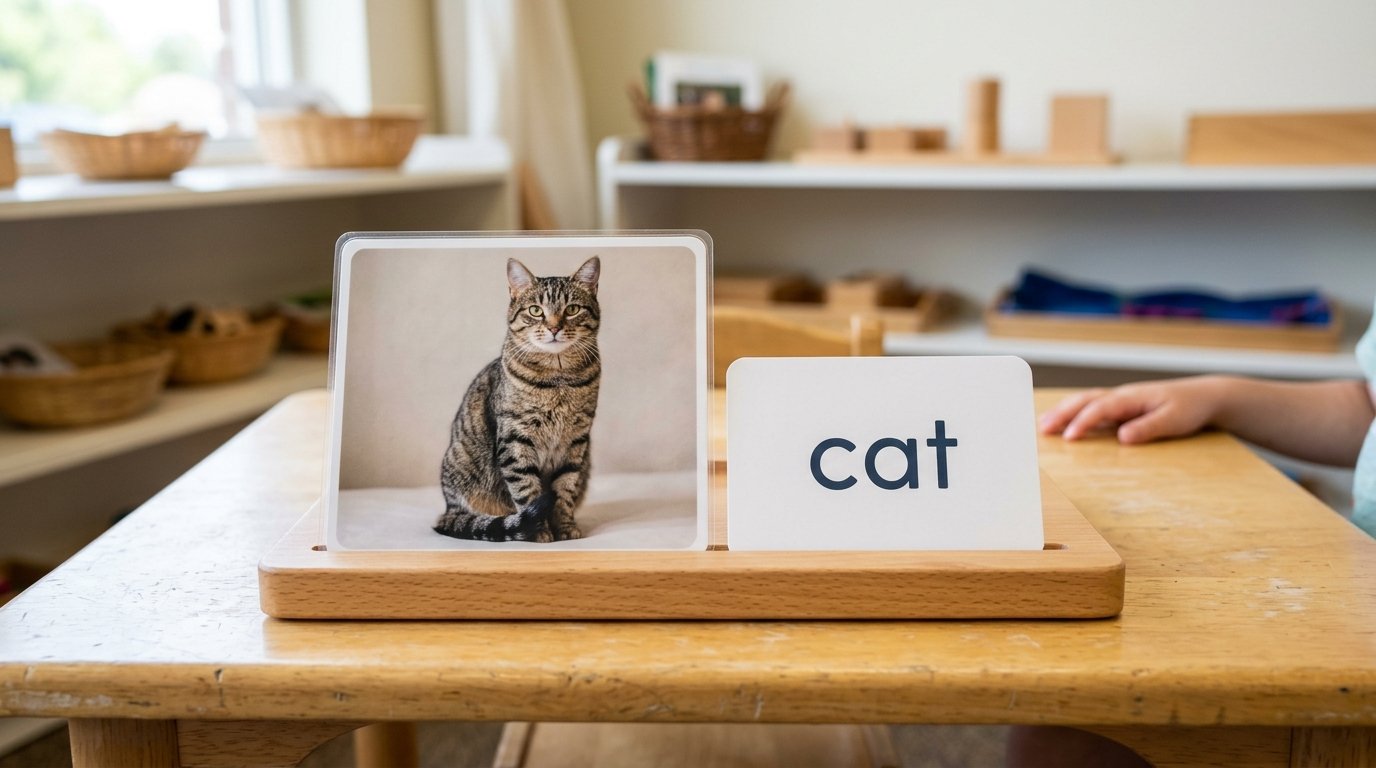
The first reading materials. Object boxes hold a few small objects with matching written labels, all phonetic three-letter words, so a child reads a label and finds the object. Around four to five.
Then the reading series, which most Montessori settings organise by colour:
- Pink series. Three-letter phonetic words with short vowels: cat, pig, hen, map. One sound per letter, no exceptions.
- Blue series. Consonant blends and digraphs, and longer words: stop, duck, stamp, dress, brush, shell.
- Green series. The biggest stage by far. Phonograms, long vowels, silent letters, soft and hard letters, and non-phonetic words: gate, mail, light, though. This is where fluency actually develops.
Roughly four to eight years across the three, and children move at very different rates through green.
An honest caveat, because it matters if you are deciding what to buy: the Pink, Blue and Green series is not Maria Montessori’s own material. It is a later adaptation developed for English, because English is far less phonetically regular than Italian. It is widely used and it works, but it is not universal, and a fair number of Montessori teachers consider it too material-heavy, too structured or too expensive. You do not need to buy three colour-coded boxed sets to teach a child to read.
Where Matching Activities Actually Fit
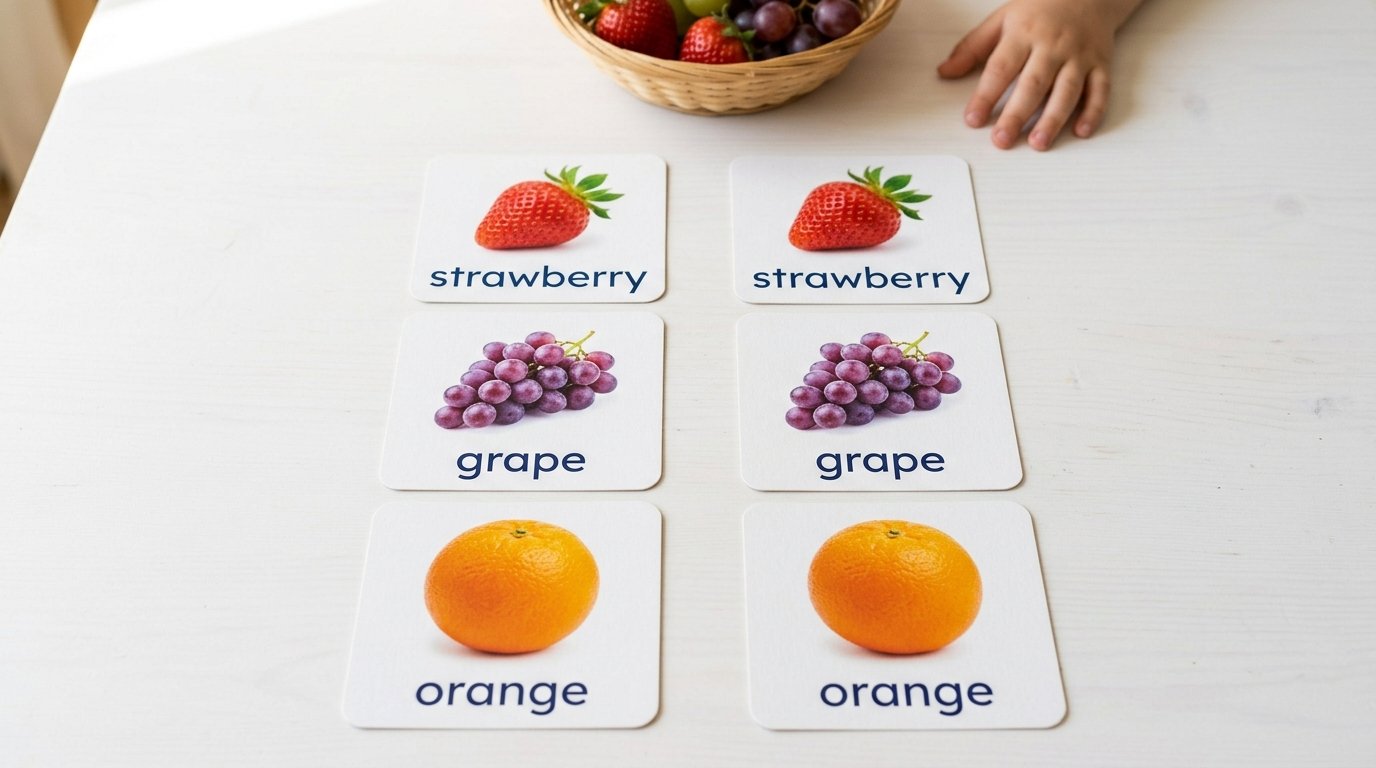
Matching is genuine Montessori work, and the earlier version of this article was right that it builds vocabulary, visual discrimination and concentration. What it lacked was a sense of where matching sits, which is early and mostly at stage one.
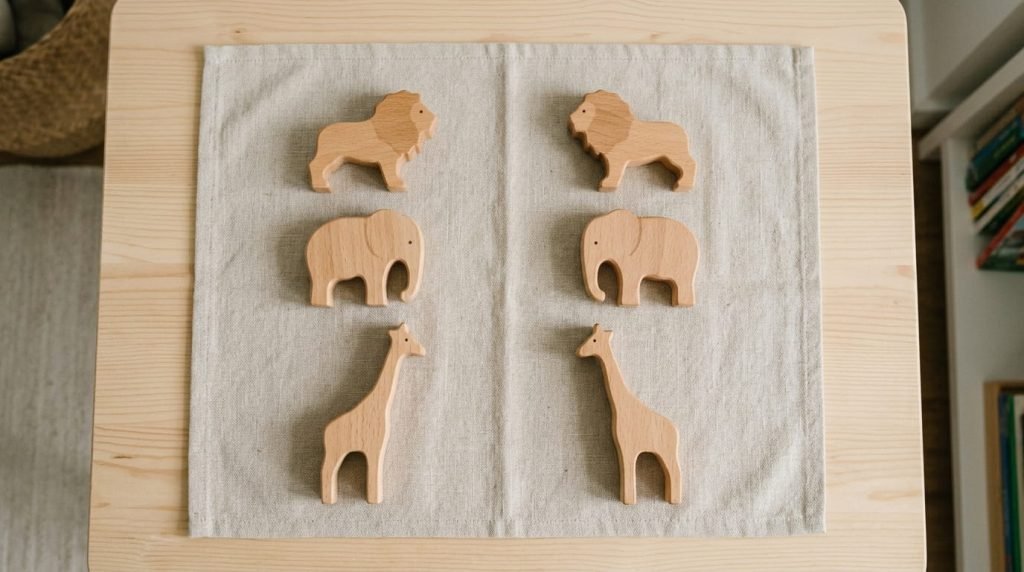
- Object to object, from around 18 months. Two identical sets, match the pairs. Pure visual discrimination, and a good first tray.
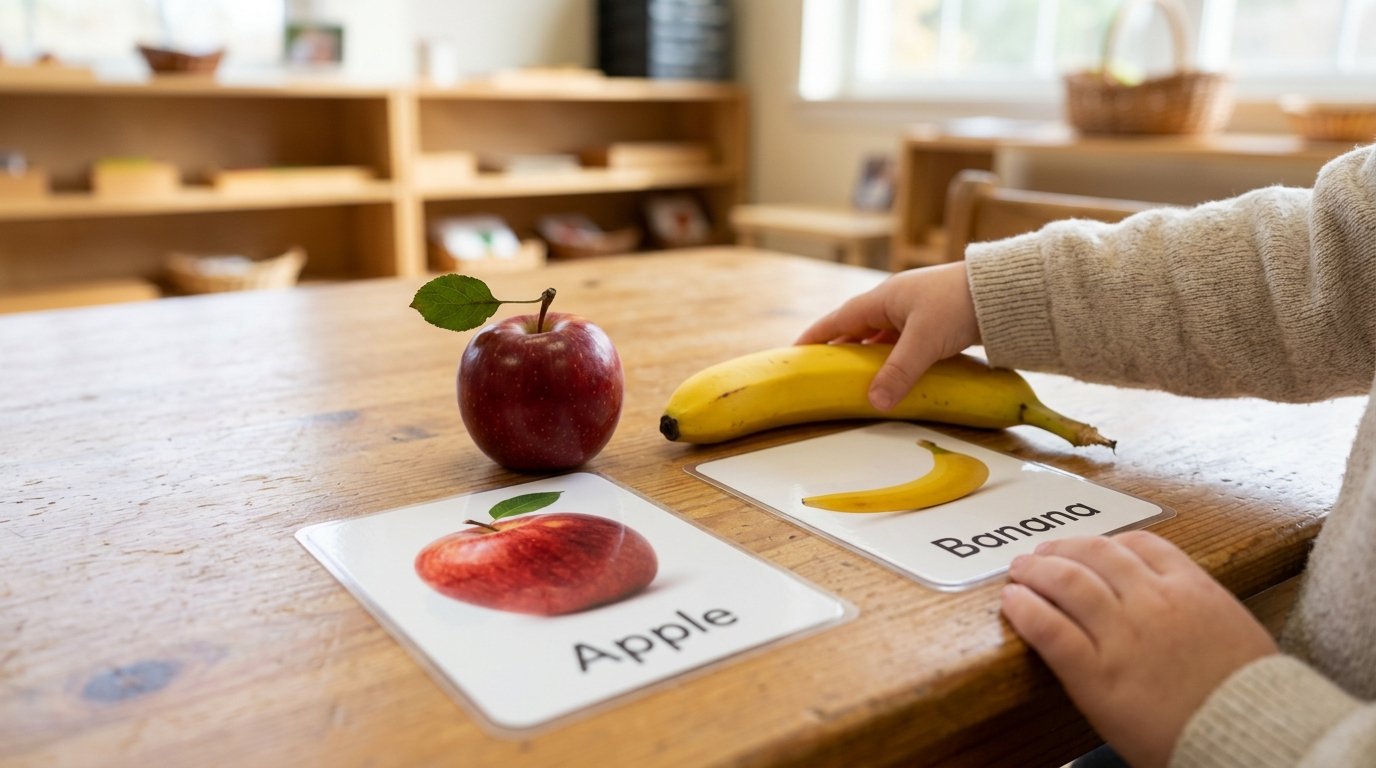
- Object to picture, from around 2. This is the important one, because it teaches that a picture represents a real thing, which is the same abstraction reading depends on.
- Picture to picture, from around 2. Use realistic photographs rather than cartoons.
- Beginning sound sorting, from around 2.5. Two baskets, two sounds, sort the objects. This is a sound game with objects, and it belongs to stage two.
- Word to picture, from around 4. This one belongs at stage five, after the child can decode, not before.
So matching spans the whole sequence, but each type has a place in it. Offering word-to-picture matching to a two-year-old is asking them to recognise words by shape, which is not reading.
The Letter Matching Problem
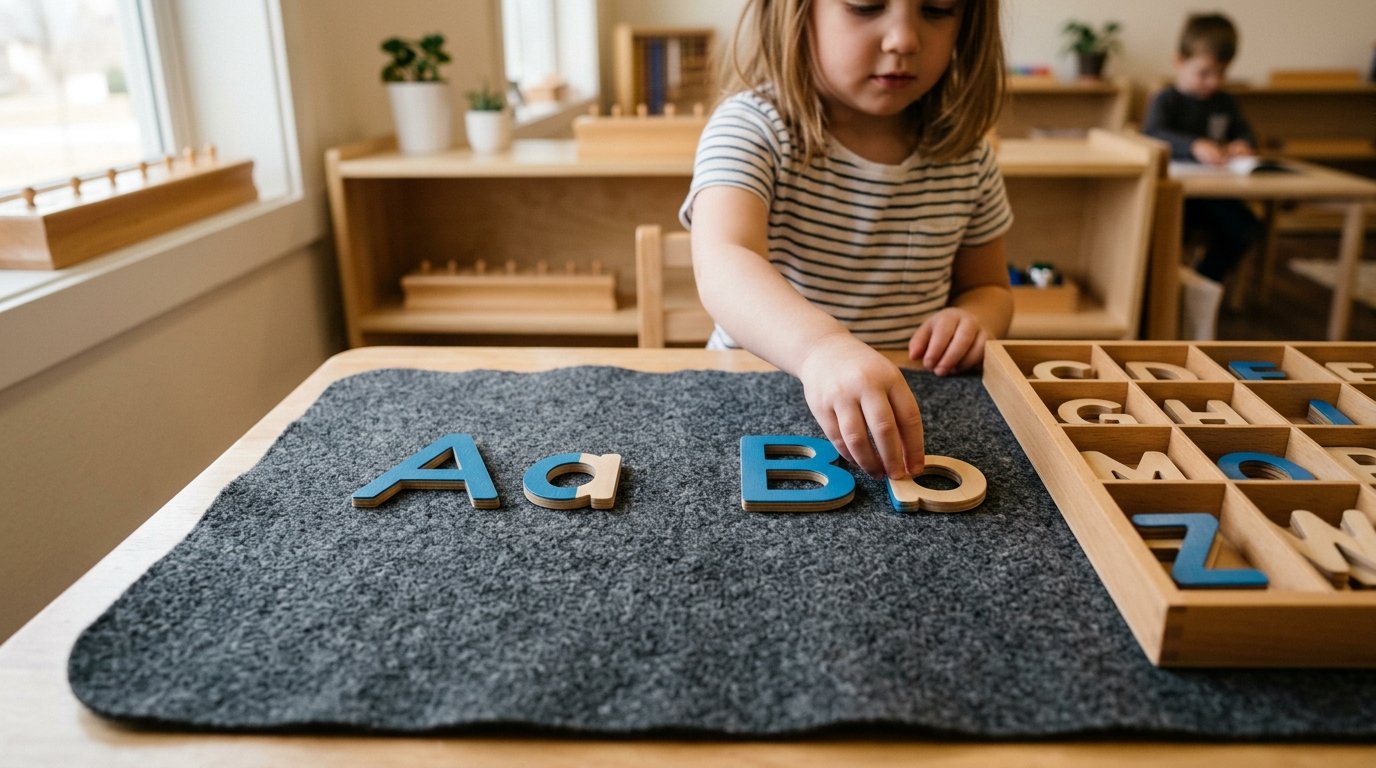
A correction to the earlier version of this article, which recommended pairing uppercase letters with their lowercase partners and described it as building letter recognition.
That activity conflicts with Montessori practice on two counts. It is a letter-identity task, normally reasoned about by name, as in ‘big A goes with little a’, and Montessori teaches sounds exclusively at the start. And it leads with capitals, when Montessori introduces lowercase first and adds capitals only after a child reads and writes simple words. There is a secondary practical problem too: in print, several capitals and lowercase letters look similar, which causes confusion at exactly the wrong moment.
Being fair about it: uppercase and lowercase matching is not harmful, it is a mainstream early literacy activity, and children do eventually need it. It is simply out of sequence, and labelling it Montessori is inaccurate. If you want to keep it, put it after your child is reading simple words and describe it honestly as case matching rather than as Montessori language work.
What to do instead at that stage: sound-to-object sorting, or tracing a sandpaper letter while saying its sound.
What the Evidence Says
Montessori writing rarely engages with reading research, which is a shame, because on this particular point the research is supportive.
The US National Reading Panel, convened by the National Institute of Child Health and Human Development, concluded in 2000 that explicitly teaching children to manipulate phonemes significantly improves both reading and spelling, and that the evidence was clear enough to make it an important component of instruction. The peer-reviewed meta-analysis behind it, covering 52 studies, reported effect sizes of about 0.86 on phonemic awareness itself, 0.53 on reading and 0.59 on spelling, with benefits for typically developing, at-risk and struggling readers alike.
Two findings from that analysis are directly relevant to how Montessori does this. Teaching letters together with phonemes outperformed teaching phonemes alone, which is precisely what sandpaper letters and the moveable alphabet do, since both bind a sound to a symbol through touch. And focusing on one or two skills at a time outperformed teaching many at once, which is an argument for the two-or-three-letters-at-a-time approach.
What the evidence does not support is extended standalone drilling. Brief, explicit, letter-linked sound work is the version that has support behind it.
Five Mistakes That Slow Things Down
- Teaching letter names. The most common and the most consequential. Sounds first, names much later.
- Starting with the alphabet song and uppercase letters. Neither helps a child read.
- Quizzing instead of teaching. Naming something once then asking ‘what is it?’ skips the entire second period of the three-period lesson.
- Too much on the shelf. Four to eight activities out at a time, rotated weekly.
- Pushing letters before the ear is ready. If your child cannot hear the beginning sound of a word, sandpaper letters are too early. Go back to sound games for a few months.
Setting Up a Language Shelf at Home
You need very little, and almost none of it needs to be bought.
- One tray or basket per activity, so each has visible boundaries.
- Four to eight activities out, rotated weekly, matched to the stage your child is actually at.
- Real objects wherever possible, and realistic photographs rather than cartoons when objects will not do.
- One set of sandpaper letters is the only material genuinely worth buying, and only at stage three.
- Make the rest. Object baskets come from your kitchen. Picture cards can be printed. A moveable alphabet can be card letters in a box.
- Store the next stage out of sight, so you are not tempted to offer it early.
Frequently Asked Questions
Does Montessori teach letter names or letter sounds?
Sounds, exclusively at the start. You trace a sandpaper letter and say ‘sss’, not ‘ess’. Letter names are introduced later, once sounds are secure. This is the single biggest difference between Montessori language work and most mainstream alphabet teaching, and it is the reason Montessori children often read earlier than their letter knowledge would suggest.
At what age do Montessori language activities start?
Vocabulary and spoken language from birth. Sound games from around 2.5. Sandpaper letters after 3. The moveable alphabet around 3.5 to 4.5. Reading around 4 to 5. These are approximate practitioner ranges rather than official milestones, and readiness matters more than age.
What is the three-period lesson?
A three-step way to introduce any new vocabulary. First ‘This is a triangle’, and nothing else. Second ‘Show me the triangle’, repeated many times over days. Third ‘What is this?’, only when you are confident of success. The second period is the longest and is the one most people skip.
Why does Montessori teach writing before reading?
Because building a word is easier than reading one. Composing requires only analysis, breaking a spoken word into sounds. Reading requires analysis then synthesis, blending sounds back into a recognisable word. Children usually begin reading around six months after they start building words with the moveable alphabet.
What are the Pink, Blue and Green series?
The Montessori reading progression. Pink is three-letter short-vowel words like cat and pig. Blue adds blends and digraphs, so stop and brush. Green covers phonograms, long vowels and irregular spellings, and is where fluency develops. Roughly ages 4 to 8. Worth knowing that this is a later English-language adaptation rather than Montessori’s own material, and you do not need to buy it to teach reading.
Is cursive or print used in Montessori?
Traditionally cursive first, on the grounds that it is formed in one continuous movement and the letters look less alike. But it varies genuinely by school and by country, and materials are available in both. If your child attends a Montessori school, match what they use.
Can I do this at home without buying materials?
Almost entirely, yes. Vocabulary work, sound games, object baskets and matching all use things you own. The one purchase worth making is a set of sandpaper letters at stage three, because the tactile surface is doing real work. Everything else can be made from card.