
Short answer: in Yoto vs Toniebox, buy a Toniebox if your child is under three, because Tonies rates its boxes for ages 1 and up while Yoto rates its players for 3 and up. Buy Yoto if your child is four or older, or if you want audiobooks rather than short story figures. The thing nobody tells you: the cheapest and the most expensive routes are both Tonies. A Toniebox Lite with Pocket Tonies costs about $305 over three years. A Toniebox 2 with Classic Tonies costs about $850. Yoto sits in between at roughly $380 to $580. So the honest answer to which is cheaper is: it depends far more on which content you buy than on which box.
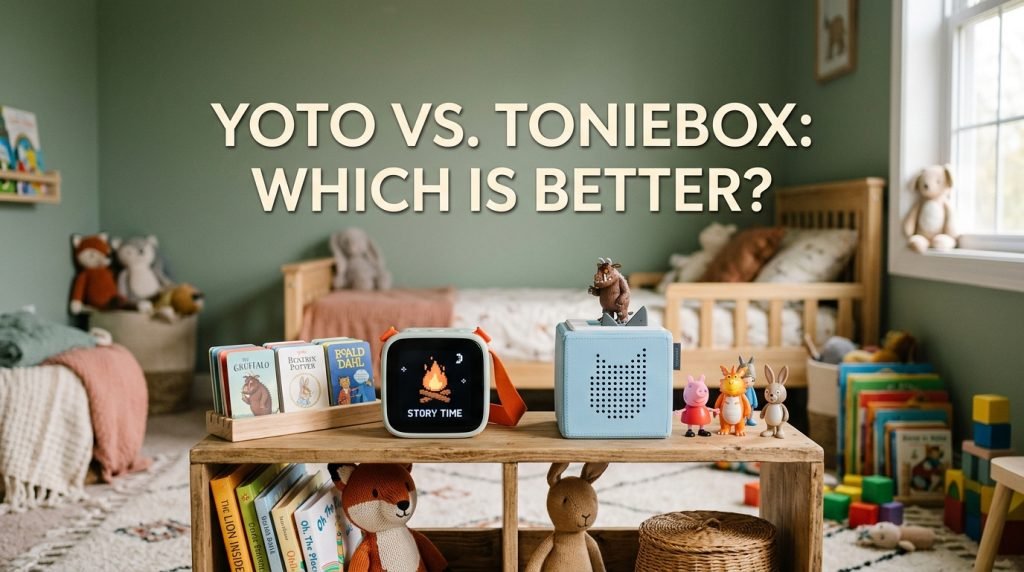
All prices and specifications on this page were checked on 2 September 2026 on the manufacturers’ own US stores. That matters more than usual here, because most comparisons you will find, including some on very large sites, are quoting prices and products that no longer exist.
Yoto vs Toniebox
What Changed, and Why Other Comparisons Are Wrong
If you have read two or three other comparisons and come away confused, this is why. Almost all of them describe a market that has moved on.
- There are now two Tonieboxes, not one. The Toniebox 2 and the smaller, cheaper Toniebox Lite have meaningfully different features. Most comparisons still talk about ‘the Toniebox’ as a single product.
- Yoto also has two players, the Yoto Player (3rd Generation) and the Yoto Mini, which most articles do mention but often price wrongly.
- Prices have risen across the board. Widely cited figures of $99 for the Yoto Player, $69.99 for the Yoto Mini and $14.99 for a Classic Tonie are all now out of date.
- Yoto’s library has grown a lot. Comparisons citing around 600 cards are behind. Yoto now advertises over 1,000 titles.
- Tonies has added Tonieplay, a screen-free games layer with its own controller, which works on the Toniebox 2 but not the Lite. It did not exist when most of these articles were written.
None of this means the older articles were dishonest. It means this is a fast-moving product category and a comparison is only as good as the date it was checked.
The Prices, Checked Today
The boxes:
- Toniebox 2 $129.99. Soft fabric shell with silicone ears, about 5.1 by 5.1 by 6 inches. Six colours. Works with Tonieplay games. Has a dynamic light ring, a sunrise alarm and a sleep timer where the light fades with the volume. USB-C cable included.
- Toniebox Lite $79.99 as a set. Smaller, about 3.9 by 3.9 by 4.1 inches, and a hard shell rather than soft fabric. Protective covers are sold separately. No Tonieplay, no light ring, no sunrise alarm. Sleep timer fades volume only. The USB-C cable is sold separately, which is worth knowing before you unwrap it as a gift.
- Yoto Player (3rd Generation) $109.99. Up to 16 hours of play per charge, stores 600+ hours offline, works as a regular Bluetooth speaker, has a room thermometer, an ok-to-wake clock with seven night light colours, sleep sounds and white noise. No microphone, no camera, no ads. Includes a free Make Your Own card.
- Yoto Mini $79.99. The portable one.
The content, and this is where the money actually goes:
- Classic Tonie $19.99 each. The figurines everyone pictures.
- My First Tonie $14.99 each, or about $13.33 each in a three pack at $39.99.
- Book Tonie $19.99 each, or about $10.00 each in a four pack at $39.99.
- Pocket Tonie about $6.25 each, in four packs at $24.99. Not figurines, so much cheaper.
- Creative Tonie $9.99. Blank, and you record onto it yourself.
- Cuddle Tonie $29.99. A soft toy with a Tonie inside.
- Yoto Cards $6.99 to $14.99 for most single titles, with collections from $29.99 to $49.99.
- Yoto Club subscription Explorer $4.99 a month or $39.99 a year, digital only. Collector $10.99 a month or $99.99 a year, which includes one card credit a month plus 10% off the store. Collector+ $18.99 a month or $169.99 a year for two credits a month. Two week free trial.
Look at that content list again. A Classic Tonie at $19.99 and a Pocket Tonie at about $6.25 are both Tonies content for the same box. That is a threefold difference in the cost of a story, from the same company, and it is the single most useful thing to understand before you buy.
Which Is Actually Cheaper Over Three Years?
Nobody does this calculation, so here it is. The assumption is modest: twelve new titles a year for three years, so 36 titles, which is a story a month.
- Toniebox Lite plus Pocket Tonies about $305 ($79.99 box, plus nine four packs at $24.99)
- Toniebox 2 plus Pocket Tonies about $355
- Yoto Mini plus Yoto Club Collector annual about $380 ($79.99 plus $99.99 a year, giving 36 credits)
- Yoto Player plus Yoto Club Collector annual about $410
- Yoto Player plus buying cards outright about $578 (36 cards at around $12.99)
- Toniebox 2 plus Classic Tonies about $850 (36 figurines at $19.99)
So the cheapest route and the most expensive route are both Tonies, and the gap between them is nearly $550. The brand you choose matters far less than the format you choose within it.
Three practical conclusions from that:
- If you buy Classic Tonies at full price, Tonies is by far the most expensive option. The figurines are lovely and children genuinely play with them, but you are paying about $20 a story.
- If you buy Pocket Tonies, Tonies is the cheapest option. They are not collectible figures, which is exactly why they cost a third as much.
- Yoto Club changes the maths considerably. Buying cards one at a time costs about $578 over three years. The same 36 titles through the Collector annual plan costs about $410. If you are going to use Yoto steadily, the annual subscription is the cheaper path, and if you are not, the player alone plus a handful of cards is fine.
These are list prices with no sales, bundles or secondhand figures included, and all three of those will move the numbers. Treat this as the shape of the decision rather than a quote.
What the Manufacturers Say About Age
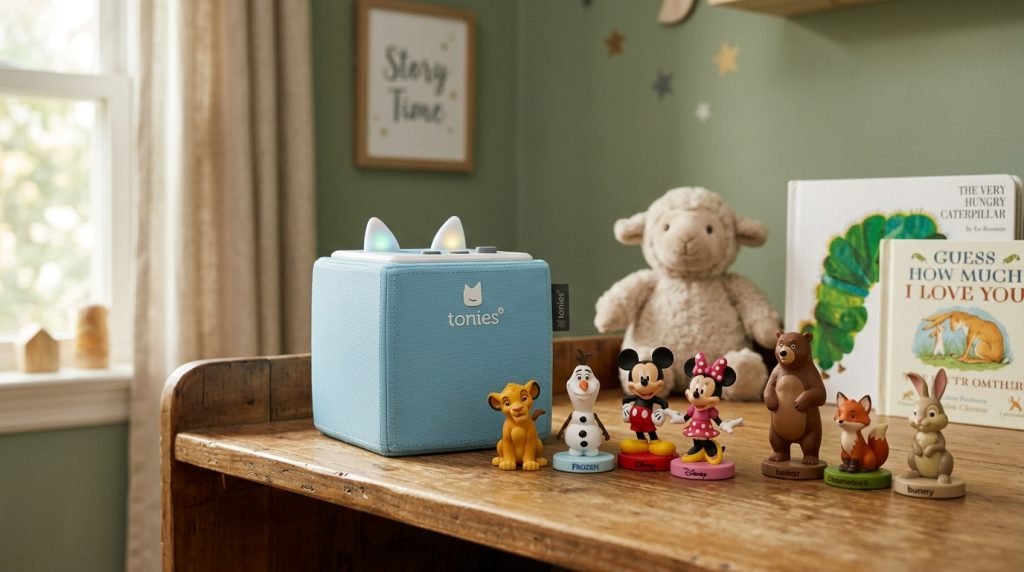
This is the question everyone argues about, and both companies answer it plainly on their own websites.
- Tonies: ages 1 to 12+ for both the Toniebox 2 and the Toniebox Lite.
- Yoto: ages 3 to 12+ for the Yoto Player.
That is a two year difference at the bottom end, from the people who made the things, and it settles the toddler question more convincingly than any reviewer’s opinion. Yoto’s own website even frames the youngest band as parents in control for 0 to 2, and only calls it kids in control from 3 to 5.
It makes sense mechanically too. Placing a chunky figure on top of a soft box is an easier action than posting a thin card into a slot, and a Toniebox is designed to be dropped. If your child is one or two, this is the deciding factor and everything else is secondary.
Neither One Is Quite Screen-Free
Both brands market themselves as screen-free, and both are, in the sense that matters most: no video, no camera, no feed, no autoplay next episode, no ads. That is the real benefit and it is a genuine one.
But the Yoto Player and Yoto Mini both have a small pixel display. It shows simple pixel art for whatever is playing, plus the clock and the night light. CPSC’s own description of the Yoto Mini lists ‘a pixel display’ among its identifying features, and Yoto’s own instructions tell you to flip the display face down at bedtime.
The Toniebox 2 has no display. It has a light ring that glows while a Tonie is playing.
Is a pixel display a screen? For most families, not in any way that matters. But if you are choosing these devices specifically to keep glowing rectangles away from a young child, you should know one of them has a small one and the other does not, rather than finding out after it arrives.
The Yoto Mini Recall, and Why It Matters Secondhand
This is verified and no other comparison mentions it, so here it is with the detail you need to act on.
In December 2024, Yoto reannounced a recall of the Yoto Mini with the US Consumer Product Safety Commission, recall number 25-065. The hazard was that the lithium-ion battery can overheat and catch fire. About 251,165 units were affected in the US, plus about 18,932 in Canada. Yoto received nine reports from US consumers and three from the UK of the speaker overheating or melting. No injuries were reported.
The important boundaries on that, because it is easy to overstate:
- It covers Yoto Minis sold between November 2021 and April 2024 for about $70, with SKU PRPLXX00860, pale grey with orange controls. The serial number is on the base.
- It was first announced in April 2024 with a smart cable remedy, then reannounced in December 2024 with a full battery replacement kit, and Yoto said owners should request the kit even if they already received the cable. The first fix was not enough.
- A Yoto Mini bought new today is not the recalled product. This is not a reason to avoid Yoto.
- It is a very good reason to be careful buying secondhand. If you are looking at a used Yoto Mini on a marketplace, check the serial number and SKU on the base first. Federal law prohibits reselling recalled products, but private sellers may simply not know.
- The remedy is a free battery replacement kit from Yoto at minihelp@yotoplay.com or us.yotoplay.com/recall. The old battery must not go in household waste or a shop battery recycling box, because recalled lithium batteries are handled differently.
For balance, Tonies has had a recall too, but a much smaller and less relevant one. In March 2022 about 4,200 tonies Blocks were recalled over a magnet ingestion hazard. No Tonieboxes and no Tonie figurines were affected. Blocks were a separate accessory line.
Recording Your Own Voice
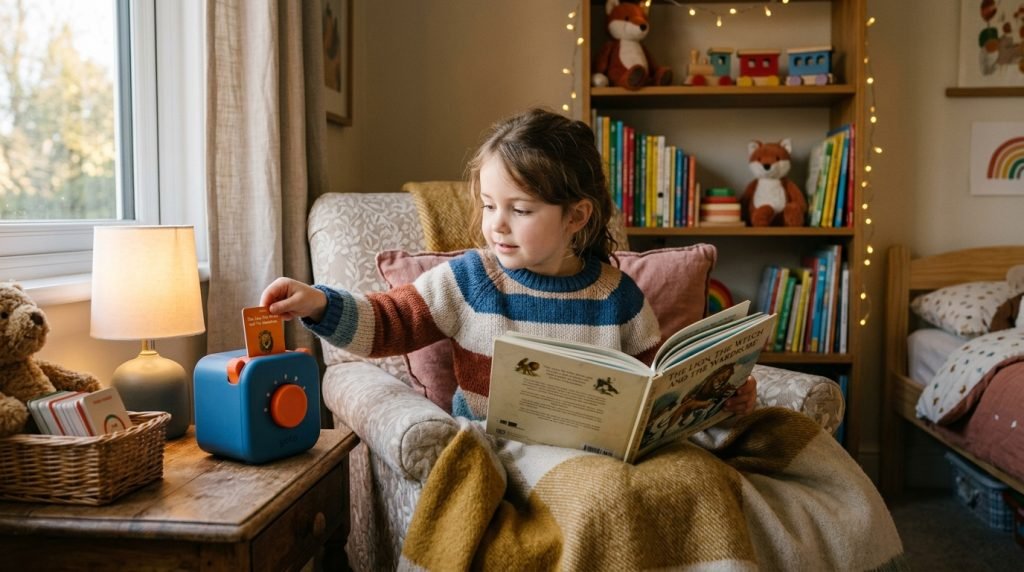
This is the most underrated feature on either device, and the one most worth caring about if you like the Montessori idea of real, personal, non-commercial materials.
- Yoto Make Your Own cards. A blank card you record onto through the app. One is included free with a Yoto Player.
- Creative Tonies. $9.99 for a blank figurine you record onto, and there is a Create Your Own option.
A grandparent reading a bedtime story onto a card, a relative abroad sending a recorded message, your child narrating their own made-up story and then listening back. That last one is a genuine language activity, and hearing your own voice played back is a surprisingly powerful thing for a three year old.
Yoto is slightly ahead here on cost, since a card comes free in the box. Tonies is ahead on appeal, because a child can hold the thing they recorded.
Is Either One Actually Montessori?
Honestly, not in a strict sense, and it is worth saying so plainly on a Montessori site rather than pretending otherwise.
A traditional Montessori environment favours real materials, self-correcting activities and a child’s own hands doing something in the physical world. A battery-powered box that plays a recording of someone else’s story is not that. Maria Montessori did not have an opinion on audio players, but the principles do not obviously point towards one.
The reasonable case in favour, and I think it holds:
- It is child-led in the way that matters. Your child chooses the card or figure, starts it, stops it, and changes it, without asking you and without a recommendation algorithm choosing for them.
- It builds independence and, with Yoto’s card slot, some real fine motor control.
- It has no ads, no video and no autoplay, which makes it categorically different from handing over a tablet.
- It supports listening comprehension, which develops well ahead of reading ability and is genuinely valuable at this age.
The honest case against:
- It is passive consumption, however good the content is. Twenty minutes of audio is not twenty minutes of doing.
- The collecting is deliberately engineered, particularly with figurines at $19.99 each, and collecting for its own sake is not a Montessori impulse.
- Every licensed character card moves you further from open-ended play and closer to branded media.
Where I land: it is a good tool used narrowly. For quiet time, car journeys, and the half hour after lights out, it beats almost every alternative. As a default activity, it does not. Neither box is Montessori, and neither has to be for it to be a sensible purchase.
Which Should You Buy?
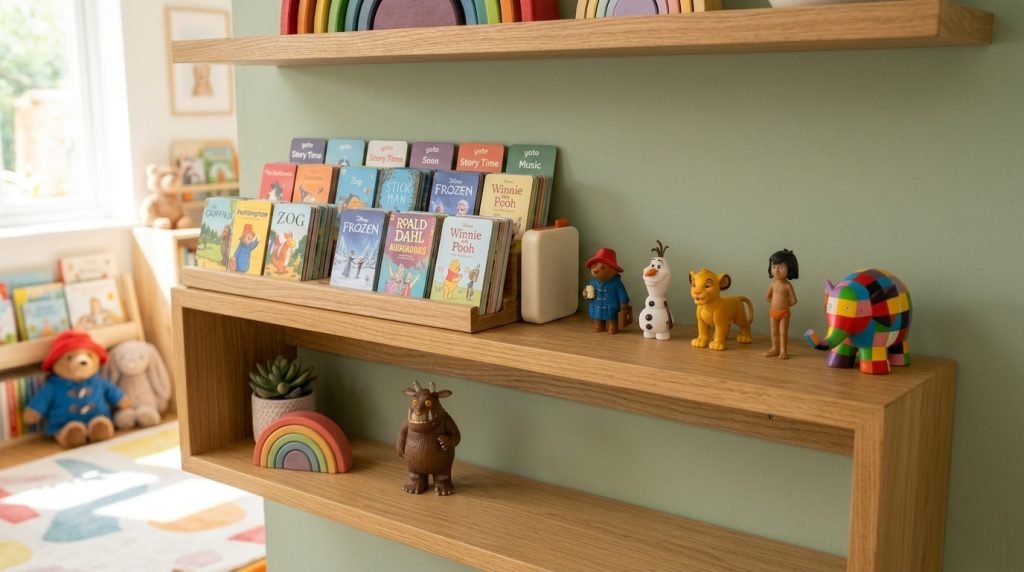
- Child under 3: Toniebox. The official age rating starts at 1, the figures are easier to handle, and the box survives being thrown.
- Child 4 or older: Yoto Player. Longer audiobooks, a much bigger library, the clock and night light, and it stays useful for years.
- Tightest budget: Toniebox Lite plus Pocket Tonies, around $305 over three years. Remember to buy a USB-C cable.
- Travel: Yoto Mini, or the Toniebox Lite if your child is a toddler.
- Two children of different ages: Yoto Player, and use headphones. The library spans the ages far better.
- You want it for bedtime specifically: Yoto Player, for the ok-to-wake clock, night light and sleep sounds. The Toniebox 2’s sunrise alarm is good but the Yoto does more.
- You mainly want the recorded-voice idea: either, and it is cheap to try. A Creative Tonie is $9.99 and a Make Your Own card comes free with a Yoto Player.
- Buying secondhand: read the recall section above before you buy a used Yoto Mini.
Frequently Asked Questions
Is Yoto better than Toniebox?
Neither is better overall. Yoto is better for children four and up, for audiobooks, and for bedtime features. Toniebox is better for one to three year olds, because Tonies rates its boxes from age 1 while Yoto rates its players from age 3, and because figurines are easier for small hands than a card slot.
What age is Toniebox best for?
Tonies officially rates both the Toniebox 2 and Toniebox Lite for ages 1 to 12+, and in practice it is strongest from about 1 to 5. Older children tend to want longer audiobooks, which is where Yoto’s library is deeper.
Is Toniebox worth the money?
It depends entirely on which content you buy. A Toniebox Lite with Pocket Tonies works out at around $305 over three years, which is good value. A Toniebox 2 with Classic Tonies at $19.99 each comes to around $850 for the same number of stories. Same brand, nearly $550 apart.
Do you need a subscription for Yoto?
No. The player comes with free built-in audio including sleep sounds, white noise, the clock and the night light, and you can simply buy cards. But if you expect to add roughly a title a month, the Yoto Club Collector plan at $99.99 a year works out cheaper than buying those cards individually.
What is the difference between Toniebox 2 and Toniebox Lite?
The Toniebox 2 at $129.99 is larger, has a soft fabric shell, works with Tonieplay games, and has a light ring and a sunrise alarm. The Toniebox Lite at $79.99 is smaller with a hard shell, has none of those three features, and does not include a USB-C cable. Both work with all Tonies and both are rated ages 1 to 12+.
Are Yoto and Toniebox really screen-free?
There is no video, camera, ads or autoplay on either, which is the benefit most parents mean. But both Yoto players have a small pixel display showing simple artwork and the clock, while the Toniebox has no display at all, just a glowing light ring.